-
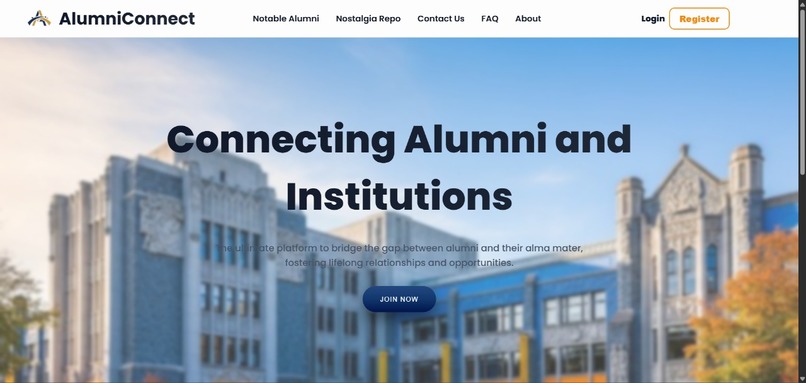
Our Landing Page of NexusConnect (AlumniConnect)

Our Hackathon Journey: Building NexusAlumni The Inspiration: Closing the Knowledge Gap The foundational idea for NexusAlumni originated from a shared frustration we experienced as students: a gaping disconnect between classroom theory and industry reality. As a team, we realized that while our college boasted a strong alumni network, it existed as a static directory rather than a dynamic resource for career development.
Our collective observation was clear:
Current students urgently need real-time, practical industry mentorship to prepare for placements.
Our alumni want to contribute meaningfully but lack a structured, low-effort platform to efficiently connect with high-potential students.
We were inspired to build a platform that turns a legacy network into a dynamic, skill-focused career launchpad—a platform that benefits both the students' growth and the alumni's ability to easily give back.
What We Learned Building NexusAlumni in a tight hackathon window was a crash course in prioritization, collaboration, and rapid development. Key lessons we learned include:
MVP Focus: We learned to ruthlessly scope the Minimum Viable Product (MVP), focusing only on the core exchange of value: profile matching and secure communication. Non-essential features were placed in the "Future Scope" plan.
Algorithm Design: We collectively designed and implemented a simple, weighted matching algorithm. This practical exercise taught us how to model user value:
Match Score=(ω 1 ×Skill Relevance)+(ω 2 ×Industry Overlap)+(ω 3 ×Alumni Availability)
The weighting (ω i ) was intentionally skewed to prioritize Skill Relevance (ω 1 ), ensuring students find mentors who can solve their immediate knowledge gaps.
Team Integration: We adopted a modular workflow, with one teammate focusing on API design (backend), another on UI/UX (frontend), and a third on data modeling and pitch presentation. This division of labor was critical to hitting the deadline.
How We Built the Project Our strategy centered on speed and effective prototyping:
Tech Stack: We chose the MERN stack (MongoDB, Express, React, Node.js) because our team was collectively proficient, allowing for rapid full-stack iteration.
Data Structure: We meticulously designed distinct data models (StudentProfile, AlumniProfile) built upon a base User model, ensuring clear segregation of permissions and necessary profile information.
Core Logic: The backend's primary function was the Matching Engine API endpoint. For the frontend, we focused on clean, professional design using a component library to quickly build intuitive user dashboards for both students and alumni.
Demo Readiness: We pre-populated the database with a functional set of test users (e.g., a "Student seeking Data Science help" matched with an "Alumnus working at Google as a Data Analyst") to guarantee a flawless live demonstration of the core feature.


Log in or sign up for Devpost to join the conversation.