-
-
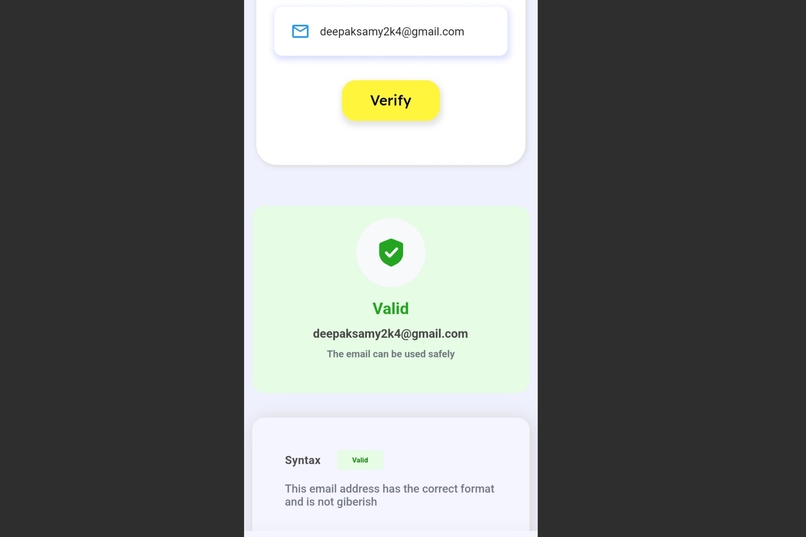
API response to a valid email
-
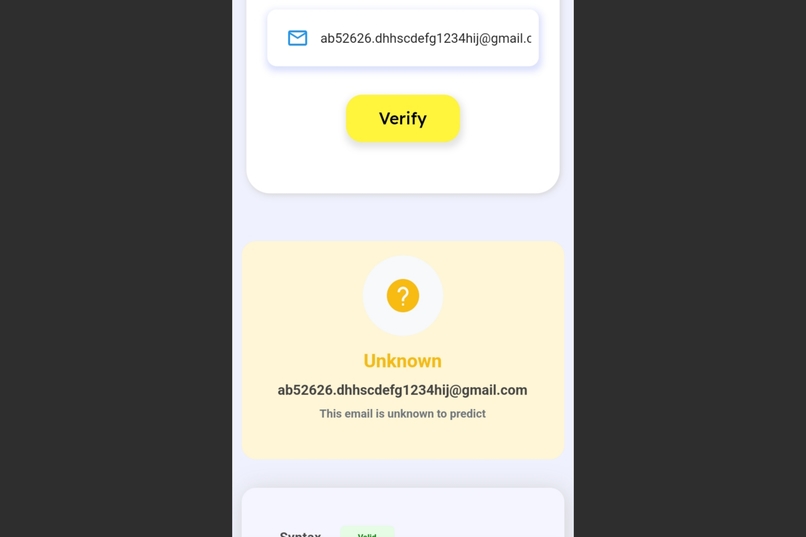
API response to an unknown email
-
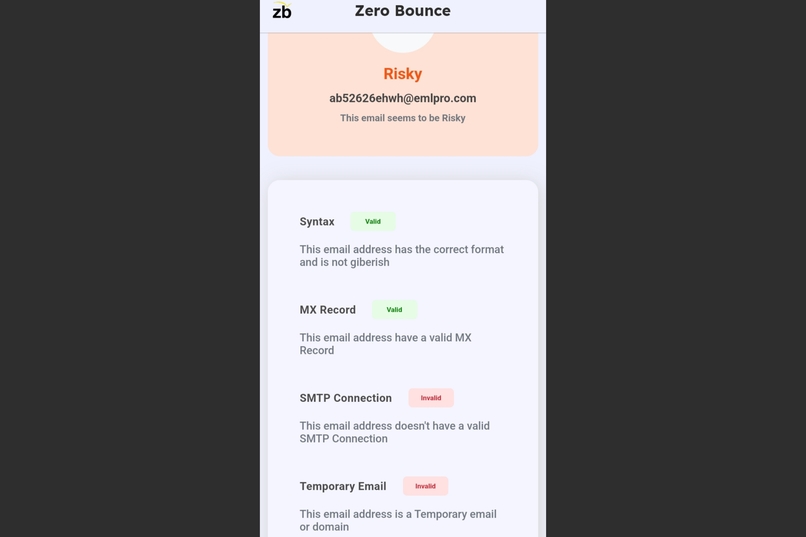
API response to a temporary email
-
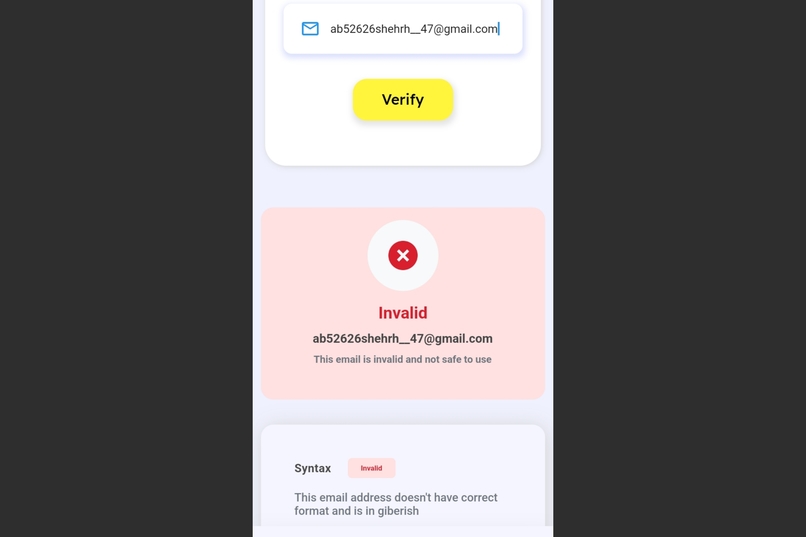
API response to an invalid email


Inspiration: The inspiration behind developing Zero Bounce Mobile was to create a versatile email verification solution that can be easily integrated into mobile applications. We aimed to provide a comprehensive set of features including syntax validation, MX record validation, SMTP validation, and disposable domain detection. Our goal was to empower mobile app developers with a reliable tool to validate and verify email addresses entered by users, ensuring data accuracy and improving user experience.
What it does: Zero Bounce Mobile is a powerful email verification tool designed for mobile applications. It provides the following key features:
Syntax Validation: The tool verifies the syntax of an email address to ensure it follows the correct format. It checks for consecutive dots, hyphens, or underscores in the local and domain parts of the email address, as well as two consecutive dots, hyphens, or underscores anywhere in the email.
MX Record Validation: The tool performs MX record validation to check if the domain in the email address has valid Mail Exchange (MX) records. It queries the DNS server to determine if the domain exists and has associated MX records, ensuring the email address is associated with a valid email server.
SMTP Validation: Zero Bounce Mobile establishes an SMTP connection with the email server to verify the existence of an email address. It sends a test email and checks for a successful response code (250) to confirm the validity of the address.
Disposable Domain Detection: The tool checks if the domain in the email address is from a disposable email service. It compares the domain against a blacklist of known disposable email domains and identifies potential disposable email addresses.
How we built it: Zero Bounce Mobile was built using a combination of Python libraries, web frameworks, and external APIs. The main components of the application include:
Email Syntax Validation: We implemented a regular expression-based syntax validation function that checks the email address for various syntax rules and patterns.
MX Record Validation: The application uses the dns.resolver module to query DNS servers and check for valid MX records associated with the domain in the email address.
SMTP Validation: Zero Bounce Mobile establishes an SMTP connection with the email server using the smtplib module. It performs a series of SMTP commands to validate the existence of the email address.
Disposable Domain Detection: The application fetches a blacklist of disposable email domains from external sources using the requests library. It compares the domain in the email address against the blacklist to detect disposable domains.
Flask API: We created a Flask API to expose the email verification functionality as a web service. The API receives email addresses as input, validates them using the implemented functions, and returns the verification results as JSON.
Challenges we ran into: During the development of Zero Bounce Mobile, we faced several challenges, including:
Email Validation Logic: Designing an accurate and efficient email validation logic that covers various syntax rules and patterns was a challenge. We had to consider multiple edge cases and ensure the validation function performs reliably.
DNS and SMTP Queries: Implementing DNS and SMTP queries in a way that provides accurate and timely responses was challenging. We had to handle DNS resolution errors, timeouts, and ensure proper handling of SMTP commands and responses.
Blacklist Management: Fetching and managing the blacklist of disposable email domains from external sources required careful handling of network requests and data processing. We had to ensure the blacklist is up-to-date and efficiently used during disposable domain detection.
Accomplishments that we're proud of: We are proud of several accomplishments while developing Zero Bounce Mobile, including:
Comprehensive Functionality: Zero Bounce Mobile offers a wide range of email verification features, covering syntax validation, MX record validation, SMTP validation, and disposable domain detection. The tool provides a robust solution to ensure the accuracy and validity of email addresses.
Integration with Flask API: We successfully integrated the email verification functions into a Flask API, allowing mobile app developers to easily incorporate email verification functionality into their applications. The API provides a simple and convenient way to validate email addresses through HTTP requests.
Scalability and Performance: The implementation of asynchronous DNS and SMTP queries, along with parallel processing using threads, enables efficient handling of multiple email verification requests. The tool is designed to handle a high volume of requests and provide timely responses.
What we learned: During the development of Zero Bounce Mobile, we gained valuable insights and knowledge in several areas, including:
Email Address Validation: We deepened our understanding of email address validation techniques, including syntax validation, DNS queries, and SMTP verification. We learned about the intricacies involved in checking the validity of email addresses and the importance of multiple verification steps.
Integration with Flask: We learned how to integrate Python code with the Flask web framework to create a scalable API. We gained knowledge about handling HTTP requests, parsing parameters, and returning JSON responses.
DNS and SMTP Protocols: The development of Zero Bounce Mobile allowed us to gain a deeper understanding of DNS and SMTP protocols. We learned about DNS resolution, MX records, SMTP commands, and responses, which are fundamental to email verification.
What's next for Zero Bounce Mobile: In the future, we plan to enhance and expand Zero Bounce Mobile by incorporating additional features and improvements. Some potential areas for future development include:
Enhanced Error Handling: We aim to implement more comprehensive error handling to provide detailed feedback in case of validation failures. This will help users identify the specific issue with their email addresses.
Intelligent Suggestions: We plan to incorporate intelligent suggestions for email domains. By leveraging string distance metrics and phonetic similarity algorithms, we can suggest alternative email domains that closely match the input domain.
Integration with Mobile SDKs: To provide a seamless experience for mobile app developers, we plan to develop SDKs (Software Development Kits) for popular mobile platforms like iOS and Android. These SDKs will simplify the integration process and offer native support for email verification within mobile apps.
Continuous Blacklist Updates: We aim to implement a mechanism to automatically update the disposable email domain blacklist. This will ensure that the tool remains up-to-date with the latest disposable domain entries, improving the accuracy of disposable domain detection.
By incorporating these enhancements, we envision Zero Bounce Mobile becoming a trusted and feature-rich email verification solution for mobile applications, helping developers deliver reliable and validated email address functionality to their users.


Log in or sign up for Devpost to join the conversation.