-
-
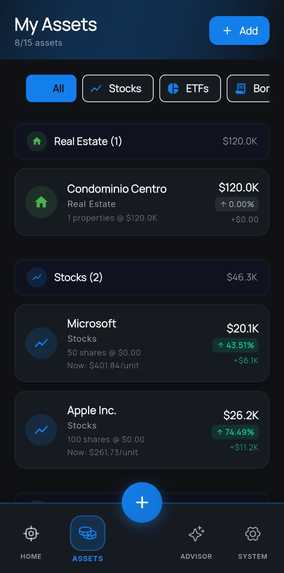
Assets Feature
-
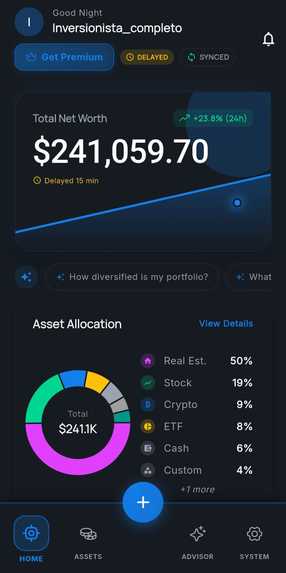
Dashboard
-
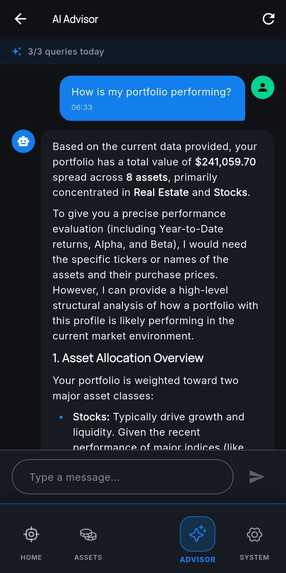
Chat Feature


WealthScope - Hackathon Submission
Inspiration
The inspiration came from a personal frustration: having wealth scattered across multiple platforms without being able to see the complete picture. Stocks at Interactive Brokers, crypto at Binance, a rental apartment, bonds at the bank, and physical gold stored away. Every month, getting a real balance sheet required opening 5 different apps and maintaining a manual Excel spreadsheet.
We thought: "Why doesn't a Mint or Personal Capital exist that includes ALL assets, not just bank accounts? And why not use AI to actually advise me?"
That's how WealthScope was born: your personal CFO in your pocket that sees ALL your wealth and tells you what to do with it.
What it does
WealthScope is a mobile app (Flutter) that consolidates all your assets into one intelligent dashboard:
🎯 Unified Dashboard
- Aggregates stocks, bonds, crypto, real estate, gold, commodities
- Calculates your REAL net worth including illiquid assets
- Visualizes portfolio distribution with interactive charts
🤖 Conversational AI (Google Gemini)
- 24/7 financial chat: "Should I sell my apartment to buy stocks?"
- Predictive analysis: "What if I sell X and buy Y?"
- Contextualized responses to your real financial situation
📸 Smart OCR
- Scan real estate contracts, property titles, gold certificates
- Automatically extract amounts, dates, terms
- Create assets in the system without manual entry
💰 Shadow Pricing
- Values illiquid assets without market price (real estate, physical gold)
- Uses comparables and alternative metrics with AI
- Keeps your wealth automatically updated
📊 What-If Analysis
- Simulate scenarios: "What if inflation rises 5%?"
- Compare investment strategies
- Make data-driven decisions, not emotional ones
🌅 Daily Briefings
- Personalized morning summary of your financial situation
- Market alerts relevant to YOUR portfolio
- Daily action recommendations
How we built it
Tech Stack
Backend (Go 1.23 + Gin)
- Clean Architecture: isolated domain, easy to test
- GORM for PostgreSQL (Supabase)
- Swagger/OpenAPI for automatic documentation
- RevenueCat webhooks for payments
- Yahoo Finance API for market prices
Frontend (Flutter 3.x)
- Riverpod for state management
- Feature-first architecture
- fl_chart for visualizations
- flutter_secure_storage for tokens
- image_picker + OCR for document scanning
Artificial Intelligence
- Google Gemini 3.0 for conversational analysis
- Gemini Vision for financial document OCR
- Specialized prompts for financial analysis
Infrastructure
- Backend on Railway (auto-deploy from GitHub)
- Database on Supabase (PostgreSQL with RLS)
- Auth with Supabase Auth (JWT)
- RevenueCat for paywall and subscriptions
Development Process
Week 1: Foundations
- Project architecture (backend + frontend)
- Authentication system with Supabase
- Data model for multi-type assets
- Basic dashboard with charts
- Asset CRUD (CREATE, READ, UPDATE, DELETE)
Week 2: AI Features
- Google Gemini integration
- Conversational chat with financial context
- OCR for document scanning
- Shadow pricing for illiquid assets
- What-if analysis with simulations
Week 3: Polish & Demo
- Automatic daily briefings
- Paywall with RevenueCat
- End-to-end testing
- Complete documentation
- Demo video and presentation
Git Workflow
We used simplified GitFlow:
main- stable productiondevelop- continuous integrationfeature/*- new features- PRs with code review before merge
Challenges we ran into
1. Heterogeneous Asset Modeling
The biggest technical challenge was designing a data model that supports stocks, real estate, gold, bonds, and crypto in the same table without losing flexibility.
Solution: We used a hybrid model with common fields (asset_type, quantity, current_value) and a JSONB metadata field for type-specific fields. Example:
{
  "ticker": "AAPL",
  "exchange": "NASDAQ"
}
2. Shadow Pricing of Illiquid Assets
How do you value an apartment you bought 2 years ago without paying for an appraisal every day?
Solution: We created a "shadow pricing" system that:
- Uses reference indices (price/sqft in the area)
- Applies estimated depreciation or appreciation
- Allows manual updates when there's a real appraisal
- Uses Gemini to suggest values based on comparables
3. Context Window in Gemini
Gemini has context limits. If a user has 100 assets, how do we send everything in each question?
Solution: We implemented "relevance filtering":
- Only send the top 10 most relevant assets (by value)
- Add summarized metrics (total value, % per category)
- The rest is included only if the user asks specifically
4. Market API Handling
Yahoo Finance is free but has rate limits and sometimes fails.
Solution:
- Price caching system (valid for 15 minutes)
- Fallback to previous day's prices if API fails
api_quotastable to monitor usage and avoid blocks
5. Onboarding UX
Asking the user to add 10 assets manually in the first session is a guaranteed "drop-off".
Solution:
- OCR to scan documents (quick entry)
- Simplified manual import (just name + value)
- Progressive onboarding: "Add 1 asset now, the rest later"
- Demo mode with example portfolio
6. Testing Non-Deterministic AI
How do you test a feature where Gemini can give different answers?
Solution:
- Integration tests verify response structure, not exact content
- Mocks for unit tests
- Manual tests with predefined prompts to validate coherence
Accomplishments that we're proud of
🏆 Functional MVP in 3 Weeks
From zero to a functional app with Go backend + Flutter frontend + AI in record time. It's not a prototype, it's an app we would actually use.
🎨 Polished UX
Despite limited time, the app feels professional:
- Smooth animations
- Native dark mode
- Interactive charts
- Elegant error handling
🤖 AI that Actually Helps
It's not a generic chatbot. Gemini has context of YOUR portfolio and gives personalized advice. You ask "Should I sell my Tesla shares?" and it responds based on how many you have, what they're worth, and your risk profile.
📷 Functional OCR
The ability to scan a purchase agreement and have an asset created automatically is magical for the user. It eliminates massive friction.
🏗️ Scalable Architecture
Clean Architecture in backend means we can:
- Switch from PostgreSQL to MongoDB without touching business logic
- Test without database (mocks)
- Add new asset types without massive refactors
📚 Complete Documentation
Wiki with 10+ technical documents:
- Product definition
- System architecture
- API design
- Data model
- Sprint plan
- Security & privacy
Anyone can enter the project and understand what to do.
🔒 Security-First
From day 1:
- Authentication with Supabase (JWT)
- Row Level Security in database
- Input validation on all endpoints
- No secrets in code (env vars)
- HTTPS only
What we learned
Technical
1. Google Gemini is Amazing for Finance
- Understands complex financial concepts without fine-tuning
- Gemini Vision for OCR is superior to Tesseract
- Long context handling (1M tokens) is a game-changer
2. Flutter is Ideal for Rapid Prototyping
- Hot reload = 10x development speed
- Single codebase for iOS + Android
- Riverpod makes state management predictable
3. Clean Architecture is Worth It
- Although it takes more time initially, it pays dividends
- Tests are trivial (easy mocks)
- Requirement changes don't break everything
4. Supabase is Magic
- Auth, database, and RLS out-of-the-box
- Open-source alternative to Firebase
- "Real" PostgreSQL vs limited NoSQL
Product
1. Onboarding is Everything
- If you ask for 10 assets manually, the user leaves
- OCR and demo mode reduce friction massively
- "Add later" > "Complete now"
2. AI Needs Real Context
- Generic ChatGPT doesn't work for personal finance
- The value is in connecting AI with YOUR data
- Personalized responses > general advice
3. Mobile-First is Right for Finance
- People check finances on their phone (Uber, coffee, etc.)
- Push notifications = engagement
- Desktop would be a secondary feature
Team
1. Early Documentation Accelerates
- Wiki from day 1 = less Slack, more code
- API design upfront = backend + frontend in parallel
- Clear sprint plan = everyone knows what to do
2. Simple Git Flow Works
- You don't need full Gitflow for 2 people
- Feature branches + PRs = enough
- CI/CD from week 1 avoids "works on my machine"
3. Scope Creep is Real
- We had to say "no" to 10+ cool features
- MVP = Minimum, not Maximum
- "After the hackathon" is a valid phrase
What's next for WealthScope
Short Term (Post-Hackathon)
🚀 Closed Beta Launch
- 100 early adopter users
- Weekly feedback loop
- Iterate on UX based on real usage
📊 More Data Sources
- Integration with brokers (Alpaca API, Interactive Brokers)
- Import from CSV/Excel
- Bank connections (Plaid/Belvo)
🔔 Proactive Notifications
- "Tesla dropped 5% today, you have $5k at risk"
- "It's a good time to rebalance your portfolio"
- Target price alerts
Medium Term (6 months)
🤖 More Sophisticated AI
- Fine-tuning Gemini with proprietary financial data
- News sentiment analysis
- Price prediction (with disclaimers)
📈 Auto-Trading (Premium)
- Execute trades based on AI recommendations
- Automatic portfolio rebalancing
- Automated DCA (Dollar Cost Averaging)
👥 Social Features
- Share investment strategies
- Performance leaderboards (anonymous)
- Collaborative investment groups
🌍 International Expansion
- Multi-currency support
- European and Asian markets
- Localization (English, Portuguese, Spanish LATAM)
Long Term (1-2 years)
🏦 Become a Neo-Bank
- Integrated investment accounts
- Debit cards linked to portfolio
- Asset-collateralized loans
🎓 Financial Education
- In-app investment courses
- Market simulator (paper trading)
- Certifications and badges
🤝 B2B for Financial Advisors
- Dashboard for advisors with multiple clients
- White-label for financial institutions
- Public API for developers
🔐 Decentralization (Web3)
- Integrated crypto wallet
- DeFi positions tracking
- NFTs as assets
Final Vision
WealthScope is not just a finance app. It's the financial copilot we all deserve.
In 5 years, we want people to say: "Before WealthScope, I didn't really know how much I was worth or what to do with my money. Now I have clarity and confidence."
Democratizing premium financial advisory is not just a pitch, it's our mission.
Team: 2 developers, 3 weeks, 1 dream.
Stack: Go + Flutter + Gemini + PostgreSQL
Status: MVP ready for beta testing
Next Step: Turn this hackathon into a real product that changes lives.
🚀 Let's build the future of personal finance, together.
Built With
- flutter
- gemini
- go
- postgresql
- revenuecat
- supabase


Log in or sign up for Devpost to join the conversation.