-
-
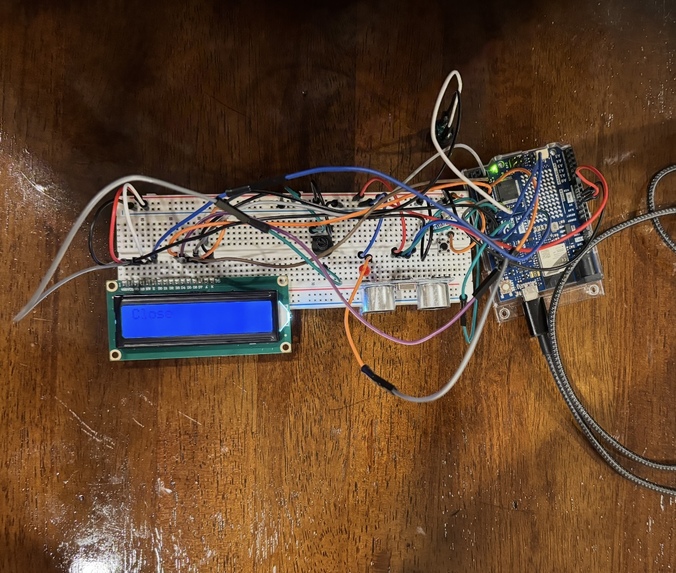
VisionMate Device
-
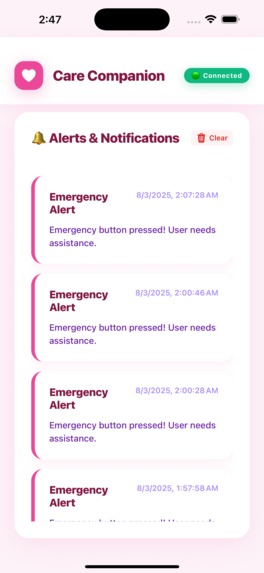
VisionMate Companion App
-
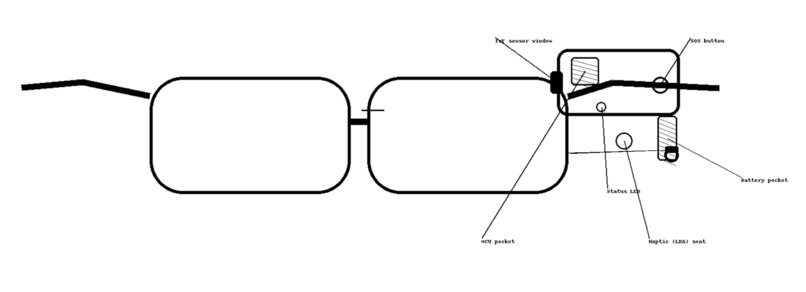
VisionMate 3D Model


Inspiration
Picture yourself walking down the street, and then being hit in the face by a hanging sign: your white cane swept the floor below clear, but provided no warning above. For more than 80 million blind people worldwide, this is a daily hazard. Conventional canes need continual sweeping and provide minimal proximity detection, usually failing to detect obstacles above ground level. Worse, most users mention an experience of self-consciousness and social stigma that comes with the use of the white cane, which undermines their confidence and dignity. Learning these facts was a wake-up call for me. It became clear that what millions rely on for mobility is, in many respects, compromised and outdated. That's why I invented VisionMate: to upend the status quo and remake assistive mobility through groundbreaking technology. VisionMate is not a product, it's a commitment to empowerment. This project is my personal call for equity, dignity, and innovation for the people who need it most.
What it does
VisionMate is smart eyewear that is lightweight, unobtrusive glasses that detect obstacles beyond the cane's reach and translate distance into intuitive, graded haptic cues. The result is confident, heads-up walking without the need for constant ground-sweeping or fear of the social stigma often associated with using sticks.
This is how it works:
Obstacle sensing: A distance sensor continuously scans the user's path and identifies obstacles such as signs, branches, open doors, etc. Graded feedback: Vibration and buzzing frequency increases as objects get closer, giving an immediate sense of proximity and allowing real-time route adjustments. One-press safety: A discreet temple button sends instant alerts to selected contacts and activates a visible LED to flag nearby help.
VisionMate is creative due to:
Form factor innovation: VisionMate is eyewear and not a handheld device which frees both hands and reduces stigma while maintaining dignity and eye contact. Above-ground coverage: Complements the cane's ground truth with early warnings for mid and upper-body collisions that the cane often misses. Privacy-first guidance: Distance sensing and haptics allow for immediate assistance by design.
VisionMate is fully functional:
Hardware: compact distance sensor + microcontroller; haptic motor and piezo for distinct feedback; SOS button; high-visibility LED. Mobile link: WiFi connection to a companion app for contact management and notification logs. User experience: Intuitive from first wear: No training needed: the closer the object, the louder the buzz with a button to signal for help. Discreet: Looks like everyday glasses and the feedback is private, not audible. Hands-free: allows the users to complete other tasks and be comfortable while navigating their daily walk.
Why it matters:
VisionMate addresses the blind spot of traditional canes: obstacles above knee height, quiet obstructions, and dynamic indoor layouts. By moving guidance to the face and the feedback to touch, VisionMate turns uncertainty into a steady, learnable rhythm of safety.
How we built it
To build the hardware system, I created an integrated solution using the Arduino R4 platform, incorporating components such as an ultrasonic distance sensor for spatial sensing, a potentiometer for dynamic tuning, and a pushbutton interface to accommodate user input. Real-time indication of hazards was achieved using a red LED and a pushbutton, and instant on-device feedback was achieved using a 16x2 LCD display. I used 220-ohm resistors in order to keep the current regulated throughout the circuit, being careful with voltage levels for protection of components. All the circuitry was designed using jumper wires and executed using the Arduino IDE for embedded control logic. On the software side, I developed a cross-platform companion app in JavaScript and React Native with support for real-time user interaction and tracking of data. For allowing seamless communication between the hardware and mobile app, I integrated Blynk's IoT platform so that the system can push sensor readings and notifications via Wi-Fi, even over mobile hotspots, combining physical-world input with an intuitive digital interface.
Challenges we ran into
One of the most challenging parts of creating VisionMate was that I had to establish stable, real-time communication between the mobile app and the Arduino hardware. Traditional serial or Bluetooth-based methods were restricted by mobility as well as network integration. After exploring a variety of possibilities, I utilized Blynk's IoT platform to bridge the hardware and the app via Wi-Fi. This included managing asynchronous transportation of data, managing connectivity via mobile hotspots, and enabling the device to push and receive state updates in a fault-tolerant fashion, all ultimately providing a seamless interaction between physical inputs and the app UI.
Accomplishments that we're proud of
I'm proud of developing an assistive device that leverages embedded sensing and wireless communication to alleviate mobility-related problems in the visually impaired. With the incorporation of real-time obstacle detection, intuitive feedback systems, and wireless app connectivity, I created a scalable system that has the potential to enhance spatial awareness and independence for millions globally. This project not only pushed the boundaries of what is possible with low-power microcontrollers, but also demonstrated the power of affordable hardware and thoughtful system design to facilitate meaningful social change.
What we learned
Through this project, I deepened my understanding of the rich, dynamic, real-world issues that individuals with visual impairments deal with such as the inadequacy of traditional mobility aids in changing contexts. Hence, I led a user-centered design approach, where I researched and experimented with a variety of sensor modalities for spatial detection and selected components based on performance, power efficiency, and environmental resilience. I also gained practical experience with systems integration, bridging hardware and software to create an integrated end-to-end prototype. From calibration of sensors to user interface development, VisionMate sharpened my ability to be able to transform user requirements into a technically viable and socially acceptable solution.
What's next for VisionMate
In the future, I will continue to expand VisionMate. Future releases will have additional modules like a GPS module for real-time geolocation and navigation, a gyroscope and accelerometer module to sense falls and analyze posture, and perhaps a medical-grade hearing aid for all-around hearing assistance. All these features will expand the capabilities of the device from obstacle detection to situational awareness and safety monitoring. I also intend to enhance the mobile app with location alerts and caregiver notification, such that VisionMate becomes a smart, networked solution for independent mobility and emergency response.


Log in or sign up for Devpost to join the conversation.