-
-
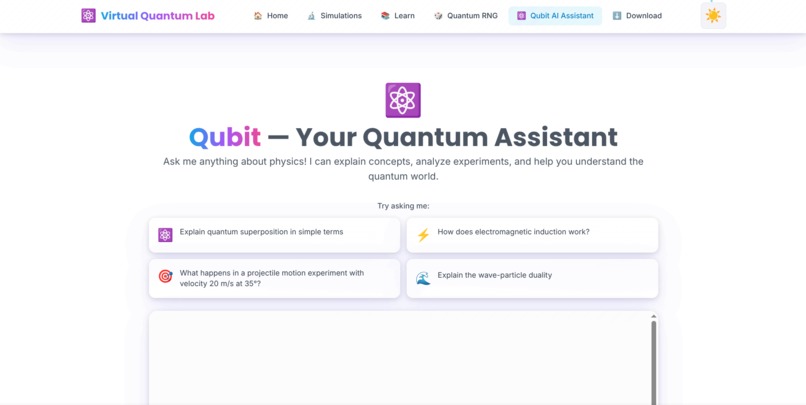
Qubit AI
-
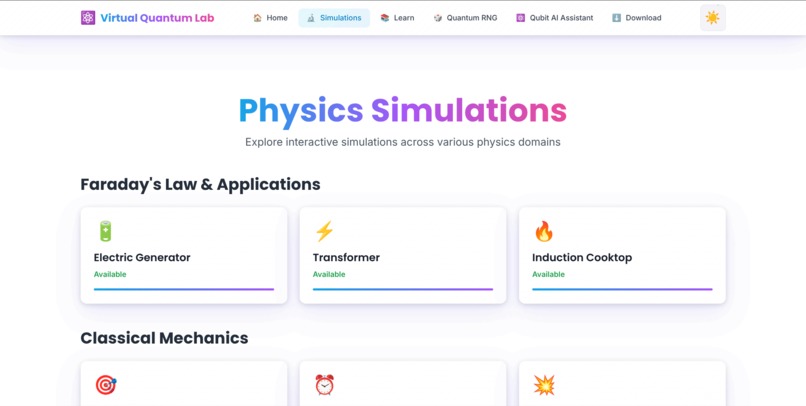
Simulation Page
-
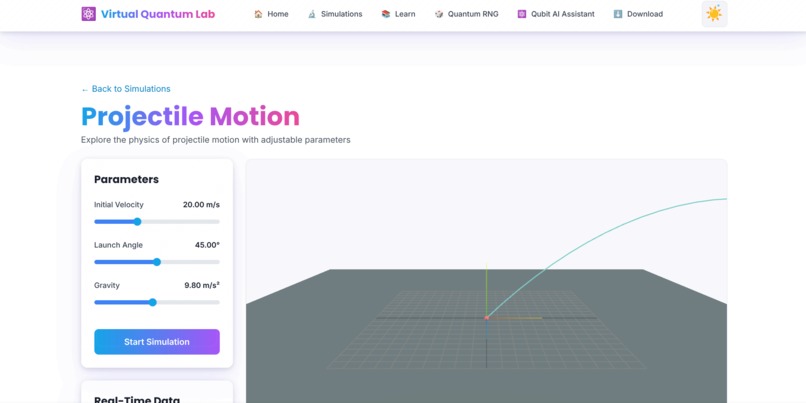
Simulation View Page
-
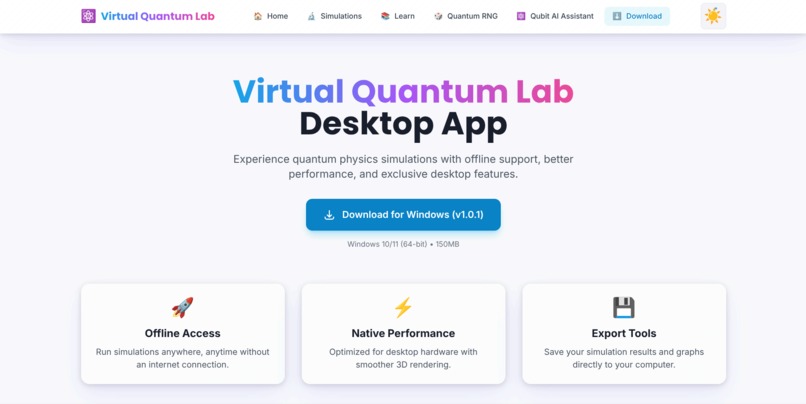
Desktop App
-
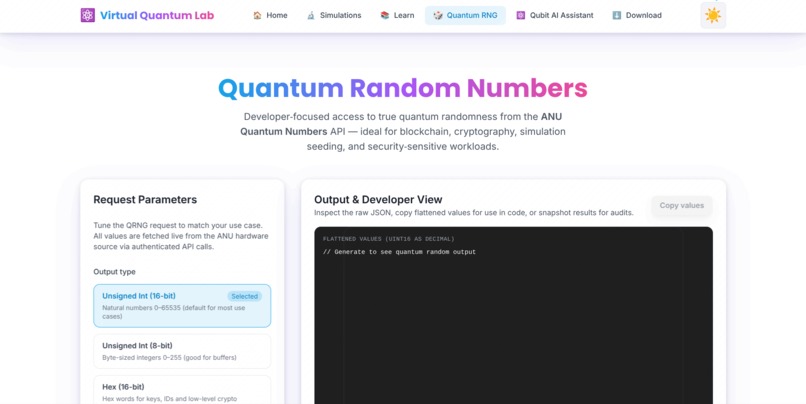
Random Numbers
-
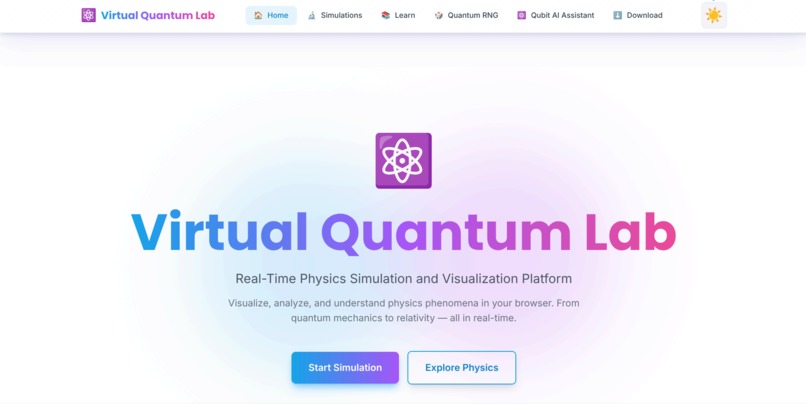
Home Page
-
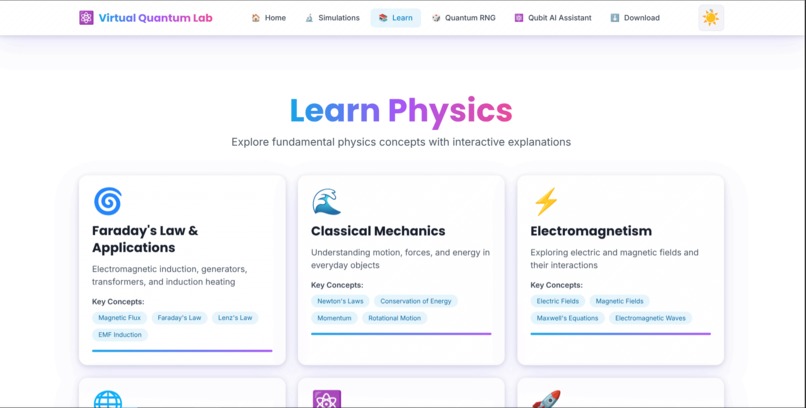
Leanring Page
-
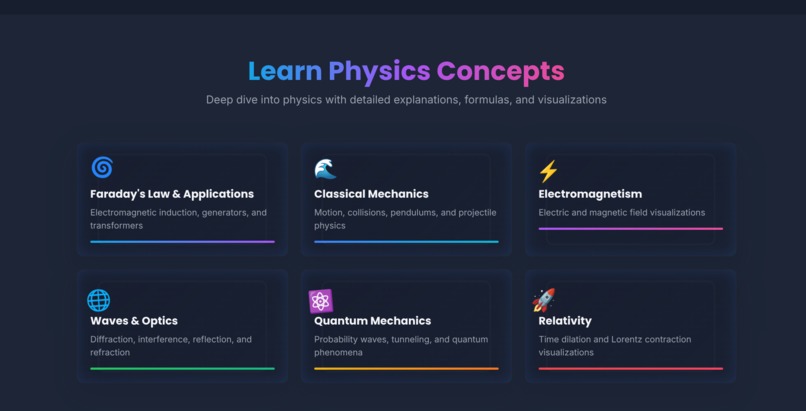
Dark Theme


Inspiration
Physics is one of the most conceptually challenging subjects because it describes a three-dimensional, dynamic world using static equations and diagrams. While learning physics, we noticed that many students—including ourselves—could solve formulas but struggled to truly understand what was happening physically.
The lack of accessible laboratories, limited classroom time, and passive online resources inspired us to rethink how physics should be learned. We wanted to create an environment where learners could see physics in action, experiment freely, and ask questions while learning, just like in a real lab—without cost or physical constraints.
What it does
Virtual Quantum Lab is an interactive physics simulation platform that allows users to explore complex physics concepts through real-time 2D and 3D simulations.
Users can:
- Manipulate physical parameters and observe instant outcomes
- Visualize motion, forces, fields, waves, and quantum phenomena
- Explore simulations across classical mechanics, electromagnetism, waves, quantum mechanics, and relativity
- Interact with an AI-powered assistant (QubitAI) that explains concepts, formulas, and experimental behavior contextually
- Use the platform on the web or as a desktop application for offline-friendly access
The platform turns passive learning into an exploratory, experiment-driven experience.
How we built it
Virtual Quantum Lab was built as a modular, scalable application using modern web and visualization technologies.
- The frontend is built with React and Vite for fast development and performance
- Three.js and React Three Fiber are used to render immersive 3D simulations
- Custom JavaScript physics engines handle calculations independently of rendering logic
- Chart.js visualizes real-time simulation data
- Tailwind CSS and Framer Motion create a clean, modern, and responsive UI
- The AI assistant (QubitAI) is integrated using the OpenRouter API
- A desktop version was created using Electron, enabling offline-friendly usage
- The application is deployed on Vercel for global access
The system is designed so that physics logic, visualization, and AI assistance remain cleanly separated.
Challenges we ran into
- Accurately translating physics equations into real-time simulations without sacrificing performance
- Synchronizing simulation state between 3D visuals, charts, and user input
- Designing simulations that are both scientifically correct and intuitive for beginners
- Integrating AI assistance in a way that enhances learning without overwhelming users
- Ensuring cross-platform consistency between web and desktop environments
- Balancing performance and visual fidelity for lower-end devices
Accomplishments that we're proud of
- Building a fully working physics simulation lab from scratch
- Successfully integrating real-time 3D simulations with AI-guided learning
- Creating a cross-platform application usable on both web and desktop
- Designing a clean, immersive UI that encourages exploration
- Delivering a functional, live demo within hackathon constraints
What we learned
- Physics education improves dramatically when learners can interact instead of observe
- Visualization and experimentation are more effective than memorization
- AI is most valuable in education when it is contextual and assistive, not intrusive
- Separating physics logic from rendering makes simulations easier to scale and maintain
- Clear communication and user experience matter as much as technical complexity
What's next for Virtual Quantum Lab
- Expanding simulation coverage to include more advanced topics
- Adding guided learning paths and structured experiments
- Introducing AR/VR-based exploration for immersive learning
- Enhancing AI tutoring with adaptive learning and progress tracking
- Collaborating with educators to align simulations with academic curricula
- Making the platform available for classrooms and institutions globally
Repository Note
This project is being developed as a long-term product for future release and commercialization.
For that reason, this GitHub repository may include only selected code-related components, samples, or modules, and not the complete production codebase.

Log in or sign up for Devpost to join the conversation.