-
-
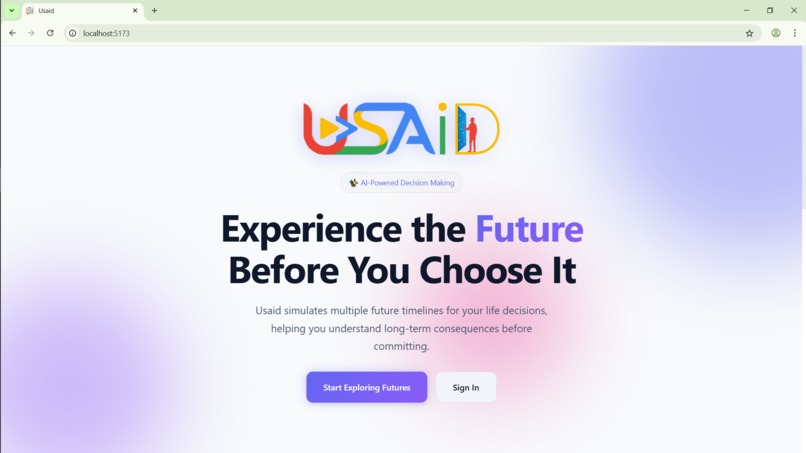
welcome page
-
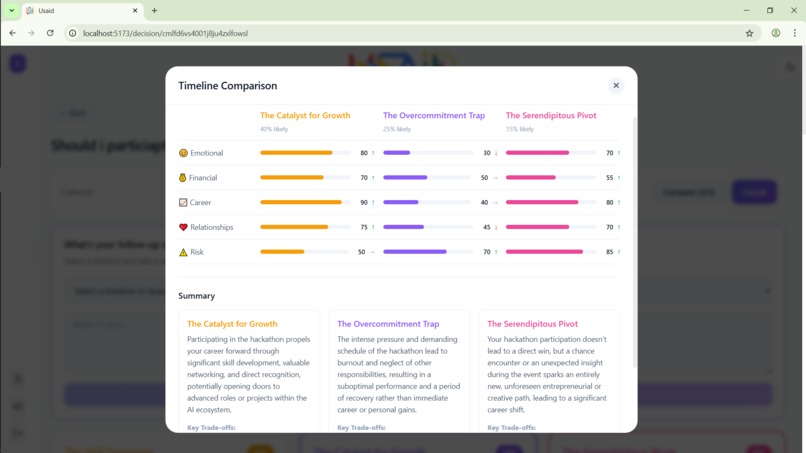
future foresight
-
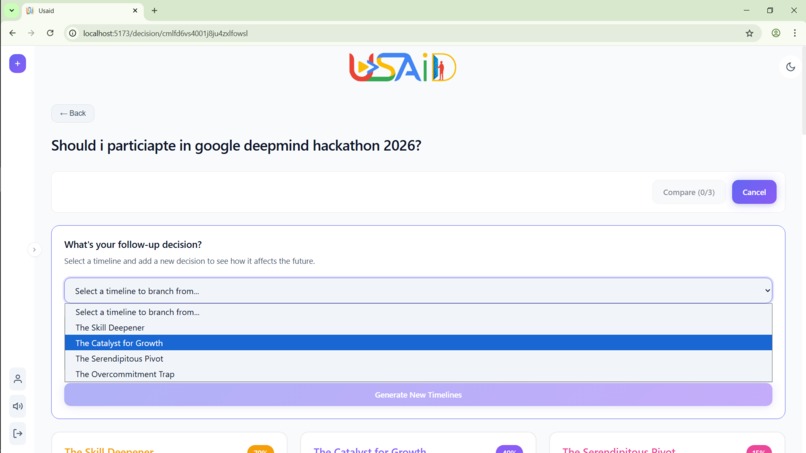
future inside future
-
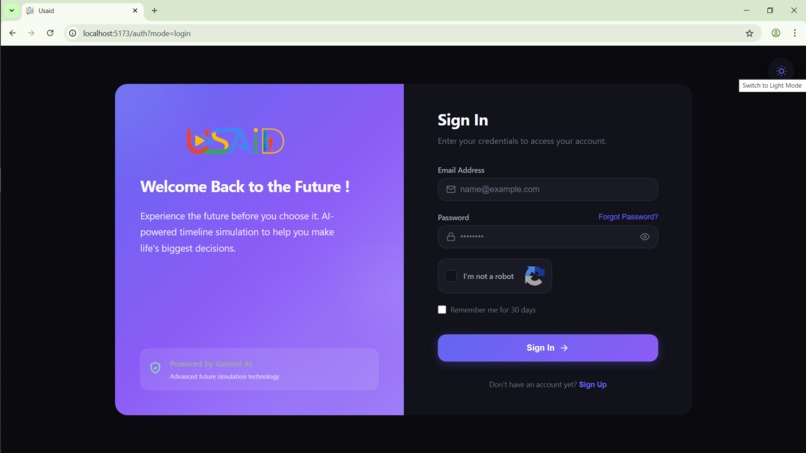
dark theme for late night work


Usaid - The AI Future Architect for Higher Education
Inspiration
University students today face an overwhelming number of choices: "Which major should I choose?", "Should I take that internship or study abroad?", "Is grad school worth the debt?". Traditional academic advising is often reactive, understaffed, and focused solely on graduation requirements rather than holistic life success. Students are paralyzed by the fear of making the wrong choice, leading to high dropout rates, major switching, and post-graduation regret.
We asked ourselves: What if students could "live" their future semesters before committing to them?
Inspired by the concept of "Strategic Foresight" used by governments and corporations, we built Usaid to bring military-grade decision simulation to the university experience. It's not just a counselor; it's a flight simulator for your life & career.
What it does
Usaid is an AI-Driven Academic & Life Strategy Engine that directly addresses the core challenges of the modern educational environment:
1. 🧠 Intelligent & Automated Student Assessment Most assessments only look at grades. Usaid assesses the whole student. By analyzing a student's risk tolerance, core values, financial goals, and academic history, it builds a comprehensive "Cognitive Profile". This allows the AI to predict how a student might thrive (or struggle) in different academic paths—not just academically, but emotionally and financially.
2. 🤖 Smart Educational Assistant (24/7 AI Counselor) Usaid serves as an always-on Smart Educational Assistant. Students can ask complex, open-ended "What if?" questions:
- "What if I switch from Engineering to Psychology?"
- "What if I take a gap year to work on a startup?"
- "How will a student loan impact my life at age 30?"
The AI doesn't just give a generic answer. It generates 3 distinct future timelines (Optimistic, Pragmatic, and Pessimistic) to show the full range of possibilities.
3. 📊 Analyze Educational Data to Support Decision-Making Usaid transforms abstract anxiety into concrete data. Our Timeline Visualization Engine quantifies the impact of every educational choice across four key metrics:
- 🎓 Career Growth: Projected job stability and advancement.
- 💰 Financial Health: Student debt impact, salary potential, and savings.
- ❤️ Emotional Well-being: Stress levels, work-life balance, and satisfaction.
- 🤝 Relationships: Impact on social life and networking.
This empowers students to make evidence-based decisions about their education, rather than guessing.
4. 🎓 Improving the Digital Learning Experience We've reimagined the "student portal" experience. Instead of clunky, bureaucratic interfaces, Usaid offers a gamified, premium digital experience featuring:
- Glassmorphism UI: A calm, futuristic interface that reduces anxiety.
- Interactive Timelines: Students can click on future years to see detailed "simulated events".
- Dynamic Feedback Loops: Students can inject new decisions into a timeline (e.g., "What if I get a scholarship in Year 3?") and watch the future rewrite itself in real-time.
How we built it
- Frontend: Built with
ReactandTypeScriptfor a robust, type-safe codebase. We usedVitefor lightning-fast builds andZustandfor state management. The UI is custom-designed withCSS Modulesto achieve the premium "Glassmorphism" aesthetic. - Backend: A
Node.jsandExpressserver handles API requests, withPrismamanaging ourSQLitedatabase for storing user profiles and saved timelines. - AI Engine: The core intelligence is powered by Google Gemini 3 Flash. We developed a novel "Context-Aware Prompt Engineering" system that feeds the AI structured data about the student's current state, enabling it to generate deterministic, JSON-structured timelines that our frontend can render as graphs.
- Security: Implemented full
JWT-based authenticationto ensure student data privacy.
Challenges we ran into
- Prompt Engineering for Determinism: Getting a Large Language Model (LLM) to output consistent, structured JSON data for complex timelines was difficult. We had to iterate extensively on our system prompts to ensure the "Optimistic" timeline was genuinely distinct from the "Pessimistic" one without hallucinating impossible scenarios.
- Visualizing Complex Data: Representing multi-dimensional life paths (Finance vs. Happiness) on a mobile-friendly screen required several design iterations. We settled on a comparative card view that simplifies the complexity without losing depth.
Accomplishments that we're proud of
- Real-Time Simulation: Generating 3 detailed 10-year timelines in under 5 seconds.
- The "Emotional" Metric: Safely quantifying "emotional well-being" in a way that feels supportive rather than judgmental.
- Seamless UX: Creating an interface that feels like a high-end consumer app rather than a typical university tool.
What we learned
- Students crave data: When presented with concrete "future scenarios," test users felt significantly less anxious about their choices.
- Context is King: The more data we fed the AI about the user's values (not just their grades), the more accurate and resonant the simulations became.
What's next for Usaid
- Integration with University Systems: Pulling live course data and GPA to make academic predictions even more accurate.
- Alumni Mentorship Matching: Connecting students with alumni whose "past timelines" match the student's "projected future."
- Institutional Analytics Dashboard: Giving universities aggregated (anonymized) data on what paths students are exploring, helping them adjust curriculum and support services.
Usaid is more than a tool; it's a compass for the next generation.
Built With
- css-modules
- express.js
- google-gemini-3-flash
- jwt
- node.js
- prisma
- react
- sqlite
- typescript
- vite
- zod
- zustand

Log in or sign up for Devpost to join the conversation.