-
Home
-
General Health Check
-
Physical Health Check
-
Physical Health Check- Self Assessment
-
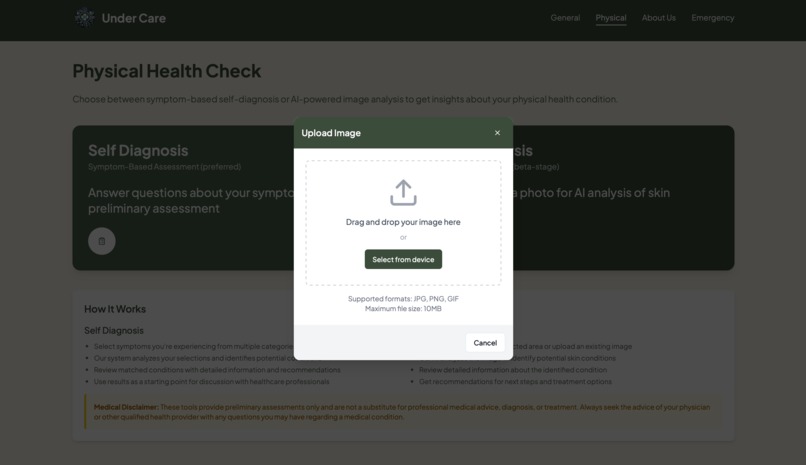
Physical Health Check - Image Analysis
-
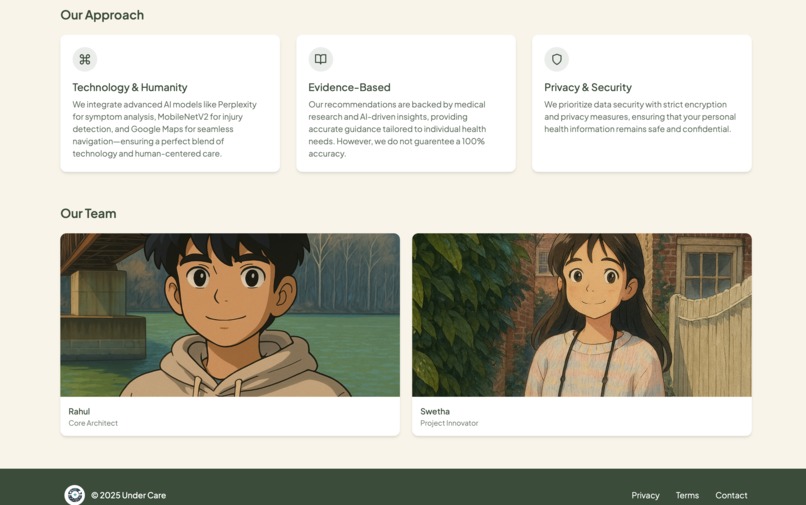
About
-
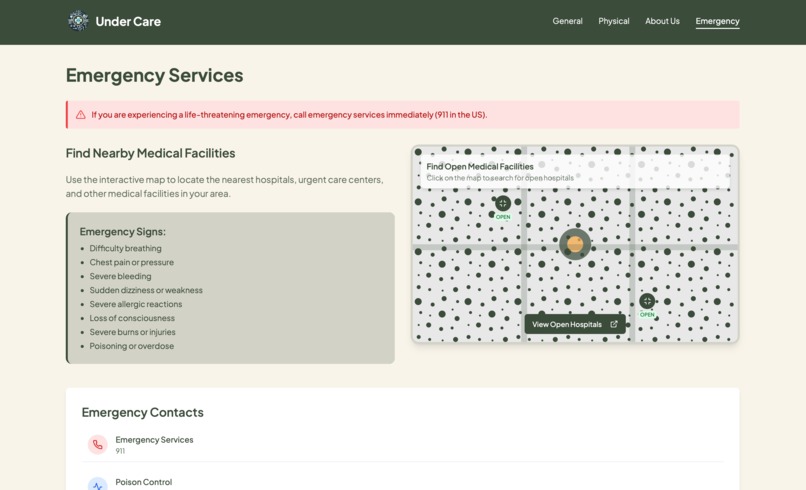
Emergency


Inspiration
The inspiration behind Under Care came from a personal experience when a close friend faced continuous stomach pain and struggled to get a timely medical appointment. After being given a two-week wait time and seeing people with similar challenges face months of delays, we realized the need for quick, accessible secondary healthcare solutions. Additionally, when I had a minor eye injury and couldn’t get immediate medical help, I saw the value in being able to access medical guidance remotely. This sparked the idea to create an app that would bridge the healthcare gap, offering quick relief, diagnosis, and guidance for both general and physical health issues (we want to emphasize that while Under Care provides symptom analysis and advice, it is never a replacement for professional medical care).
What it does
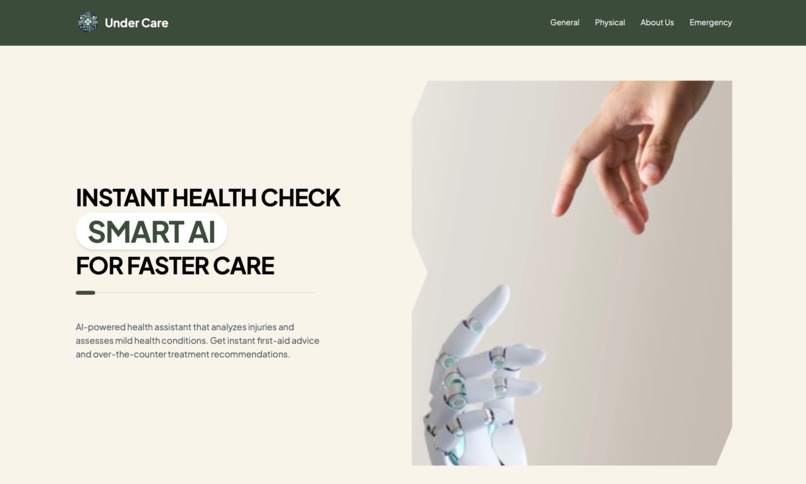
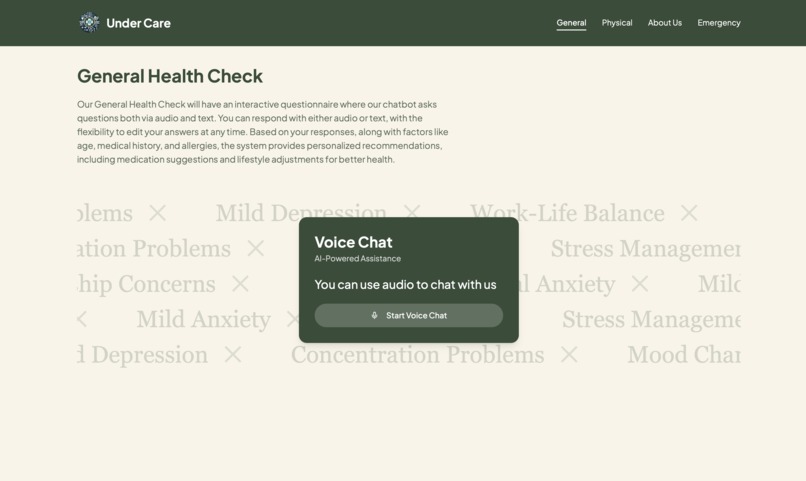
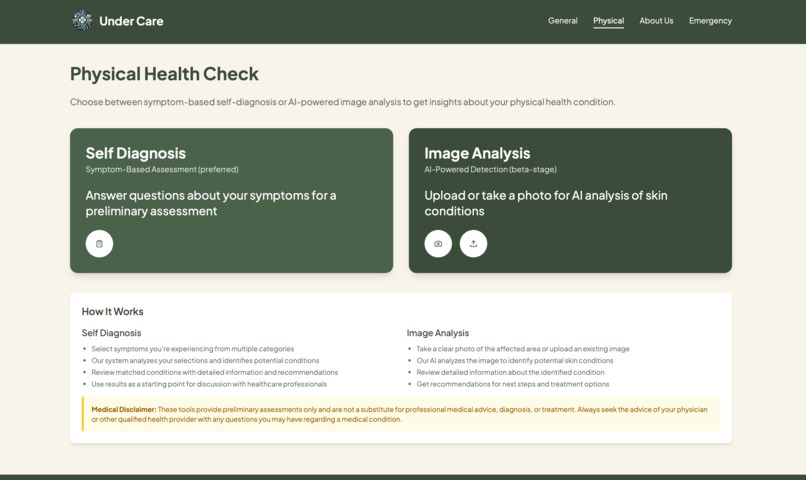
Under Care is an AI-powered web application that diagnoses minor injuries and non-urgent health conditions. This application is compatible with both laptop and phone(recommended to use in chrome or edge search engine for best experience). The platform provides reliable symptom analysis, injury assessments, and personalized recommendations, including over-the-counter medication suggestions and lifestyle adjustments. It offers both text and audio-based chatbot interactions and photo-based physical health assessments, providing users with actionable advice while they wait for professional care.
How we built it
We built Under Care using Next.js for the frontend, hosted on Vercel, and Tailwind CSS for styling. For the backend, we used FastAPI to connect with our AI model. The AI leverages Perplexity API to analyze user inputs and offer personalized health advice. We integrated text-to-speech and speech-to-text engines for the chatbot, which enables both audio and text-based communication. Additionally, we used ResNet-50, a pre-trained model, for image classification in physical injury assessments. For location services, we integrated Google API to direct users to the nearest open hospitals.
Challenges we ran into
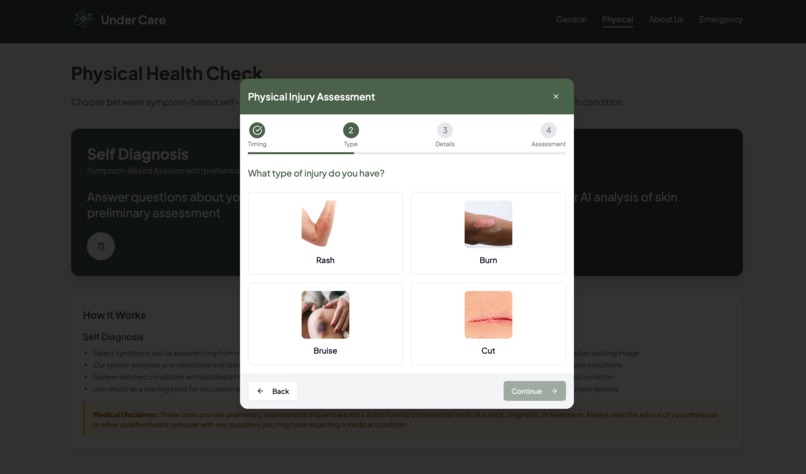
One of the main challenges we faced was working with a pre-trained models for physical injury analysis. The models were mostly biased toward certain physical problems due to the limited training data available. Since we lacked enough data to train a model from scratch, we had to rely on the most accurate pre-trained model we could find. However, this model wasn't perfect for all inputs, which led us to implement a self-diagnosis feature. This allows users to check their results and validate their symptoms before taking any actions. Another obstacle was ensuring the chatbot’s accuracy when users provide detailed health descriptions, but we overcame this with continuous testing and feedback.
Accomplishments that we're proud of
We’re incredibly proud of how well our chatbot works. The integration of text-to-speech and speech-to-text features has been seamless, allowing users to interact with the system in a natural and intuitive way. Another key accomplishment is our ability to successfully connect the backend AI model to the frontend of the application for the first time. This involved a lot of coordination and teamwork, especially when it came to handling real-time data processing and delivering accurate health recommendations.
What we learned
This project was our first hackathon experience, and it was a huge learning opportunity. We faced numerous challenges, from technical difficulties to tight time constraints, and had to make quick decisions on what features to prioritize. We also learned how to effectively use prompt engineering to optimize the results we get from the Perplexity API, ensuring we get the most accurate diagnosis possible for each user. Above all, we learned how rewarding it is to bring an innovative idea to life in a fast-paced, real-world scenario.
What's next for Under Care
Next, we plan to expand our physical health examination conditions by building a more accurate image classification model from real-world data. We also aim to enhance the general health assessment by developing a decision tree to guide more precise results. Additionally, we plan to expand the chatbot’s capabilities with more advanced AI and machine learning features for better personalization. Our long-term goal is to incorporate real-time doctor consultations and make the platform more comprehensive for users in need of non-urgent care.
Built With
- fastapi
- google-maps
- next.js
- perplexity-api
- pillow
- python
- resnet-50
- speech-to-text-engine
- tailwind.css
- text-to-speech-engine
- torch
- torchvision
- uvicorn
Log in or sign up for Devpost to join the conversation.