-
-
Landing Page
-
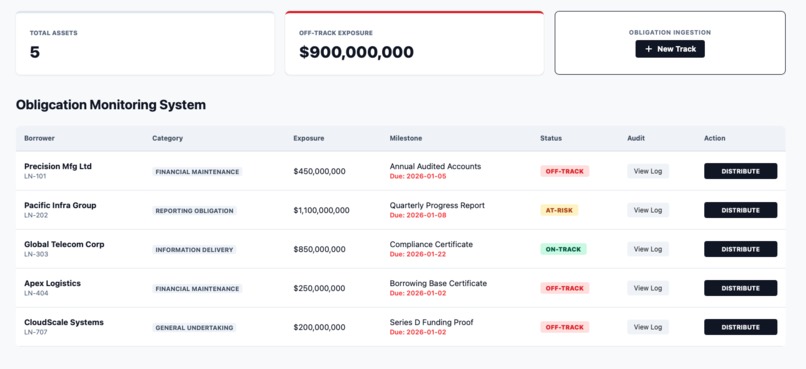
Dashboard
-
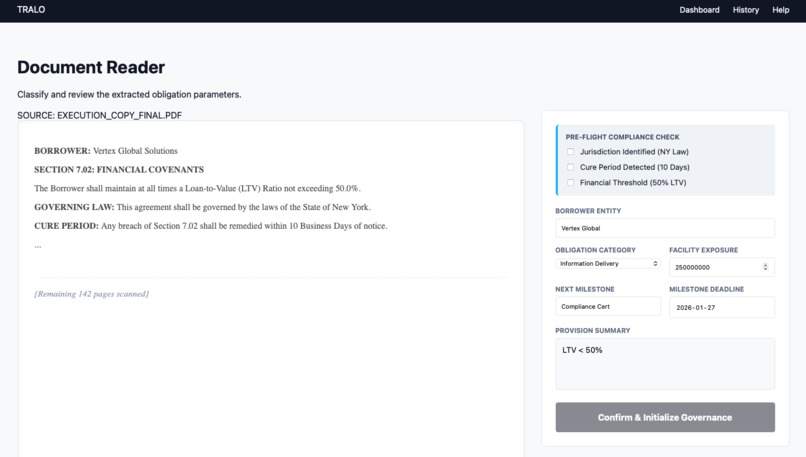
Document Intelligence
-
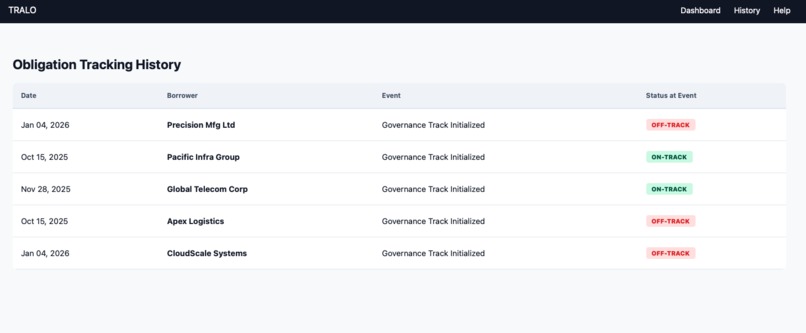
History
-
Help


Inspiration
Loan agreements set out a wide range of obligations on Borrowers, including adhering to various financial covenants, providing timely information and notifying other parties of specified events. These obligations can differ from one loan to the next. How can Borrowers and Lenders efficiently gather and distribute relevant information to ensure compliance with these requirements? This is where Tralo comes in. It is a loan obligation monitoring system.
What it does
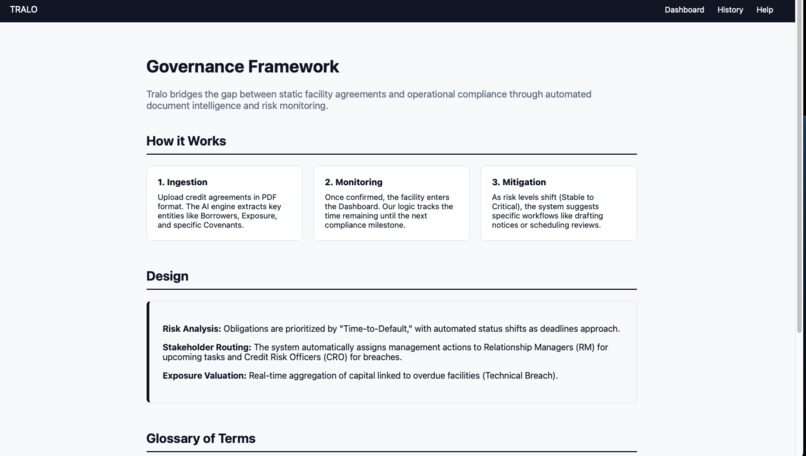
Tralo is a platform that automates the lifecycle of loan governance to keep all financial parties "on track". Unlike generic Contract Lifecycle management tools, Tralo is built for Credit Risk. It doesn't just store documents; it validates the financial outcomes within them to prevent slippage. The target user would be credit, risk financial professionals.
Key features
Data ingestion - It can in review pdfs to obtain key information from them.
Monitor: Easy to use health tracking of every active obligation using dynamic risk classification.
Enforcement: Automated distribution and remediation workflows to close governance gaps and ensure borrower compliance
Benefits
Unified Ingestion: We map "Provision Language" directly to structured milestones.
Active Monitoring: We calculate "Requirement Health" as a percentage of portfolio stability.
Closed-Loop Communication: We remove the bottleneck of manual emails by automating notice distribution and evidence collection.
How we built it
It was built by looking at some of the LMA documents. From a tech perspective it was built using the flask framework (Python, HTML, CSS and Javascirpt) for simplicity and then hosted on vercel.
Challenges we ran into
The main challenge was fleshing out the key features that needed to be added to the app.
What's next for Tralo
Integration with Financial Data Feeds.
Predictive Default Modeling based on compliance patterns.

Log in or sign up for Devpost to join the conversation.