-
-
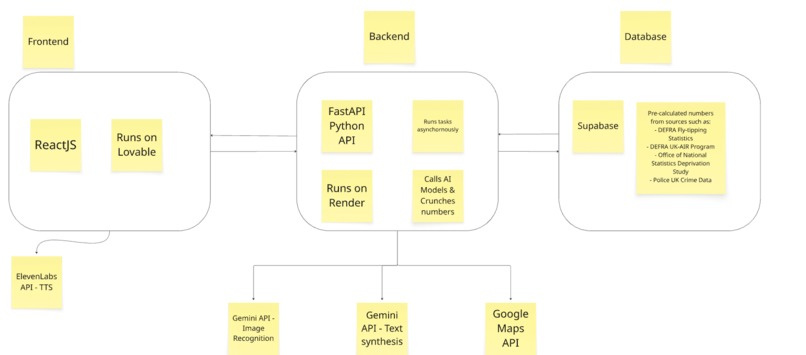
Architecture Diagram
TipReport
Inspiration
Sustainability and supporting low income communities are personal issues to us. Our lived experiences being raised in socially deprived neighbourhoods allowed us to notice a glaring intersection for these two issues - these areas have a massive problem with illegal dumping or flytipping.
Flytipping disproportionately affects marginalised areas. Children who grow up in these environments end up surrounded with antisocial behaviour and are more susceptible to various health problems. Flytipping is expensive for local councils to deal with, mattresses are often left to rot while furniture and valuable goods (which could have been recycled) are discarded or landfilled. Flytipping is the antithesis of the values held by sustainable living, and is a prominent issue across both developed and developing countries.
Low income areas in particular are marginalised and are disillusioned, often losing any sense of community responsibility or spirit which culminates with people throwing rubbish outside their own driveways and harming the same place their neighbours and children live in.
Properly building this community responsibility is difficult, requires an understanding of the people in that neighbourhood as well as what matters specifically to them. We built TipReport, technology that uses AI to enable people to develop the community responsibility needed to tackle this issue properly.
What it does
TipReport enables people who want to make a real, positive change in their neighbourhood by providing them the required knowledge, tools and data to effectively tackle the problem of flytipping. It leverages AI and data-driven workloads to empower individuals in producing high quality impact reports which they can easily distribute to help their community understand the specific impact of these incidents and help foster community responsibility.
It takes a image of an instance of flytipping and a postcode of an affected neighbourhood to produce a specific, persuasive high quality impact report that a person can use and share with other members of the neighbourhood. TipReport technology builds a profile of the individuals in the neighbourhood based on nearby locations. It determines their specific pain points and produces an impact report which the user can share to foster the community responsibility required to increase overall reporting and intervention of flytipping incidents (which research shows is the best way to tackle this issue). This impact report leverages AI to voice this statement, and is highly engineered to be as effective and persuasive to residents as possible.
How we built it
We leveraged Lovable for the frontend and Render to host the backend via a FAST API server. We integrated several datafeeds (IMD, DEFRA, Police UK/Crime data and the office of national statistics) and APIs (such as the google places API) to build a profile of the neighbourhood, and used models to extract features from the image to determine how that specific incident impacts its residents. A detailed architecture diagram is provided below.
Challenges we ran into
Architectural choices and sourcing high quality APIs was the most difficult aspect of development.
Accomplishments that we're proud of
We were able to build a seamless frontend using lovable, and were able to deliver a high quality functional PoC quickly using AI tooling. Setting up an effective workflow we could carry over to a fully fledged product was quick using the various integrations Lovable and Render had.
What we learned
How effective Lovable and AI can be for developing a PoC. If you need to get an idea to investors or a client quickly, use Lovable!
What's next for TipReport
Getting TipReport to some end users, particularly those in low income communities victimised by flytipping.
Architecture Diagram


Log in or sign up for Devpost to join the conversation.