-
-
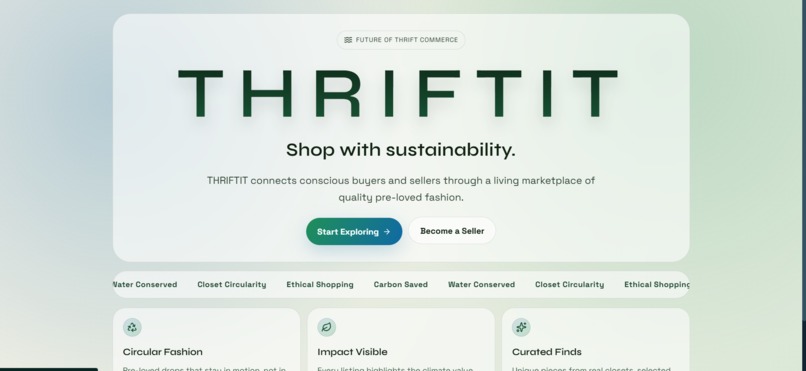
Landing page with both the buyer and seller logins
-
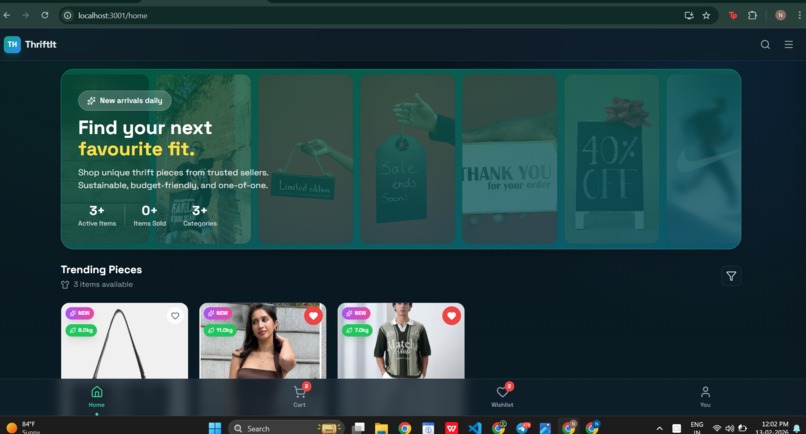
The buyer mode, where the buyer can go through all the styles and pick their favourite piece of clothing that they want to give a new home.
-
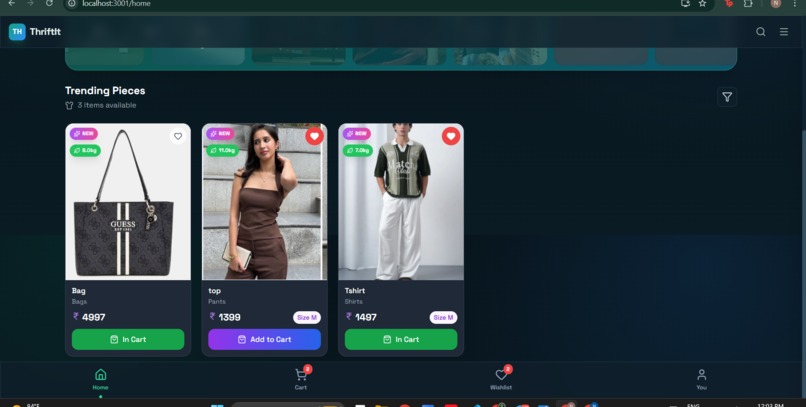
Wishlist items, add to cart their picks change modes from dark to light and many more features.
-
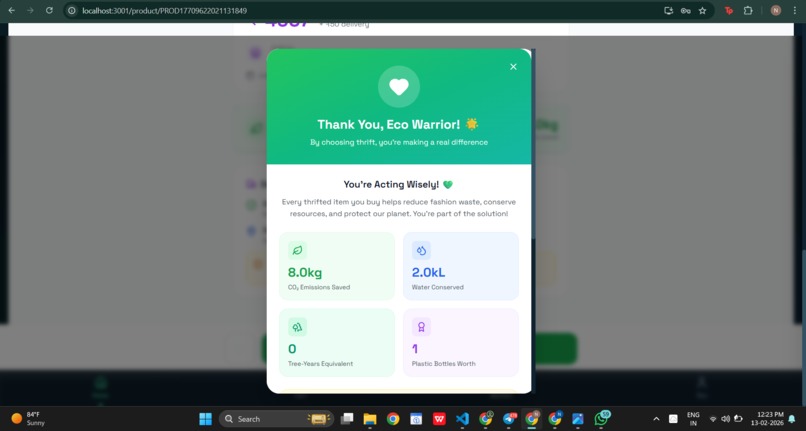
Thriftit is more than a platform, its a movement toward conscious consumption. Every item reused is one less item wasted, this empowers them
-
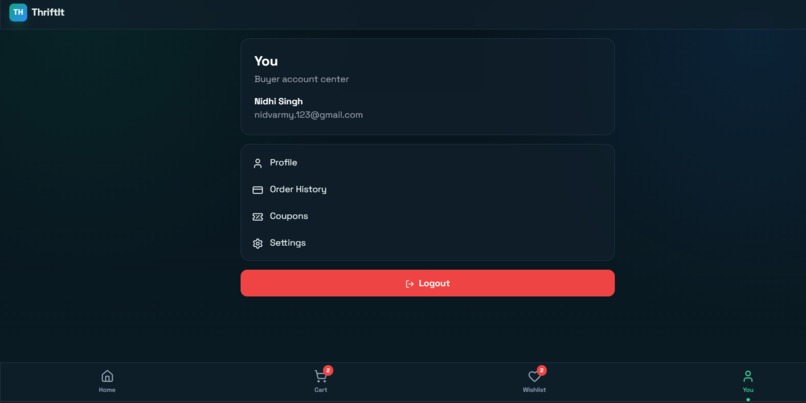
Buyer profile with all the relevant information, and logout option.
-
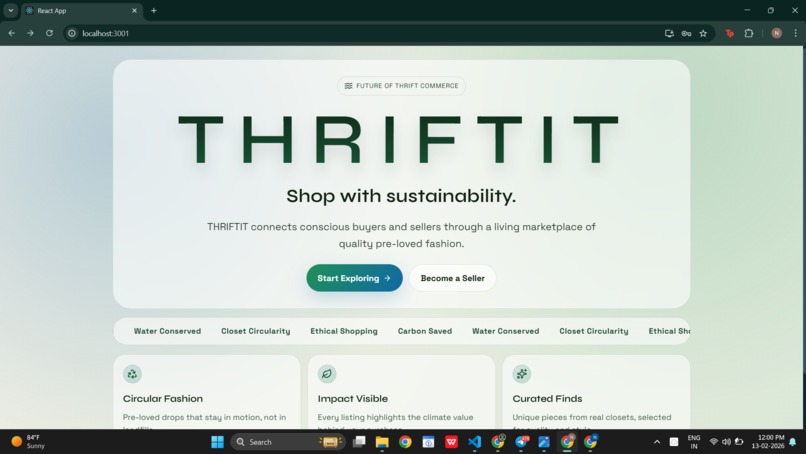
Again back to the landing page to login as a seller just click on the become a seller and get started. This helps with no confusion.
-
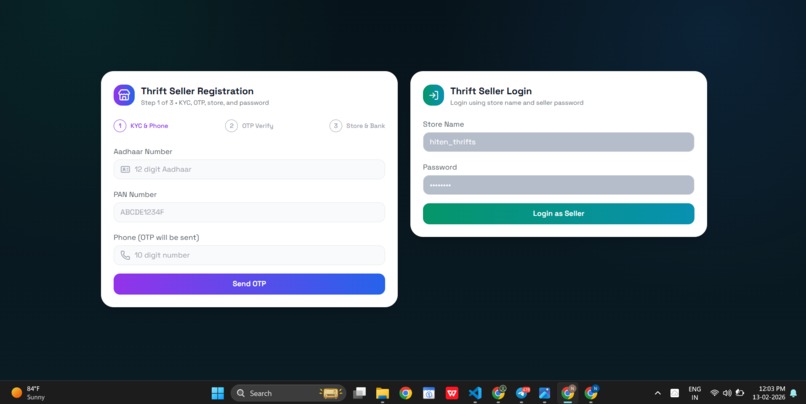
Now the seller have to register and approve information like KYC , Aadhar and PAN. If previously registered then login with name and pass.
-
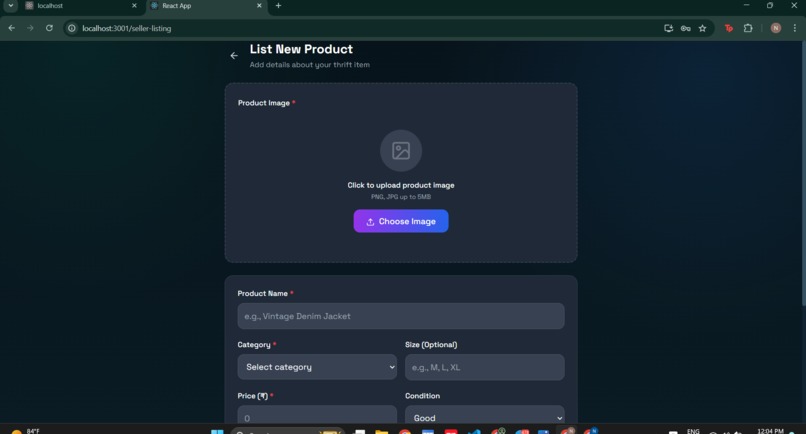
This is how you list a product.
-
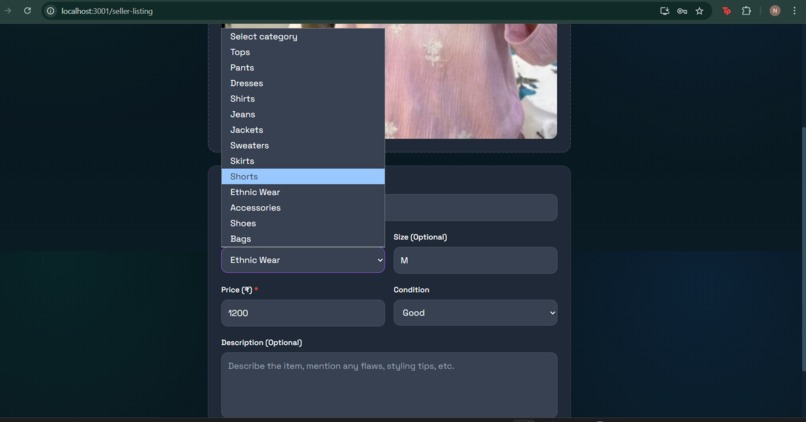
Select it from your device and give it a price and fix all labels and then click on list the product.
-
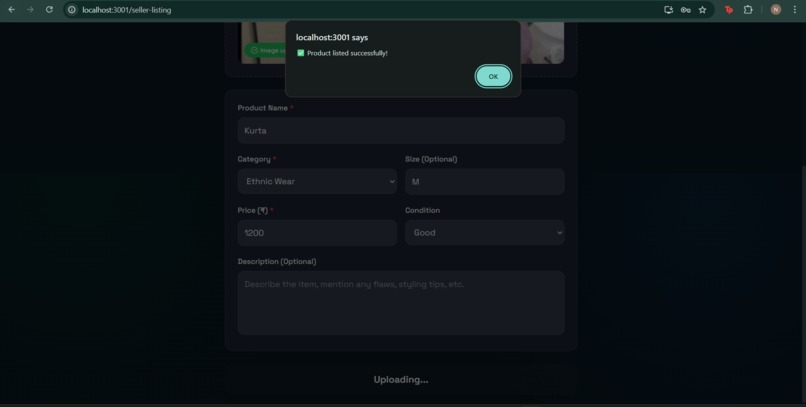
The new product is now listed and is stored in the express api and is visible on the buyers window.
-
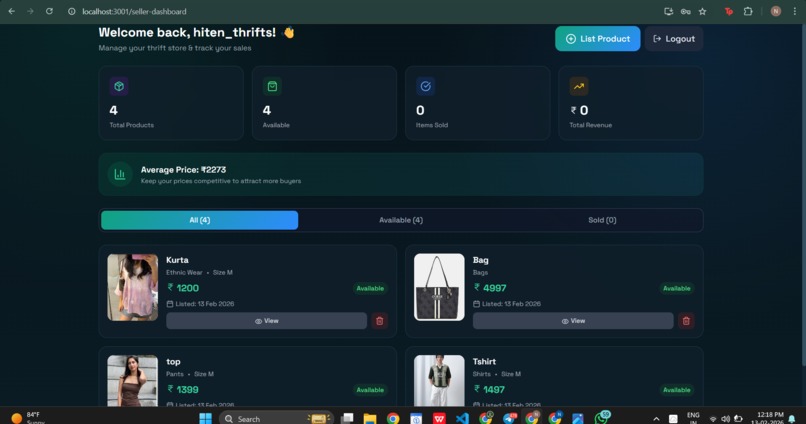
This is the seller dashboard, where they can track their selling record.
-
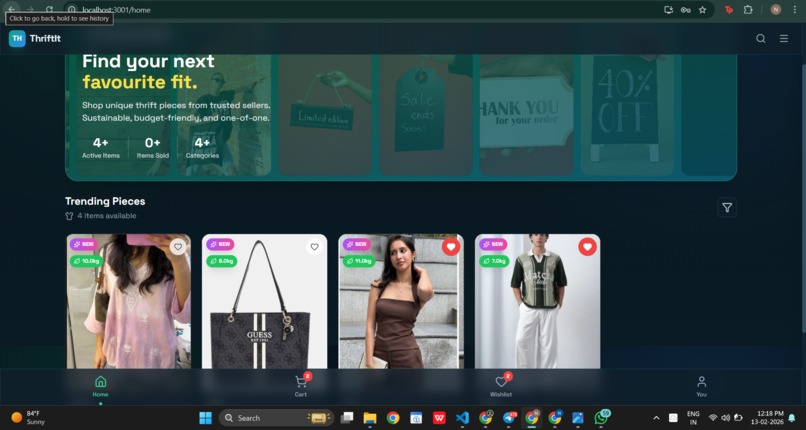
The new product that was listed, is now successfully in the market finding its new home.


ThriftIt — Project Story
Inspiration
The fashion industry discards billions of garments every year — not because they're worn out, but because the systems around reuse are too slow, too sketchy, and too inconvenient. ThriftIt started from a straightforward observation: the clothes exist, the demand exists, and what's missing is a marketplace that treats second-hand shopping as a first-class experience.
I wanted to close that gap. Not by preaching sustainability, but by removing the friction that makes people default to buying new. The core hypothesis is simple:
$$ \text{Sustainable Impact} \propto \text{Ease of Reuse} \times \text{User Trust} $$
If you make reuse fast and trustworthy, people choose it. That's the product bet ThriftIt is built on.
How I Built It
ThriftIt is a full-stack web app supporting both a buyer and a seller experience — two distinct user journeys sharing one coherent platform.
- Frontend: React, React Router, Redux Toolkit, Tailwind-based UI, Framer Motion
- Backend: Node.js + Express APIs
- Database: SQLite for product and user data
- State + UX: Cart, wishlist, auth/session flows, guarded seller routes
- Platform features: Product listings, product details, orders, profile/settings, seller dashboard
Beyond core features, I invested in production readiness — because a sustainable marketplace only works if people can actually find and use it:
- Route-based code splitting (
React.lazy+Suspense) to keep initial bundle size lean - Lazy-loaded product media to reduce above-the-fold load weight
- Open Graph, Twitter cards, and structured data for SEO and link shareability
- Route-aware title and description logic to make every page indexable in a SPA context
What I Learned
The biggest shift in my thinking was realising that product quality is not a single axis. Features get you to functional. Performance, discoverability, and clarity are what get you to good.
- Architecture pays forward. Clear route boundaries and reusable components early on meant I could move fast later without untangling a mess. The discipline upfront was worth it.
- SEO is a product decision, not an afterthought. In a SPA, if you don't explicitly manage metadata per route, your pages are effectively invisible. Treating it as a feature changed how I approached every new route.
- Performance is additive. There is no single fix — it is a series of small decisions that compound. Load time breaks down as:
$$ T_{\text{load}} = T_{\text{network}} + T_{\text{parse}} + T_{\text{render}} $$
Shaving time from each term separately is what produces a noticeably faster experience.
- Visibility drives behaviour. Sustainability features only change habits if users can see the impact. Embedding that into the product flow — rather than burying it in an "About" page — is what makes it real.
Challenges I Faced
Balancing visual richness with speed — Motion and video-heavy sections elevated the brand feel, but came with real load cost. The solution wasn't to strip the design back, but to be surgical: lazy-load what's below the fold, compress aggressively above it, and let Framer Motion handle animation weight rather than raw video where possible.
Managing multi-role flows cleanly — Buyer and seller journeys share an app but need strict separation: guarded routes, distinct session intents, and navigation states that don't bleed into each other. Getting this right required treating roles as a first-class architectural concern, not a conditional flag bolted on later.
Keeping shared state predictable — Cart, wishlist, products, and auth running in parallel is where Redux can get messy fast. Structuring slices with deliberate boundaries — each owning its own shape and actions — was what kept things from unravelling as features grew.
SEO in a single-page app — SPAs don't get metadata for free. Every route needs its own title, description, and structured data to be discoverable. Building route-aware metadata logic from the ground up was the right call, and it's now a pattern I'll carry into every future project.
Final Reflection
ThriftIt grew from a sustainability idea into a full product engineering problem — one where UX, architecture, performance, SEO, and business logic all had to work together, not in isolation. The version I built here is a foundation: the multi-role marketplace, the optimised delivery layer, and the discoverability infrastructure are all in place. What comes next is scale — more sellers, richer search, and impact metrics surfaced directly in the product so users can see the environmental difference their purchases make. The core conviction hasn't changed: make reuse easier than buying new, and people will choose it.
Built With
- cors
- create-react-app-(react-scripts)
- css3
- dotenv
- express.js
- framer-motion
- html5
- javascript
- multer
- node.js
- razorpay-integration-utilities
- react
- react-redux
- react-router
- redux-toolkit
- sqlite
- tailwind-css-(cdn)
- webvitals


Log in or sign up for Devpost to join the conversation.