-
-

Logo
-
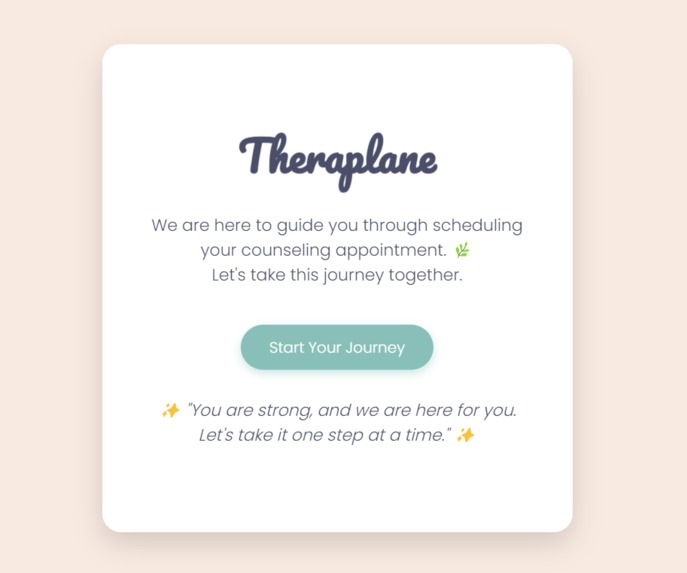
Home page
-
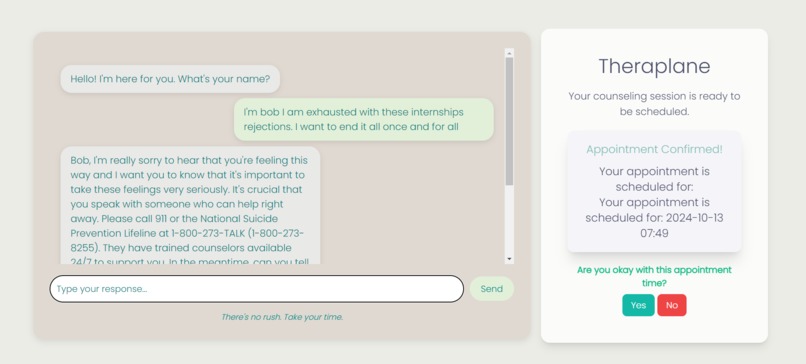
Webapp in action


Inspiration
College counselors are facing significant challenges due to the influx of incoming students, resulting in burnout, diminished therapy quality, and professionals leaving the field. Our goal is to ease the burden on college counselors by automating appointment management and prioritizing students based on their needs. By grouping students with similar mental health concerns and organizing appointments into categories, we can streamline the scheduling process. From each category, students will be selected based on the urgency of their situations, as determined by their responses to a tailored questionnaire. This focus on urgent cases allows us to maximize the effectiveness of counseling services.
What it does
Our AI-powered scheduling platform streamlines appointment management for college counselors, addressing the challenges of increased student demand and counselor burnout. The system:
- Utilizes an intelligent questionnaire to assess student needs and urgency
- Employs AI to analyze responses and prioritize appointments
- Integrates with existing calendar systems for real-time availability
- Automates notifications for appointment reminders and confirmations
By optimizing the scheduling process, our solution enables counselors to focus on the most urgent cases, manage their caseloads effectively, and provide timely support to as many students as possible, despite limited resources.
How we built it
We leveraged OpenAI's GPT-4 model to act as a therapist assistant. We created a fine-tuned model and also used Retrieval-Augmented Generation (RAG) to ensure the model retains crucial information about the students. We used GPT-4 and some mathematical algorithms to weigh the urgency of students' psychological needs. For the front-end, we used HTML, Tailwind CSS, and JavaScript. Finally, we used Flask to link the front-end, the AI model, and the database.
Challenges we ran into
Our primary challenge was finding sufficient research to address the problems of long waitlists and understaffing. We decided to develop our own initiative of ranking students by urgent psychological needs first, then ordering them by appointment request time. Another issue was fine-tuning the data for a variety of mental health issues common to students. Most of the data we found only covered stress and anxiety. They didn't include issues like suicidal ideation, eating disorders, bipolar disorder, panic disorder, or Obsessive-Compulsive Disorder (OCD). Consequently, we had to create our own dataset to fine-tune the model. We also experimented with the model and created very specific prompts to ensure it functioned effectively as a therapist assistant.
Accomplishments that we're proud of
We are particularly proud of creating our own fine-tuned dataset and implementing RAG, as this was the first time any of us had attempted these techniques.
What we learned
We acquired many technical skills along the way, such as using OpenAI's GPT-4 and fine-tuning it. We also explored techniques we didn't ultimately use, like the knapsack 0/1 genetic algorithm for weighing student urgency and LangChain for natural language processing tasks.
What's next for TheraPlane
We aim to create a user interface for therapists to improve the overall app experience. We also plan to implement a feature allowing students with similar issues to opt for group sessions. This approach will reduce therapy time as the therapist can attend to multiple students simultaneously, and it can help students form stronger connections, potentially alleviating their psychological distress.
Built With
- css3
- flask
- google-calendar
- html5
- javascript
- openai
- python
- sqlite
- tailwincss

Log in or sign up for Devpost to join the conversation.