-
-
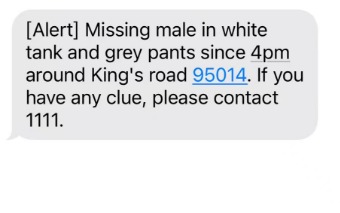
Anyone subscribing the number can see the emergencies happening in their postcode.
-
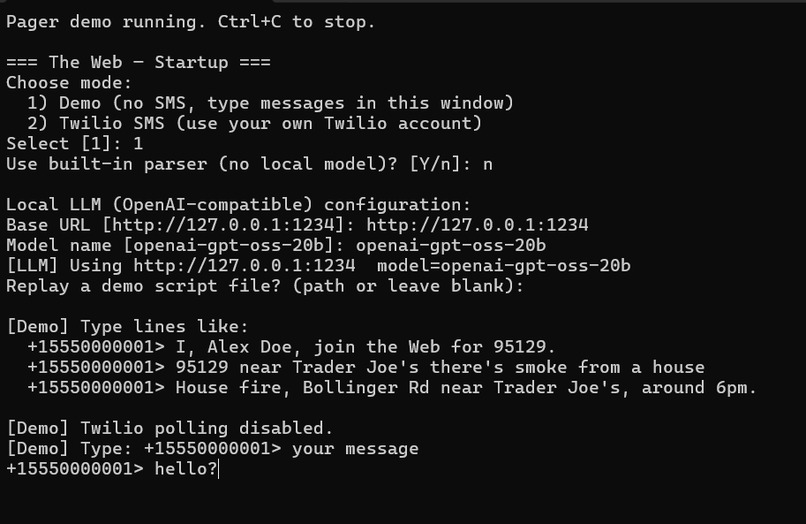
A demo mode enabled on the console. You don't need a Twillo A2P number to simulate it!


Inspiration
Emergencies outrun official alerts. When there’s a fire, a gas leak, a crash, or someone missing, neighbors need a way to tell each other now—without apps, logins, or Wi-Fi. The Web is a “neighborhood pager”: one phone number + SMS + a small local LLM that turns raw texts into instant, hyper-local alerts.
What it does
- Anyone joins by texting a short oath; then they can report incidents by SMS.
- A local language model classifies each message (spam vs. real), asks only for missing pieces (what/where/when), and when complete, composes a concise public alert.
- The alert is broadcast by postcode to nearby subscribers. Every alert includes a safety note and stays under SMS limits.
- Works fully offline in demo mode; can use Twilio (A2P 10DLC needed for unrestricted sending) or a USB GSM modem for real SMS.
How I built it
- Stack: .NET 8 console app + SQLite.
- Onboarding: strict SMS “oath” parser so join is human-simple yet machine-reliable.
- LLM brain: OpenAI-compatible local endpoint (e.g., LM Studio). I send only the last few messages from the same reporter (within 30 minutes), extract hints (postcode/time/location), and ask the model for one minified JSON decision.
- Broadcast: when complete, I format a short alert and SMS it to subscribers in the target postcode, excluding the reporter.
- Safety/ops: 30-minute cooldown per reporter, inbound de-dupe, and a demo replay script for predictable demos.
Challenges I ran into
- SMS realities: needing A2P 10DLC registration (otherwise “verified numbers only”) made true end-to-end testing tricky.
- LLM reliability: getting strictly valid JSON under token limits; preventing the model from giving unsafe advice; keeping follow-ups ultra-short.
- Partial info: robustly extracting postcode/time/location from messy texts and threads, not just the last message.
- Race/dup: avoiding double processing when polling inboxes; enforcing a per-reporter cooldown so alerts don’t spam.
Accomplishments that I’m proud of
- A working, end-to-end SMS → LLM → geofenced broadcast pipeline that runs locally.
- A clean demo mode so anyone can try it without a provider or hardware.
- Human-friendly UX in pure SMS: a one-line oath to join, one-line follow-ups for missing info, and clear, short public alerts.
What I learned
- For crisis tools, SMS first wins: zero friction beats any fancy app.
- LLMs behave best with strict schemas + guardrails (seed JSON, extract only the first balanced object, post-validate).
- Design for failure paths (timeouts, 400/429s, A2P constraints) from day one—your demo will thank you.
What’s next for The Web
- Go fully offline: USB GSM/LTE modem + SIM (no cloud dependency).
- Stronger signal: incident clustering + simple “2-reporter” corroboration gates; lightweight YAML playbooks for severity.
- Ops panel: minimal web UI to review/override alerts, see heatmaps, and adjust templates.
- A2P 10DLC & onboarding: register properly, add multilingual flows, and polish the safety copy.
- Open source packaging: one-command setup, sample replay scripts, and a tiny local model preset so anybody can run a neighborhood pager.

Log in or sign up for Devpost to join the conversation.