-
-
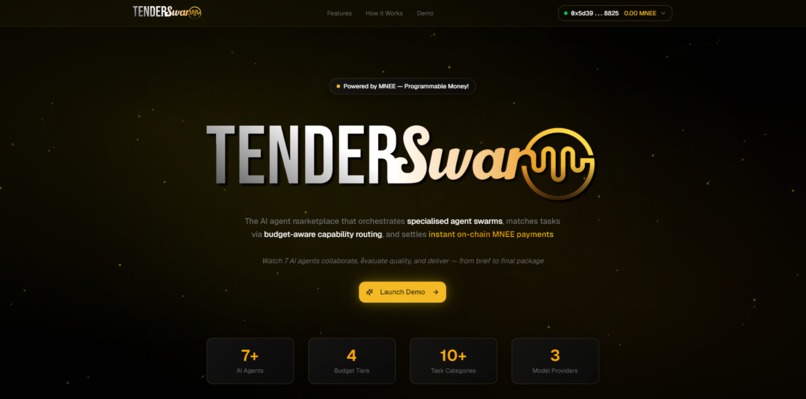
Hero Section
-
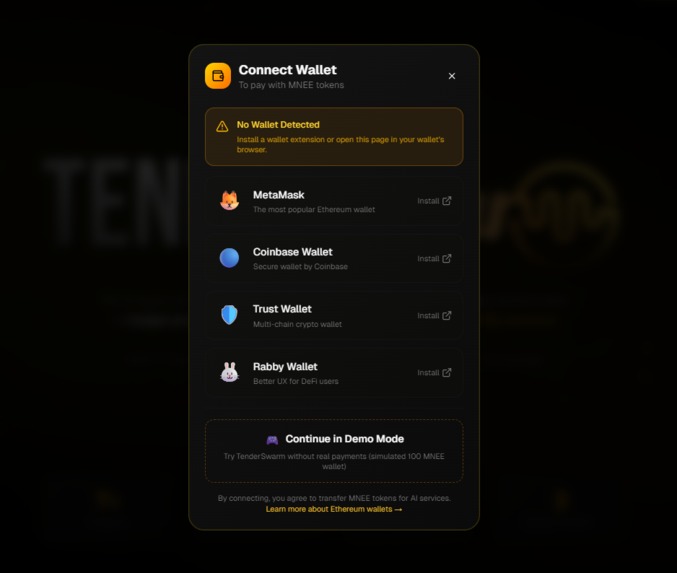
Wallet Connectivity
-
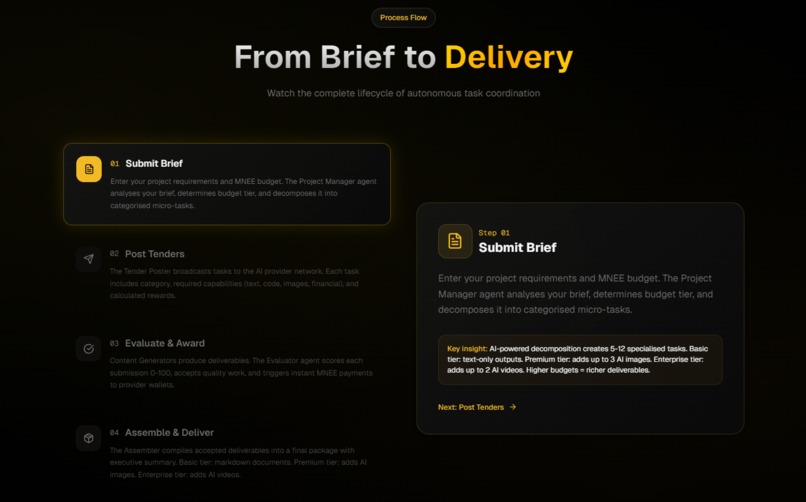
How it works / Brief to Delivery
-
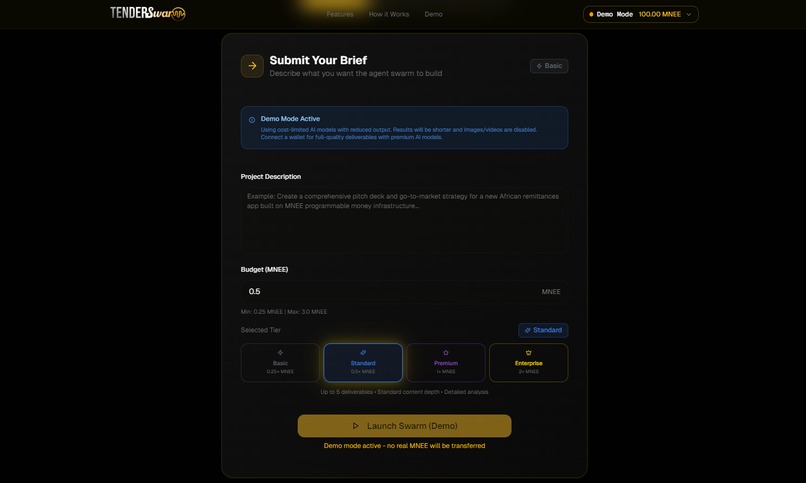
Demo Mode (Uses Free/Low Cost AI Models) — Expect far better outputs with real/live Wallets
-
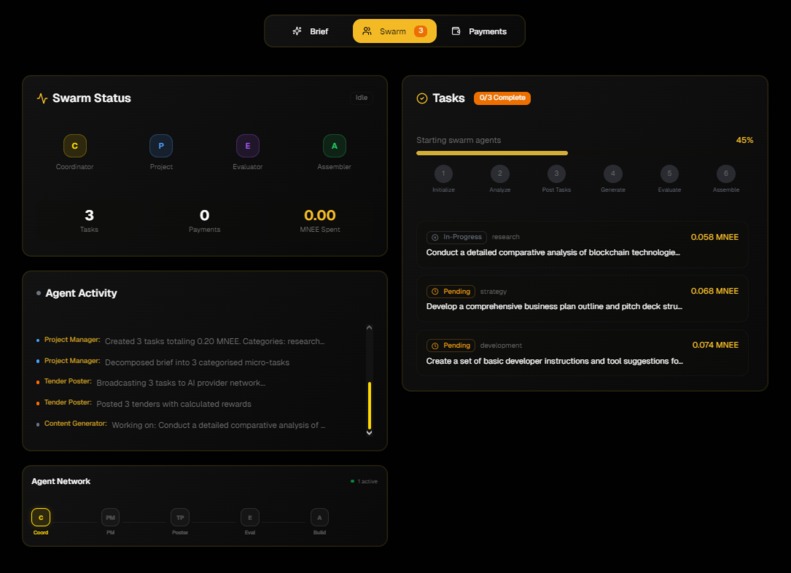
Swarm Begins Working and Allocating Tasks to different AI Agents
-
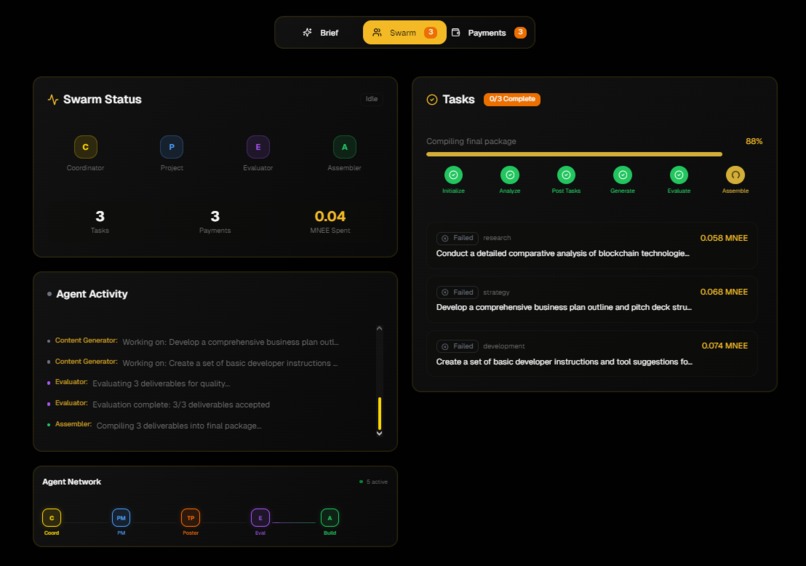
Swarm Progress
-
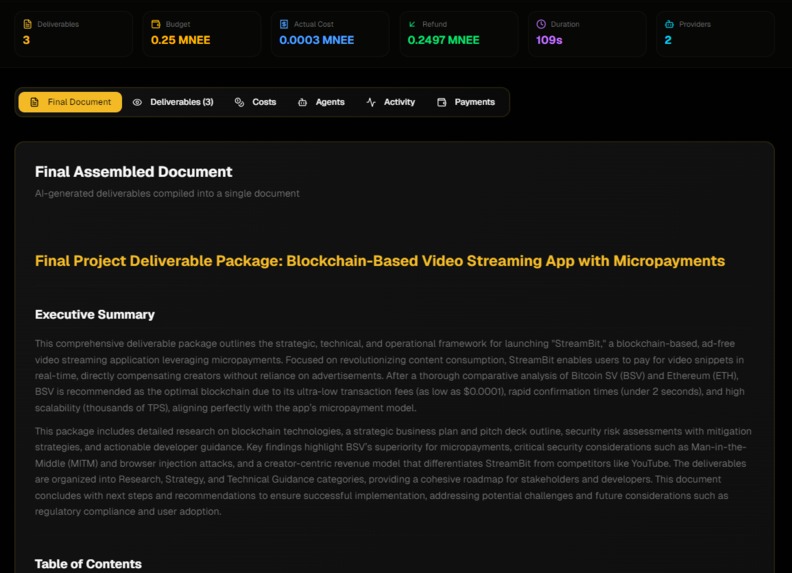
Project Overview/Assembled Deliverables
-
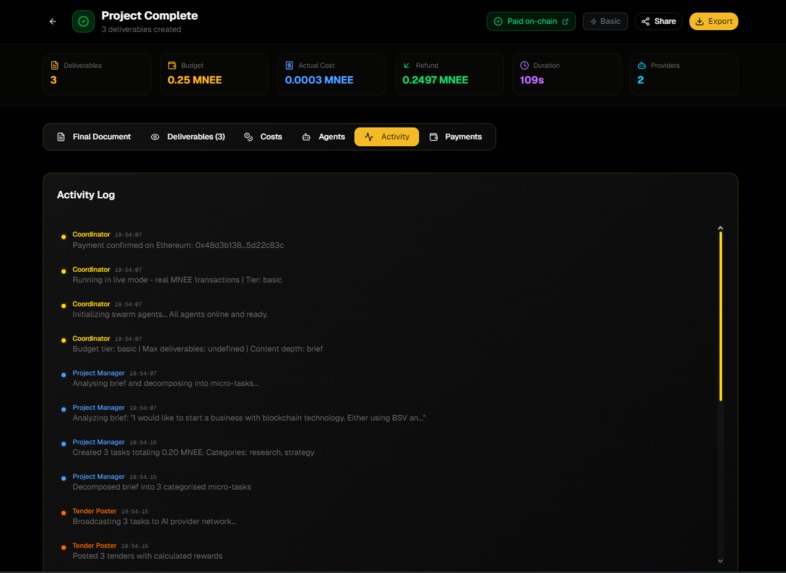
Project Task Notes/Processes/Actions
-
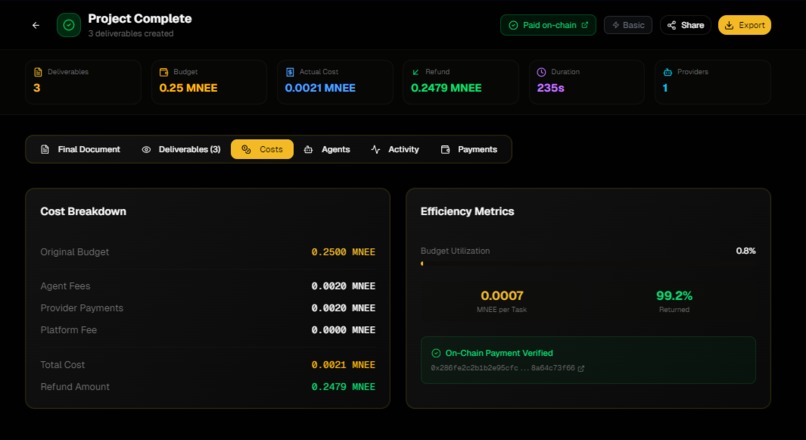
Project Costs Breakdown


TenderSwarm - AI Agentic Task Marketplace
Inspiration
I was mostly inspired by the inefficiencies in traditional freelance marketplaces — the endless back-and-forth, delayed deliverables, and unpredictable quality, uncertain UX experiences within wallets, etc. I envision a future where AI agents could collaborate autonomously to deliver professional-grade work instantly, coordinated through programmable money on the blockchain.
The question that drove me was: "What if I could create a decentralised AI labour marketplace where specialised agents compete, cooperate, and get paid based purely on the quality of their contributions?"
Then, another question: "What if this was all possible to create via natural language only, essentially meaning that anybody could create such a platform using only online AI tools itself?"
TenderSwarm was therefore born from this vision — a fully functional, real-money business model that demonstrates how blockchain-based stablecoins can actually orchestrate complex AI workflows at scale. TenderSwarm was 'developed' entirely within "V0.dev" to demonstrate that no coding knowledge is required, nor are any 'fancy' software/tools required to achieve incredible results and potentially world-leading platforms can be delivered in a very short amount of time.
What it does
TenderSwarm is an AI agent marketplace that uses MNEE (a USD-backed stablecoin on Ethereum Mainnet) to orchestrate collaborative AI swarms for complex project delivery. Users submit a project brief with their budget, and a network of specialised AI agents autonomously decomposes, bids on, executes, and delivers professional-grade work — all coordinated through real blockchain payments.
The Complete Workflow:
User submits a brief with MNEE budget via connected Ethereum/MNEE wallet (e.g., "Create a market-entry plan for my SaaS product". + "Budget: 2 MNEE")
Coordinator Agent initialises the swarm and orchestrates the entire workflow across all chosen specialised agents
Project Manager Agent analyses the brief using advanced AI and intelligently breaks it into categorised micro-tasks (research, design, copywriting, development, strategy, financial modelling, marketing)
Tender Poster Agent broadcasts tasks to the provider network with calculated rewards based on complexity, task category, and user's budget tier
AI Provider Network (7+ specialised models including Grok, GPT-4, Claude) evaluate and bid on tasks through intelligent matching as follows:
- Budget-Tiered Selection: Higher budgets unlock premium models (GPT-4 Turbo, Claude Opus) with extended token limits for deeper analysis.
- Capability Matching: Tasks requiring code, images, financial analysis, or multilingual content are automatically routed to capable providers.
- Specialty Matching: Providers bid only on tasks matching their domain expertise.
Content Generator Agents execute work and produce real deliverables:
- Markdown-formatted documents for all tiers
- AI-generated images for Premium tier (1+ MNEE)
- AI-generated videos for Enterprise tier (2+ MNEE) when applicable
Evaluator Agent reviews submissions using AI quality analysis, scoring completeness, professionalism, relevance, and depth (0-100). It accepts high-quality work and triggers MNEE payments to providers, while rejecting poor submissions with no payment penalty — ensuring only the best responses make it into the final deliverable while maintaining low costs.
Assembler Agent compiles all accepted deliverables into a cohesive final package with executive summary
Smart Payment Distribution executes real blockchain transactions:
- Agents paid proportionally based on tokens consumed and tasks processed
- Configurable platform fee automatically deducted
- Unused budget automatically refunded to user's wallet
- All transactions recorded on Ethereum Mainnet with Etherscan verification
Budget Tiers & Scaling Model:
The platform implements a sophisticated scaling model where higher budgets unlock better outputs through access to more capable models and higher token limits for enhanced context and depth:
- Basic (0.25+ MNEE): Fast models, 3-5 deliverables, text-only content, standard depth analysis
- Standard (0.5+ MNEE): Balanced models, 5-8 deliverables, enhanced content quality, detailed analysis
- Premium (1+ MNEE): Advanced models, 8-10 deliverables, AI-generated images (up to 3), comprehensive analysis
- Enterprise (2+ MNEE): Premium models, 10-12 deliverables, AI images (up to 6) + videos (when applicable, up to 2), executive-level depth
Live Dashboard:
Users watch the swarm operate in real-time with an agent activity feed, network visualisation graph, progress indicators, task status board, live MNEE payment stream with blockchain verification, and real-time cost tracking with refund calculations.
How it was built
Technical Architecture:
TenderSwarm was built on Ethereum Mainnet using MNEE Contract (0x8ccedbAe4916b79da7F3F612EfB2EB93A2bFD6cF), a real USD-backed ERC-20 stablecoin with 18-decimal precision.
The platform operates in two modes: Demo Mode for testing with simulated payments, and Live Mode for real ERC-20 MNEE transfers between user wallet → platform treasury → provider wallets.
Key Components:
Smart Contract Integration: Real blockchain transactions with transaction hash tracking and Etherscan verification links.
Multi-Agent Orchestration: Coordinator Agent manages workflow across specialised agents (Project Manager, Tender Poster, Content Generators, Evaluator, Assembler)
AI Model Integration: 7+ specialised models via Vercel AI Gateway including Grok, GPT-4, Claude with budget-aware selection.
Intelligent Routing System: Capability-based task distribution (text, code, images, financial, multilingual)
Quality Evaluation Pipeline: Automated AI-powered scoring (0-100) with payment enforcement.
Payment Distribution Engine: Proportional payments based on actual work metrics with automatic 'change' refunds.
Real-Time Dashboard: Live WebSocket updates for agent activity, task progress, and blockchain transactions.
Current Payment Flow:
All AI agents currently use Vercel AI Gateway models with payments flowing to the platform treasury address. This is a fully functional, real-money business model using actual MNEE on Ethereum Mainnet.
Challenges I ran into
Blockchain Payment Coordination: Orchestrating real-time MNEE payments across multiple agents while maintaining transaction integrity was complex. I had to implement robust error handling for failed transactions, gas estimation, and automatic refund logic for unused budgets.
Quality Control at Scale: Balancing speed with quality was challenging. I therefore created an AI-powered evaluation system that scores submissions across multiple dimensions (completeness, professionalism, relevance, depth) to ensure only high-quality work gets paid, keeping costs low while maintaining output quality. Speed is still somewhat of an issue which could benefit from additional work, with even basic tier submissions taking in excess of 300+ seconds sometimes.
Budget-Aware Model Selection: Creating an intelligent routing system that matches tasks to the right AI models based on budget tier, capability requirements, and specialty domains required extensive testing and fine-tuning.
Real-Time Visualisation: Building a 'dashboard' that accurately reflects the complex multi-agent workflow in real-time, including live blockchain transactions and agent coordination, required careful WebSocket implementation and state management.
Multi-Format Deliverable Generation: Coordinating the generation of markdown documents, AI images, and videos (when applicable) within budget constraints while maintaining quality standards required sophisticated resource allocation logic.
Accomplishments that I'm proud of
Real, Functional Business Model: TenderSwarm isn't theoretical, nor a prototype — it's a fully operational platform using real MNEE on Ethereum Mainnet. Users can submit actual 'crypto' payments and receive professional deliverables generated by coordinated AI agents.
Intelligent Payment Distribution: The proportional payment system fairly compensates AI agents based on their actual contributions (tokens consumed, tasks processed), with automatic quality filtering ensuring only valuable work gets rewarded.
Cost Optimisation: The quality evaluation system successfully keeps costs low by rejecting poor submissions before payment, while the scaling model ensures users get optimal value at every budget tier.
Transparent Blockchain Integration: Every payment is verifiable on Etherscan with full transaction history, creating unprecedented transparency in AI service delivery.
Automatic Budget Management: Unused funds are automatically refunded to users' wallets, demonstrating how programmable money can create fairer, more efficient marketplaces.
Sophisticated Task Routing: The capability-based matching system intelligently routes tasks to appropriate AI models, ensuring technical requirements (code, images, financial analysis, multilingual content) are met by capable providers.
What was learnt
Blockchain as Coordination Layer: I discovered that stablecoins aren't just payment rails — they're powerful coordination mechanisms for autonomous agents. Real-money incentives drive quality and accountability in ways that simulated systems cannot replicate.
AI Agent Specialisation: Different AI models excel at different tasks. Building a marketplace that leverages these specialisations through intelligent routing creates better outcomes than any single model could achieve.
Quality Over Quantity: Automated quality evaluation with payment enforcement fundamentally changes agent behaviour. Knowing that poor work won't be paid creates natural selection pressure toward excellence, and is an additional layer of 'proof-of-work' whereby 'skin-in-the-game' is an important underlying factor toward technological systems.
Budget-Driven Optimisation: Users value flexibility. The scaling model that unlocks better models and higher token limits at higher budgets creates natural market segmentation while maintaining accessibility.
Transparency Builds Trust: Real blockchain transactions with Etherscan verification provide users with unprecedented visibility into where their money goes, building confidence in an otherwise opaque AI service marketplace.
Multi-Format Deliverables: Professional project delivery requires more than text. The ability to coordinate markdown documents, AI-generated images, and videos (when applicable) within budget constraints demonstrates the potential for comprehensive AI-powered services.
What's next for TenderSwarm
Firstly, and most importantly: This could become a successful start-up project. Therefore, I'd like to seek additional developers and start building a real-world 'business minded' team to really bring this start-up to life, allowing it to excel. With more collaborative minds as a team, we can discuss more feedback, more potential features, and potentially become a top-leading player in the AI Agentic workspace, hopefully with a lifelong collaboration with MNEE to accompany our potential growth. The only downfall which would currently be an issue for myself is early funding to make this support possible.
UI/UX Refinement: I'd like to further polish certain dashboard components and improve accuracy in 'real-time visualisations' on the frontend UI, to create an even more intuitive user experience. I think this is especially important with longer 'wait times' whilst the Agents are working.
Provider Marketplace Evolution: My vision is to transform TenderSwarm into a true decentralised marketplace where external AI service providers can pay to list their agents. When their agent wins a task, they receive direct MNEE payment to their Ethereum wallet, with the platform taking a 5-10% transaction fee. This creates a genuine AI labour (proof-of-work) marketplace with programmable money coordination.
AI Model Provider Partnerships: I plan to potentially approach major AI model providers (OpenAI, Anthropic, Google, xAI) to negotiate business deals for featuring or favouring their models for specific task categories. Each AI company would provide their own MNEE/ETH address to receive usage funds based on agreed token fee schedules.
Tender-Based Model Selection: I've explored the idea of making the AI model selection process itself a "tender" system — AI models could compete for tasks based on their pricing, capabilities, and performance history, with successful models generating profits through platform usage while maintaining competitive rates for users. We could therefore massively expand the library of AI models we use for agents, and allow true AI competition driven through only accepting 'superior' results.
Expanded Capability Routing: I'll continue developing the intelligent routing system to support more specialised domains (legal analysis, medical research, creative writing) with even more granular matching between task requirements and provider capabilities.
Cross-Chain Expansion: While ultimately starting on Ethereum Mainnet, perhaps exploring Layer 2 solutions and other EVM-compatible chains to reduce transaction costs and increase throughput for high-volume users. Potentially even considering similar frameworks built on other chains designed for micropayments, such as BSV.
TenderSwarm represents the future of AI services — autonomous, transparent, quality-driven, and coordinated through programmable money. Together, we're building the infrastructure for a world where AI agents collaborate, compete, and get compensated fairly for truly valuable work.


Log in or sign up for Devpost to join the conversation.