-
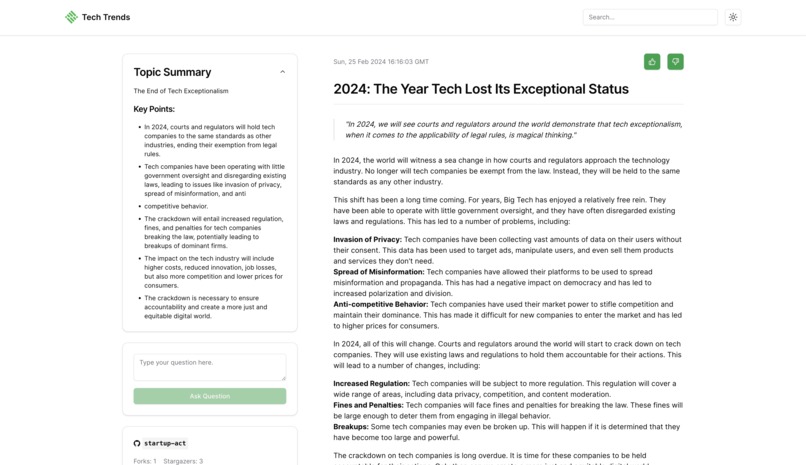
Light Mode
-

Dark Mode
-
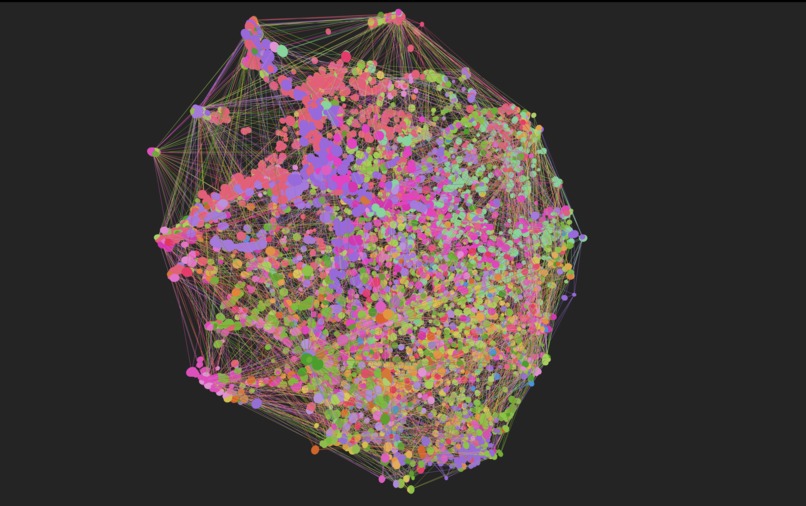
Scraped Article Visualization


Inspiration
Tech Trends was inspired by the challenge of navigating the vast sea of tech news and articles available online. We recognized the need for a more personalized and engaging way to discover tech content that aligns with individual interests, without the overwhelming choice or the risk of missing out on relevant information. By merging the intuitiveness of like-dislikes with the power of AI-driven personalization, we set out to create a platform that makes tech news discovery as easy and enjoyable as possible.
What it does
Tech Trends allows users to effortlessly discover and engage with tech news articles that match their interests. Through a simple thumbs-up (like) and thumbs-down (dislike) system, our platform learns the user's preferences over time, curating a feed of tech articles from leading sources. This approach ensures that users are exposed to content that is not only relevant but also aligned with their evolving interests.
How we built it
We built Tech Trends with a robust Python backend, leveraging ChromeDB for efficient data management and Pinecone as a vector database to support our AI-driven personalization engine. To enhance our content discovery and recommendation capabilities, we fine-tuned leading Language Learning Models (LLMs) like Google Gemini and OpenAI's GPT-4, each chosen for their unique strengths. Google Gemini, known for its Mixture of Experts (MoE) architecture, excels at content generation, while OpenAI's GPT-4, with its Chain-of-Thought architecture, is adept at semantic search and understanding user preferences. We sourced approximately 8,000 articles from top tech news outlets and generated around 400 high-quality articles to start, demonstrating our system's capability to produce engaging content clusters based on user feedback.
Challenges we ran into
One of the main challenges was integrating different AI models effectively and consistently while ensuring that the system remains efficient and responsive. Balancing the generation of high-quality content with real-time user interaction and feedback processing required careful optimization. Additionally, accurately interpreting user preferences from binary feedback to personalize content recommendations presented a complex problem that demanded continuous refinement of our algorithms.
Accomplishments that we're proud of
We are particularly proud of creating a seamless, user-friendly platform that intelligently adapts to individual preferences, making tech news discovery more personalized than ever before. The successful integration of advanced AI models for content generation and recommendation, demonstrating our technical capability to leverage the latest advancements in AI for enhancing user experience, is another significant achievement. Our platform's ability to learn and evolve with the user's interests represents a major step forward in personalized content discovery
What we learned
Throughout the development of Tech Trends, we learned the importance of user-centric design in AI-powered applications. We gained valuable insights into the complexities of machine learning model integration and the nuances of user interaction with AI-driven systems. This project also deepened our understanding of vector databases and RAG networks.
What's next for Tech Trends
Looking ahead, we plan to expand Tech Trends by building a more robust user platform that can store and utilize individual preferences to offer even more tailored content recommendations. We aim to incorporate additional sources and types of tech content, and explore ways to further refine our AI algorithms for better accuracy and user satisfaction. As we grow, our goal is to become the go-to platform for anyone looking to stay informed and inspired by the ever-evolving world of technology.

Log in or sign up for Devpost to join the conversation.