-
-
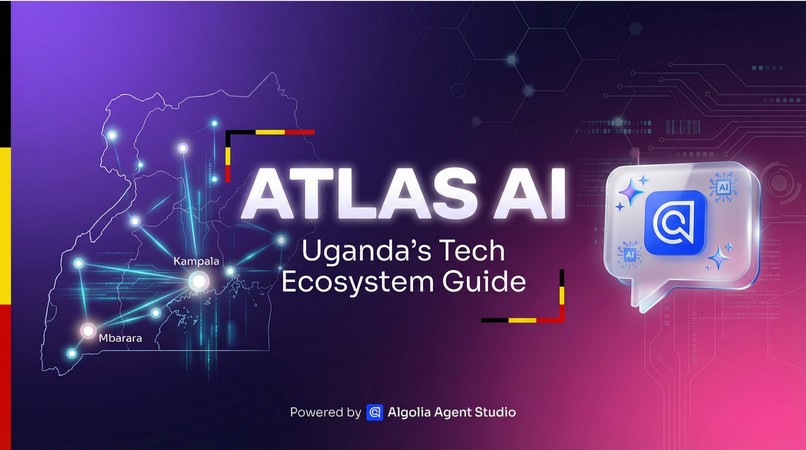
Image-Gen
-
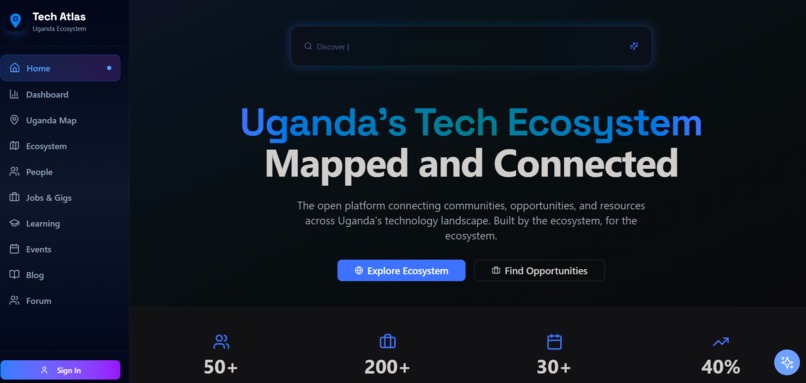
Home
-
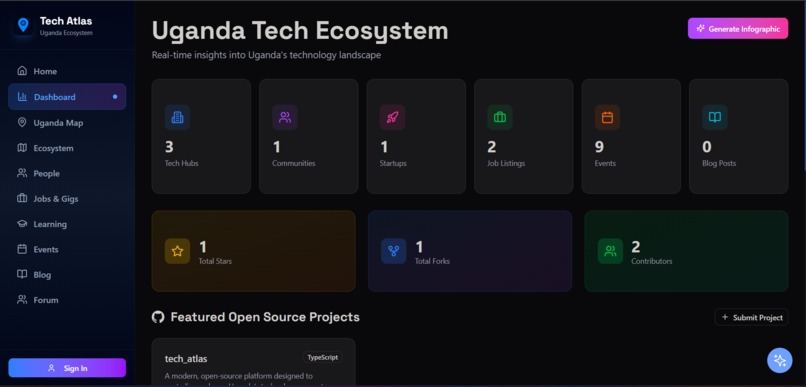
The Dashboard
-
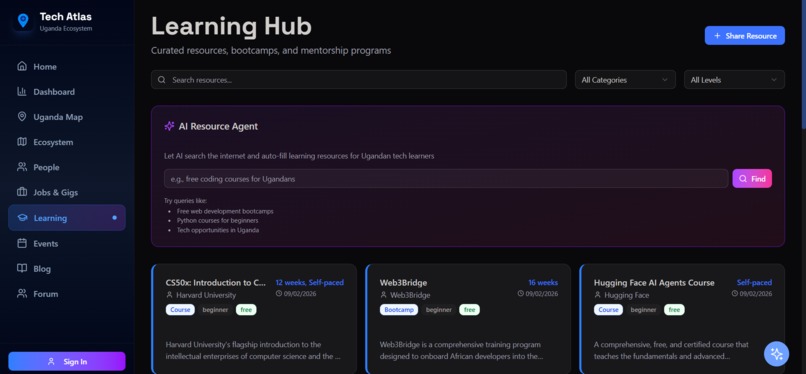
Learning
-
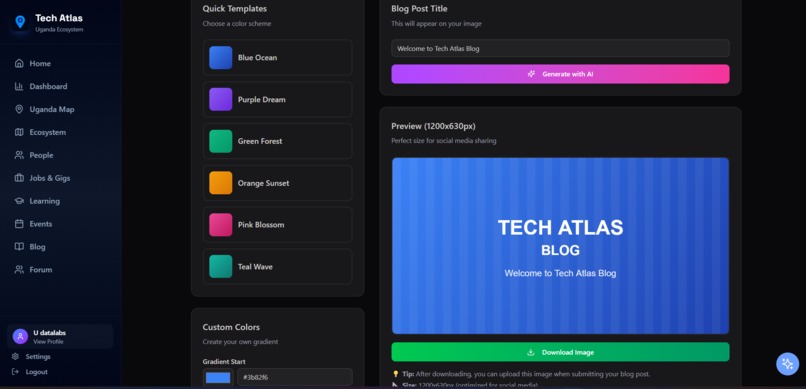
Blog ImageGen
-
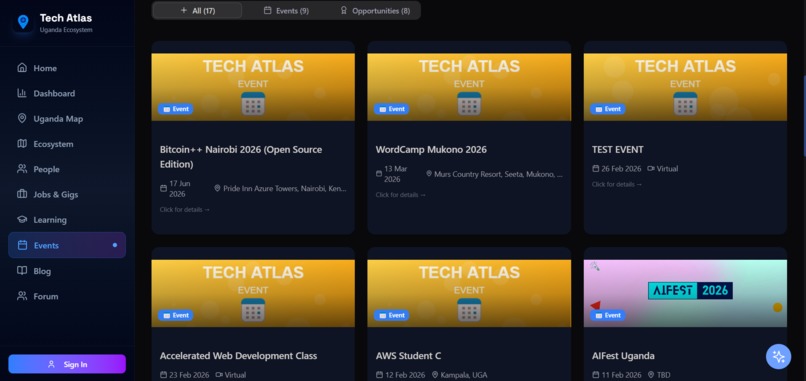
Events
-
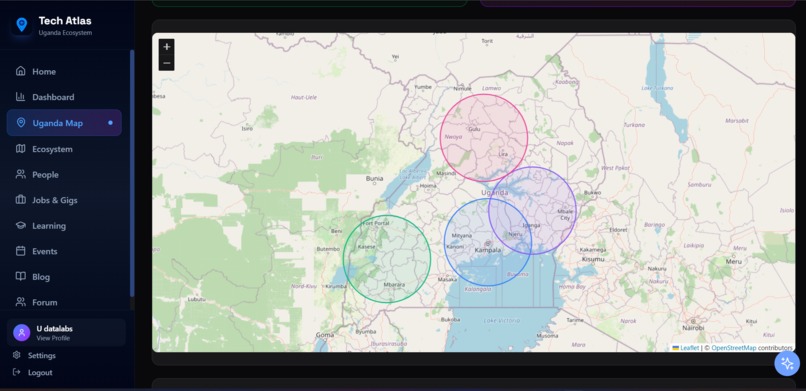
Maps


Introducing Tech Atlas Uganda: Mapping the Future of Uganda's Tech Ecosystem
Connecting Innovation, One Node at a Time 🇺🇬
The Problem We're Solving
Imagine you're a talented developer in Kampala, eager to find your next opportunity. You scroll through countless WhatsApp groups, check multiple Facebook pages, ask friends, and still miss out on that perfect job posting. Or you're a startup founder looking for the right tech hub to join, but information is scattered across dozens of websites and personal networks.
This is the reality for thousands of people in Uganda's tech ecosystem today.
Information fragmentation is holding back one of Africa's most vibrant tech communities. Data about hubs, communities, startups, jobs, learning resources, events, and opportunities exists, but it's scattered, incomplete, and often inaccessible to those who need it most.
That's why we built Tech Atlas Uganda.
👉🏾 You don't want to read 😊: Watch full story instead: https://www.youtube.com/watch?v=gB0VFNICwaA
What is Tech Atlas?
Tech Atlas is an open-source, community-owned platform that serves as digital infrastructure for Uganda's technology ecosystem. Think of it as the definitive map of Uganda's tech landscape—a single place where you can:
- 🗺️ Discover tech hubs, communities, and startups across Uganda
- 💼 Find jobs, internships, and freelance opportunities
- 📚 Learn with curated resources and career roadmaps
- 📅 Attend tech events, meetups, and hackathons
- 🏆 Apply for grants, fellowships, and scholarships
- 💬 Connect with other tech professionals in our forum
- 👥 Showcase your skills in our talent directory
- ✍️ Share your story through our community blog
But here's what makes Tech Atlas different: it's not a commercial product. It's community-owned infrastructure, treating ecosystem data as a public good that benefits everyone.
Inspiration
The inspiration for Tech Atlas came from a simple observation: Uganda's tech ecosystem is thriving, but it's invisible to itself.
We have:
- 50+ innovation hubs and co-working spaces
- 100+ active tech communities
- 300+ tech startups
- Thousands of talented developers, designers, and entrepreneurs
- Countless events, opportunities, and resources
Yet, discovering any of this requires insider knowledge, personal connections, or hours of searching through fragmented sources.
We asked ourselves: What if there was a single, authoritative source for all ecosystem information? What if newcomers could instantly see the entire landscape? What if opportunities reached everyone, not just those in the right WhatsApp groups?
That question became Tech Atlas.
What It Does
Tech Atlas consolidates Uganda's tech ecosystem into one comprehensive platform:
🗺️ Ecosystem Mapping
Interactive directory of tech hubs, communities, and startups with Google Maps integration. Color-coded markers, detailed profiles, and location-based discovery make it easy to explore Uganda's tech landscape.
💼 Jobs & Gigs Marketplace
Comprehensive listings for full-time jobs, internships, freelance gigs, and paid tech help. Advanced filtering by type, location, remote status, skills, and experience level. Plus, our AI Jobs Agent automatically discovers and posts relevant opportunities.
📚 Learning Hub
Curated educational resources spanning beginner to advanced levels. Career roadmaps for Web Development, Mobile, AI/ML, Data Science, Cybersecurity, and more. Our AI Resource Agent continuously finds new learning opportunities for Ugandan learners.
📅 Events & Opportunities
Centralized calendar of tech events (meetups, hackathons, workshops, conferences) and funding opportunities (grants, fellowships, scholarships, competitions). The AI Events & Opportunities Agent keeps the platform updated with the latest happenings.
✍️ Community Blog
Platform for sharing startup stories, career guidance, policy insights, and event recaps. Markdown support, cover images, and community-driven content.
💬 Discussion Forum
Threaded discussions with categories, voting, and moderation. Anonymous posting option for sensitive topics. A space for the community to help each other.
👥 Talent Directory
Public profiles where tech professionals can showcase their skills, expertise, and social links. Get discovered by employers and connect with peers.
🤖 AI-Powered Discovery
Four intelligent agents powered by Google's Gemini 3 Flash with Google Search grounding:
- AI Resource Agent: Finds learning resources
- AI Events & Opportunities Agent: Discovers events and funding
- AI Jobs Agent: Searches for tech jobs
- AI Infographic Generator: Creates visual content
👉🏾 Plus one more blog Image Generator Live here: https://techatlasug.com/tools/image-generator
How We Built It
Tech Atlas is built with modern, production-ready technologies:
Frontend Stack
- React 19 with TypeScript for type-safe UI development
- Vite for lightning-fast builds and hot module replacement
- Tailwind CSS 4 for beautiful, responsive styling
- shadcn/ui for accessible, customizable components
- Framer Motion for smooth animations
- Wouter for lightweight client-side routing
- TanStack Query for efficient data fetching and caching
Backend Stack
- Node.js 22 with Express for the web server
- tRPC 11 for end-to-end type-safe APIs
- Drizzle ORM for type-safe database queries
- PostgreSQL for reliable data storage
- Supabase for authentication and file storage
- Zod for runtime validation
AI & Search
- Google Gemini 3 Flash with Google Search grounding for intelligent agents
- *Google Gemini 2.5 * for AI powered location search
- Algolia for fast, relevant search (planned)
Infrastructure
- Railway for hosting and deployment
- Supabase Storage for avatars and images
- Google Maps API for location mapping
- pnpm for efficient package management
Architecture Highlights
- Full-stack type safety: Shared types between frontend and backend via tRPC
- Database-first design: Schema defined in Drizzle ORM with automatic migrations
- Component-based UI: Reusable, composable React components
- Role-based access control: 5-tier permission system (Guest, User, Editor, Moderator, Admin)
Challenges We Ran Into
Building Tech Atlas wasn't without its hurdles:
1. Data Fragmentation
The very problem we're solving was our biggest challenge. Gathering initial ecosystem data required extensive research, outreach, and verification. We're still working on comprehensive coverage.
2. AI Agent Reliability
Getting AI agents to consistently return structured, accurate data required extensive prompt engineering and error handling. We iterated through multiple approaches before finding the right balance of specificity and flexibility.
3. Duplicate Prevention
With AI agents automatically discovering content, preventing duplicates became critical. We implemented multi-layered checks: database queries, in-memory history, and title/URL comparison.
4. Deployment Configuration
Railway deployment with pnpm and patched dependencies (wouter patch) required careful configuration. We eventually simplified to direct build commands rather than complex nixpacks configurations.
5. Type Safety Across Stack
Maintaining type safety from database to frontend required careful setup of Drizzle ORM, tRPC, and Zod schemas. The payoff is worth it—compile-time errors catch bugs before they reach production.
6. Content Moderation at Scale
Designing a moderation system that's both effective and community-friendly required balancing automation with human oversight. We implemented a multi-tier role system with clear guidelines.
7. Performance Optimization
With rich content (maps, images, AI features), keeping the platform fast required code splitting, lazy loading, image optimization, and efficient database indexing.
Accomplishments That We're Proud Of
🎉 Comprehensive Platform in Record Time
We built a full-featured platform with 7 major sections, 4 AI agents, and complete admin infrastructure in just 2 weeks +.
🤖 AI-Powered Content Discovery
Our 4 AI agents automatically discover and populate content from the internet, reducing manual effort and keeping the platform fresh. They use Google Search grounding for accurate, up-to-date information.
🔒 Production-Ready Architecture
Full type safety, role-based access control, content moderation, and secure authentication. This isn't a prototype—it's ready for real users.
🌍 Community-First Governance
We established a transparent governance model from day one. Tech Atlas is community-owned infrastructure, not a commercial product.
📊 Rich Feature Set
From ecosystem mapping to job marketplace, learning hub to discussion forum—Tech Atlas covers the entire spectrum of ecosystem needs.
🎨 Beautiful, Accessible UI
Modern design with dark mode, responsive layouts, smooth animations, and accessibility features. Built with shadcn/ui for consistency.
📈 Scalable Infrastructure
Deployed on Railway with PostgreSQL, Supabase, and efficient caching. Ready to handle thousands of users.
What We Learned
Technical Lessons
Type Safety is Worth It: The upfront investment in tRPC and Drizzle ORM pays massive dividends in developer experience and bug prevention.
AI Needs Structure: Free-form AI responses are unreliable. Structured output with JSON schemas and validation is essential for production use.
Simplicity Wins: Our deployment issues were solved by simplifying configuration, not adding complexity. Sometimes the straightforward approach is best.
Database Design Matters: A well-designed schema with proper indexes and relationships makes everything else easier.
Component Libraries Save Time: shadcn/ui provided a solid foundation, letting us focus on features rather than reinventing UI components.
Community Lessons
Governance from Day One: Establishing clear governance principles early builds trust and sets expectations.
Open Source Attracts Talent: Making Tech Atlas open source has already attracted interest from contributors who want to help.
Documentation is Critical: Comprehensive documentation (like our 500+ line guide) helps onboard contributors and users.
Community Needs Are Diverse: Different users need different things. A platform must serve job seekers, employers, learners, organizers, and more.
Data Quality Matters: Accurate, verified information is more valuable than large quantities of unverified data.
Product Lessons
Start with Core Value: We focused on solving the fragmentation problem first, then added enhancements.
AI Augments, Doesn't Replace: AI agents help discover content, but human curation and moderation remain essential.
Mobile Matters: Many Ugandans access the internet primarily via mobile. Responsive design is non-negotiable.
Local Context is Key: Features like "Uganda-relevant" filtering in AI agents make the platform more useful for our target audience.
What's Next for Tech Atlas
We're just getting started! Here's our roadmap:
Phase 2: Enhancement (Q1-Q2 2026)
- 📱 Mobile Applications: Native iOS and Android apps for better mobile experience
- 🔍 Advanced Search: Algolia integration for lightning-fast, relevant search
- 📧 Email Notifications: Stay updated on new jobs, events, and opportunities
- 📰 Newsletter System: Weekly digest of ecosystem highlights
- 🤝 Mentorship Matching: Connect learners with experienced professionals
- 💰 Salary Insights: Transparent salary data for tech roles in Uganda
- 🔌 API Access: Third-party integrations for ecosystem tools
- 🌐 Multi-Language Support: Luganda and Swahili translations
Phase 3: Scale (Q3-Q4 2026)
- 🌍 Regional Expansion: Extend to Kenya, Tanzania, Rwanda (East Africa)
- 📊 Advanced Analytics: Ecosystem health metrics and trends
- 💼 Startup Funding Tracker: Track funding rounds and investor activity
- 📝 Job Application Tracking: Manage applications within the platform
- 📅 Calendar Integrations: Sync events with Google Calendar, Outlook
- 💳 Premium Features: Optional paid features for sustainability
- 🏷️ White-Label Solution: Let other ecosystems deploy their own Tech Atlas
- 🤖 ML Recommendations: Personalized job and resource recommendations
Phase 4: Ecosystem (2027+)
- 🌍 Pan-African Expansion: Connect tech ecosystems across Africa
- 📈 Ecosystem Health Metrics: Measure and track ecosystem growth
- 🎯 Impact Measurement: Quantify Tech Atlas's impact on the ecosystem
- 🤝 Partnership Marketplace: Connect startups with service providers
- 💰 Investor Network: Connect startups with investors
- 📜 Policy Advocacy Tools: Data-driven insights for policymakers
- 📊 Research and Reports: Annual state of the ecosystem reports
- 🏆 Ecosystem Benchmarking: Compare with other African tech hubs
Community Priorities
We're also listening to the community! Top requested features:
- Dark mode improvements
- Bookmark collections
- Advanced filtering options
- Export functionality
- Slack/Discord integrations
- RSS feeds
- Podcast directory
- Video content support
- Live streaming for events
Join Us
Tech Atlas is open source and community-owned. We need your help to make it the definitive platform for Uganda's tech ecosystem.
How You Can Contribute
- Use the Platform: Browse, submit content, engage with the community
- Spread the Word: Tell your network about Tech Atlas
- Contribute Code: Fix bugs, add features, improve performance
- Create Content: Write blog posts, add resources, share opportunities
- Provide Feedback: Tell us what's working and what needs improvement
- Become a Moderator: Help maintain content quality
- Translate: Help us reach more Ugandans with local language support
- Update Data: Keep ecosystem information accurate and current
Get Involved
- 🌐 Website: techatlasug.com
- 💻 GitHub: Tech Atlas
- 📧 Email: ronlinx6@gmail.com
- 🐦 Twitter: @AfroBoy
- 💼 LinkedIn: Afro Boy
A Vision for the Future
Tech Atlas is more than a platform—it's a vision for how Uganda's tech ecosystem can grow together.
We envision a future where:
- Every talented individual can discover opportunities, regardless of their network
- Every startup can find the talent, resources, and funding they need
- Every community can connect and collaborate with others
- Every learner has access to quality educational resources
- Every organizer can reach their target audience
- The entire ecosystem benefits from transparent, accessible data
This vision requires all of us. Tech Atlas is community infrastructure—it belongs to Uganda's tech community, and it will only succeed if we build it together.
Thank You
To everyone who has supported Tech Atlas—contributors, early users, advisors, and believers in the vision—thank you. You're helping build something that will benefit Uganda's tech ecosystem for years to come.
Let's map the future together. 🗺️🇺🇬
Built With
- algolia
- gemini
- node.js
- postgresql
- railway
- supabase
- tailwind
- typescript
Log in or sign up for Devpost to join the conversation.