-
-
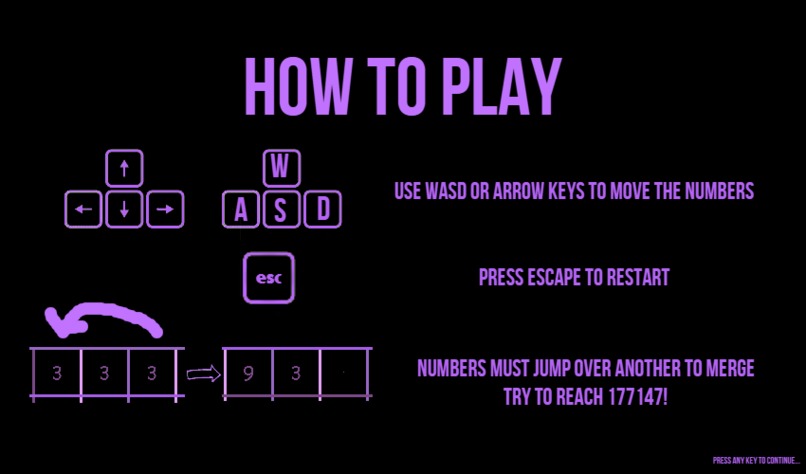
Instruction screen
-
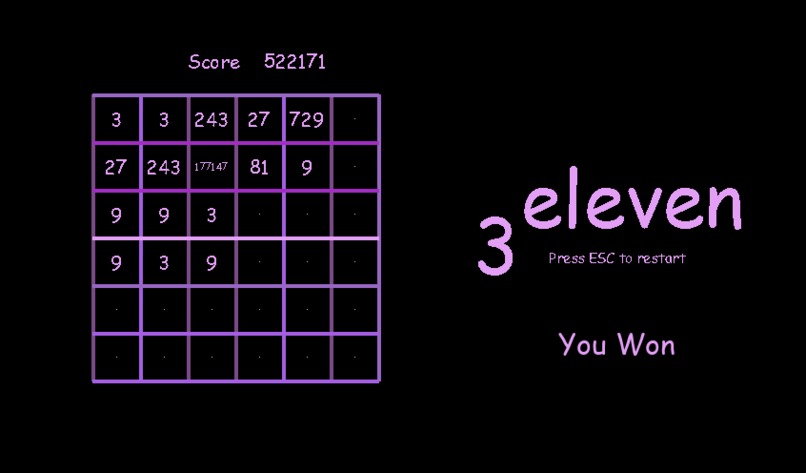
Winner winner, chicken dinner


Inspiration
The pandemic has resulted in a massive influx in the gaming community, but it's hard to find any game on par with the classic 2048. We wanted to make something more challenging and modern, but still with the same charm as the authentic version. There are already countless variations and versions of 2048, like 1024, Threes, and many more. But they're always too similar, and we thought a unique little twist would keep people entertained for just a little longer.
The reason as to why we're coming back to 2048 after all this time (as many still do) is because playing the game is beneficial to our mental health. According to neurologist Judy Willis, the game has two dopamine boosters: the opportunity to make predictions, and the sense of achievement. The brain loves to make predictions, even if they aren't always right—and with new blocks spawning after every move you make, the possibilities are endless. Furthermore, the game is challenging (and slightly dependent on luck), but just enough that it's entertaining and rewarding at the same time.
What it does
This upscaled version of the original tile-sliding game has a twist: two identical blocks can only merge if exactly one block separates them! Players use the arrow keys to slide numbered blocks around, with the goal of merging the blocks into 177147 (which is 3^11) or more. Try to get the highest score as well!
Merging specifics
The new value of the merged block is the next power of 3. The middle block remains where it is, and the merged block appears in the direction the player slid the blocks in.
For example, if a row of three consecutive blocks 3 9 3 were slid to the left, it would become 9 9 0 (the 0 is a placeholder), whereas if it were slid to the right, it would become 0 9 9 instead.
Score specifics
Your score goes up by the value of the new block(s) merged. For example, if you merged two 3's into a 9, your score would go up by 9. If you merged two 3's into a 9 and two 9's into a 27 in one move, your score would go up by 36: 3*3 + 9*3.
How we built it
This project was built by perseverance, skill, and a bit of luck. We started by learning the basics of Pygame, such as how to create a screen, and how to print text. After nailing the fundamentals, we started with coding the game itself, beginning with the graphics then the mechanics. We worked in a Visual Studio Code, which allowed for all of us to collaborate at the same time. We also made sure to take breaks to make sure we didn't burn out making such a big project in such a tight time frame.
Challenges we ran into
This was our first time working with Pygame, and even one of our group member's first time working with Python. Therefore we inevitably ran into basic challenges that a beginner would, such as forgetting to update the screen (and not realizing for way too long) and also not knowing how to center stuff. In the end, Google and our brains were able to pull through and help us overcome these challenges.
Pre-hack
None of us had sufficient experience in coding in Pygame, much less from scratch. There were some complications right before the hackathon started, which threw us into a small frenzy, before we realized that a calm and collected mindset was what we needed to push on and continue as planned. Moreover, one of our teammates was trying to run Python on Visual Studio Code on a macOS — that was a nightmare in itself.
During-hack
Implementing the game and all the intricate rules proved to be much more complicated than we had imagined. Numbers got too big, blocks would hit corners and go out of bounds, indexing was off — and this was just the tip of the iceberg. Nobody likes debugging, and we were frustrated way too many times to count.
Video-editing
TBD but pls no
Accomplishments that we're proud of
- Our team name
- The instruction screen looks nice
- The game actually works: we didn't expect our first game to go this smoothly
- The idea is quite unique
- The game name actually slaps
- The visuals are appealing
What we learned
It's easy to play a game and think of how simple it is; we definitely underestimated the complexities of designing video games. There are so many edge cases and scenarios that we would forget to account for, and fine tuning the graphics took all the patience we didn't have. All of us, without a doubt, have a newfound respect for all the talented people in charge of bringing video games to life.
What's next for 3leven
The game turned out surprisingly well for our first ever game. We're not too familiar with game development at this point, but we do plan on implementing different board sizes, and also animations to the sliding. If everything goes well, we may even try to release the game on a website somehow.


Log in or sign up for Devpost to join the conversation.