-
-
Mini
-
Dashboard
-
Mini Archtecture


Tableau Mini: Agentic Semantic Governance Layer
Executive Summary: The Data Supply Chain Crisis
In the "Agentic AI" era, the gap between data ambition and data reality has become the primary blocker to enterprise ROI.
According to the Salesforce State of Data and Analytics report (November 2025), while 76% of business leaders face mounting pressure to drive value with AI, the underlying data foundations are crumbling. The study explicitly highlights that 84% of technical leaders admit their data strategies require a "complete overhaul" before their AI ambitions can succeed.
Tableau Mini answers this specific market urgency. It is an agentic semantic middleware designed to bridge the gap between raw data chaos and the "Trusted, Unified Data" required for the Agentic Enterprise.
The Problem: "Trapped" Value and the Trust Deficit
The Salesforce study identifies a critical paradox: companies have more data than ever, but less confidence in using it.
- The High Cost of Bad Data: The "Garbage In, Garbage Out" risk is no longer theoretical. The report notes that 89% of leaders have already experienced misleading AI outputs, and 55% have wasted significant resources training models on flawed data.
- The "Trapped" Insight Dilemma: While only 19% of data is estimated to be siloed or inaccessible, leaders believe 70% of their most valuable insights reside within that specific trapped 19%.
- Semantic Dissonance: Without a semantic layer to provide business context, "syntactically correct" data leads to "semantically wrong" decisions.
The Solution: Tableau Mini serves as the "Overhaul" mechanism Salesforce leaders are calling for. It acts as a semantic firewall that audits, scores, and certifies data integrity before ingestion, ensuring that the "Agentic Enterprise" is built on a foundation of truth.
Core Product Capabilities
1. Agentic Data Ingestion & Ontology Mapping
Mini moves beyond simple regex matching. It utilizes an agentic AI workflow to ingest raw files and perform semantic column mapping. The system references the organization's centralized Data Dictionary to map ambiguous headers (e.g., "Q1_Rev") to standardized schemas (e.g., "Revenue_FY24_Q1") based on context and relevance.
2. Zero-Trust Data Quality Scoring
We implement a "Zero Trust" approach to data ingestion. Mini calculates a weighted quality score for every column and row. This allows Technical Leaders to pivot from "hoping" data is good to "knowing" it is ready for AI application.
3. Automated "Mini Certification" Pipeline
To reduce the operational overhead on Data Stewards, Mini automates the governance process. Datasets that pass the weighted scoring threshold are tagged as "Mini Certified" upon publication to Tableau Cloud, ensuring downstream analysts are consuming validated truth sources.
Technical Architecture & Performance (Hackathon Deep Dive)
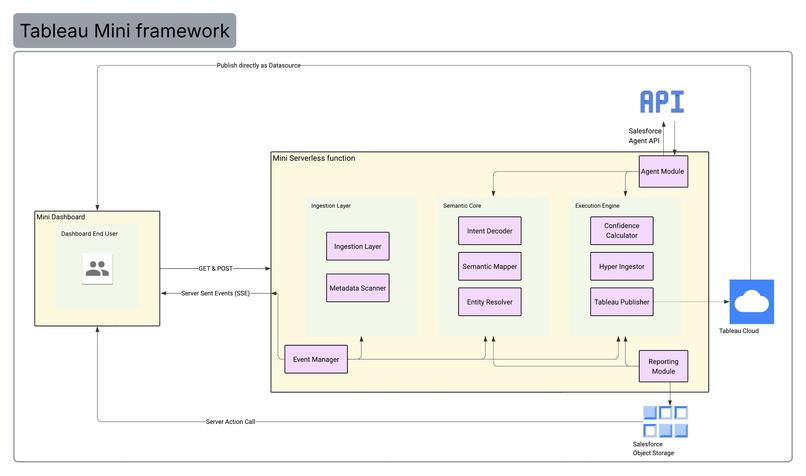
Mini is built on a decoupled, event-driven architecture designed for high throughput and security.
High-Performance Compute (Apache Arrow)
To solve the latency issues typical of browser-based processing, we integrated Apache Arrow for backend data handling. By utilizing Arrow’s columnar memory format, we achieved a 50x performance increase in in-memory data operations compared to standard Pandas implementation.
Privacy-Preserving "Agentic" Analysis
A major blocker for Enterprise AI is privacy. We implemented a Deterministic Pre-Processing Layer that:
- Logically identifies PII (Personal Identifiable Information) and sensitive IDs.
- Redacts these fields from the payload before the data enters the LLM context window.
- Uses post-processing sanitization to erase LLM hallucinations, ensuring 100% factual integrity in the final Hyper extract.
The Stack
- Frontend: Next.js (React) embedded via Tableau Extensions API.
- Backend: Python Serverless functions invoking Salesforce Agents API.
- Storage: Salesforce Object Storage & Tableau Hyper API for high-speed extract generation.
Challenges & Engineering Constraints
- Salesforce Event Architecture: Navigating the limitations of Salesforce integration on event-based accounts required custom authentication flows to unlock Agentforce capabilities.
- Asynchronous Pipeline Optimization: To prevent UI thread blocking during large file ingestion, we engineered a non-blocking asynchronous architecture, ensuring the Dashboard remains responsive while heavy compute happens server-side.
Roadmap & Scalability
- Native Connection Architecture: Collaborating with Tableau R&D to move Mini from an Extension to a native Connector, leveraging the VizQL Data Service.
- Credential Caching: Implementing secure token caching (Redis) to reduce authentication friction for power users.
Deployment & Demo
Installation Instructions
- Download Artifact: Get the
.trexmanifest file. - Security Configuration: Whitelist
https://tableau-mini.vercel.appin your Tableau Cloud Extension Settings. - Local Deployment:
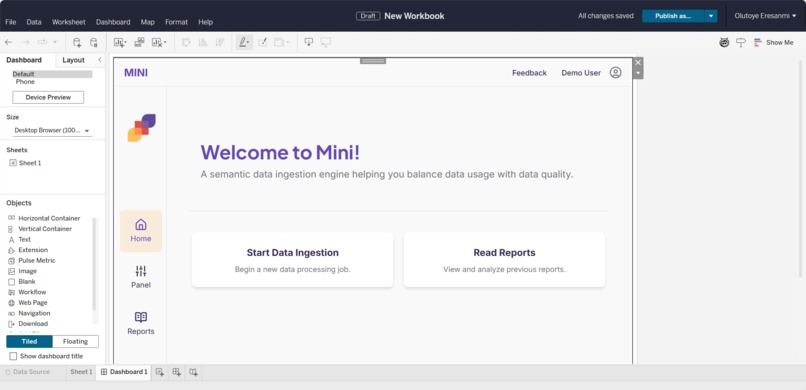
- Open Tableau Desktop/Web -> New Dashboard.
- Drag
Extensionobject -> SelectAccess Local Extensions. - Load the
.trexfile.
Public MVP Access: For judges/users without Tableau PAT (Personal Access Token) credentials, access our Public Sandbox Environment. (Note: This version bypasses auth for demo purposes and enables direct CSV download post-validation).
Thank you :]
Built With
- nextjs
- python
- salesforce
- tableau


Log in or sign up for Devpost to join the conversation.