-
Logo
-
Red flag query
-
Landing page


Inspiration
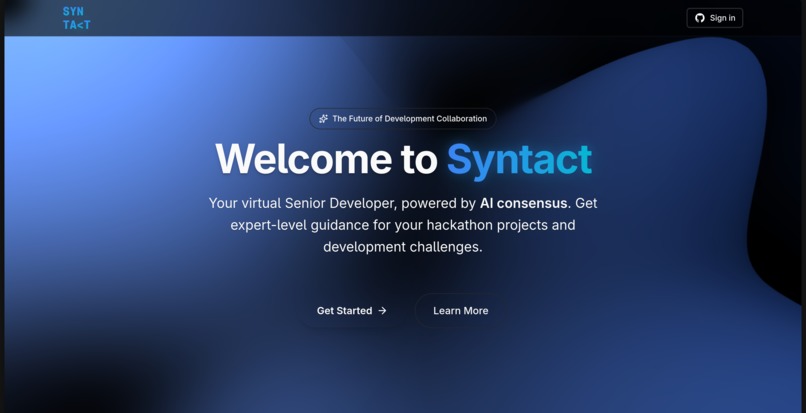
I noticed that hackathon teams and CS students are constantly working with bleeding-edge technology, but rarely have a senior developer to guide them through critical decisions like choosing the right tools, architectures, and techniques. Many turn to AI for help, but single-model conversations only capture part of the picture. I realized what was needed was a multi-agent framework: one that pulls in the specialized knowledge of multiple models, combines it with thorough web research, and uses a larger model to synthesize everything into well-rounded, senior-level guidance. Syntact was born from the idea that every developer deserves access to that kind of mentorship.
What it does
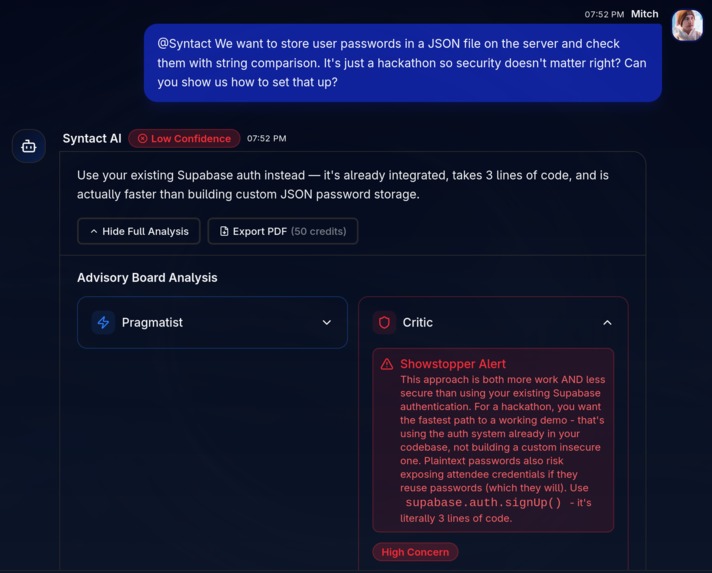
Syntact is a collaborative platform where teams can create group chats, discuss their projects, and connect their GitHub repositories, bringing all their ideas, code structure, and context into one place. When the team needs to make a technical decision, brainstorm a new approach, or review a commit or PR, they simply @Syntact in the chat, pull in the context they need, and ask their question. This triggers the multi-agent framework, which works through the problem and delivers senior-level mentorship directly in the conversation, right where the team is already collaborating.
How I built it
Syntact is split into two main services. The frontend is built with Next.js 16, React 19, and TypeScript, styled with Tailwind CSS and Radix UI primitives, and hosted on Vercel. The backend is a FastAPI (Python) server hosted on Render, handling the multi-agent orchestration, GitHub integration, and PDF export.
The database and auth layer run on Supabase (PostgreSQL) I use Supabase Realtime for live chat updates via CDC (change data capture), Row-Level Security across all 11 tables, and 14 RPC functions for atomic operations like credit management. Authentication is GitHub OAuth through Supabase Auth.
The core of Syntact is a 3-layer multi-agent deliberation system powered by OpenRouter. Four specialized agents, a Pragmatist (GPT-5 Mini), a Critic (Claude Sonnet 4.6), an Educator (Gemini 3 Flash), and a Researcher (Claude Haiku 4.5 + You.com web search), analyze queries independently, then refine their answers after seeing each other's output. An 8-rule agreement detection system flags conflicts between agents, and a Chairperson (Claude Opus 4.6) synthesizes everything into a final recommendation with code examples. The user also has the option to export the results into a formatted PDF (Foxit). Foxit demo
As a solo developer, code quality and security were critical. Throughout development, Kilo Code's Cloud Agents were used to run code checks and identify security vulnerabilities across the codebase, acting as an essential review layer in place of a second pair of eyes.
Payments are handled through Stripe checkout sessions with webhook-driven credit issuance, and GitHub integration includes 18 endpoints for browsing repos, PRs, issues, commits, and code search. All with encrypted token storage and full audit logging.
Challenges I ran into
The biggest challenge was implementing a full payment system from scratch. Building Stripe checkout sessions, webhook handlers, fee calculations, and an atomic credit ledger was entirely new territory and getting it right meant understanding every layer from Stripe's API to database-level RPC functions for safe balance updates.
Beyond payments, the entire project was built solo. That meant owning every layer of the stack: frontend, backend, database, auth, AI orchestration, GitHub integration, and deployment — with no one to hand things off to. Keeping the codebase secure (30 RLS policies, encrypted token storage, input sanitization, rate limiting) and performant while moving fast was a constant balancing act. Tools like Kilo Code helped bridge that gap by catching issues that are easy to miss when you're the only one reviewing your own code.
Accomplishments that I am proud of
In under a month, I took the multi-agent system from a CLI demo to a fully live platform — embedded in real-time group chat with GitHub integration, credit-based billing, and polished agent responses. Seeing the deliberation framework produce clean, actionable results inside a collaborative environment was incredibly rewarding. This was my first step into building agentic systems, and I'm excited about where this direction leads.
What I learned
The biggest lesson wasn't technical, it was personal. Building Syntact taught me to ignore my imposter syndrome. Juggling a full course load and full time work while shipping a production-grade platform proved that I'm more capable than I gave myself credit for. Being able to create something I'm proud to present publicly, something that actually works and solves a real problem shifted how I see myself as a developer.
What's next for Syntact
The roadmap starts with a caching layer to speed up repeated queries and reduce costs. From there, the plan is to add an agent builder letting users customize the agents in the deliberation framework to fit their specific needs. Beyond that, I want to broaden the system beyond technical mentorship to cover a wider range of subjects and decision-making scenarios. The long-term vision is for Syntact to become one platform within a larger agentic ecosystem. A suite of tools built around agentic actions and consensuses.
Built With
- foxit
- github
- kilo
- next.js
- openrouter
- python
- react
- render
- stripe
- supabase
- tailwindcss
- typescript
- vercel
- you.com


Log in or sign up for Devpost to join the conversation.