-
-
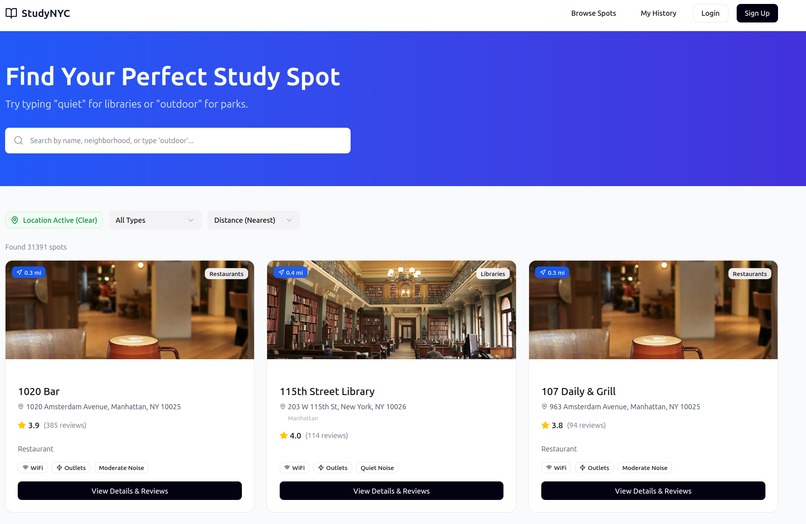
Homepage
-
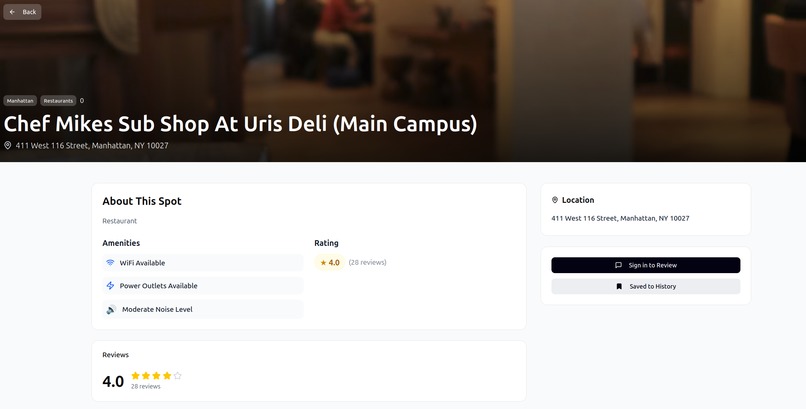
Landing


Inspiration
As college students, we often try to find ideal places to study. However, there is limited information about what amenities different locations offer and how they are reviewed, which makes choosing a study spot difficult. Therefore, we created StudyNYC to help match students with the perfect place to study based on their preferences.
What it does
StudyNYC features a comprehensive database of over 30,000 locations. Based on users’ requirements and needs, it suggests the best places for them to study. In addition, the app includes a login system that allows users to save and revisit their favorite study spots.
How we built it
We built the authentication system using Rust and used Supabase to create and manage the locations database. Figma was used to design the UI, and we implemented an algorithm to calculate the best-matching locations for each user. Location access was enabled to further improve recommendation accuracy. We also used Dedalus Lab to analyze user prompts and extract keywords from them. Finally, study spot recommendations are displayed in the form of Study Spot Cards.
Challenges we ran into
The authentication system was challenging because DAuth could not connect to MCP. We also experienced database lag issues and had to optimize our algorithm to efficiently process large amounts of data. Enabling location access was another challenge, as Figma did not adapt well to it, even though it was a crucial feature. Despite these obstacles, we successfully overcame them, and the final application performs well.
Accomplishments that we're proud of
We are proud to have built an app that effectively matches students with study spots tailored to their needs. In particular, we are proud of the system’s comprehensiveness and robustness, as it provides essential information such as distance, ratings, reviews, and addresses for each location. We believe this application is impactful, as it has the potential to fundamentally change how students discover and choose suitable study environments.
What we learned
We learned that effective software development depends on close collaboration between the frontend and backend. Our project required substantial backend data processing, making seamless information flow such as real-time location, user preferences, and user history crucial. By integrating databases, authentication systems, and APIs, we were able to ensure smooth communication between different components of the system.
What's next for StudyNYC
In the future, we plan to expand StudyNYC to include databases for other cities. We also aim to incorporate real-time crowd data to estimate how busy a location is and help users find quieter study spots.
Built With
- dedalus-labs
- figma
- gemini
- react
- rust
- sql
- supabase
- typescript


Log in or sign up for Devpost to join the conversation.