-
-
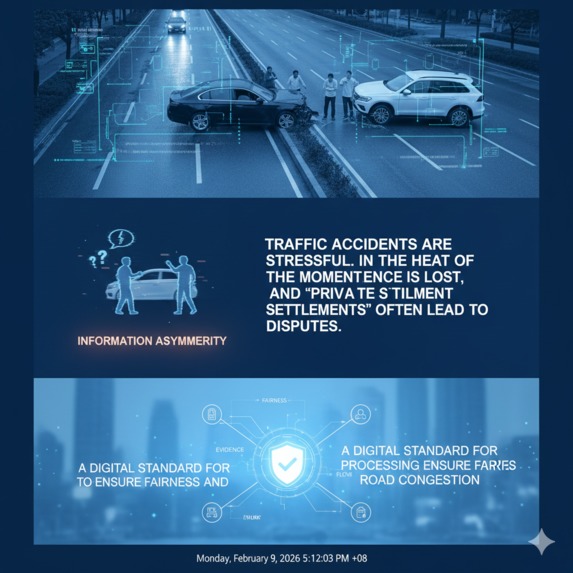
Accidents are chaotic—StarVoys brings clarity. Talk to report, let our AI handle the data, and skip the paperwork. Fast. Safe. Smart.

Project Story: StarVoys
Inspiration
Necessity is the mother of invention, but in this case, frustration was the spark. Having been involved in three minor traffic accidents in a single year, I experienced firsthand the "secondary trauma" of the reporting process. Standing on a busy roadside, fueled by adrenaline and stress, trying to type accurate details into a mobile form is nearly impossible. I realized that current systems fail because they demand manual precision when users are least capable of providing it. I built StarVoys to turn that chaos into a calm, voice-guided experience.
What it does
StarVoys is an AI-powered accident reporting and settlement ecosystem that eliminates manual data entry.
Voice-First Reporting: Using Gemini 3 Flash, users simply speak to describe the event. The system filters out background traffic noise and transcribes the narrative with high emotional intelligence.
Intelligent Data Structuring: An integrated Output Parser automatically converts unstructured speech into professional, JSON-structured insurance data.
Optimized Evidence: The app handles high-res video coding, ensuring that visual evidence is compressed for instant upload without losing the clarity needed for settlements.
How we built it
The development was centered around "Vibe Coding" within Google AI Studio.
The Core: We leveraged Gemini 3 Flash for its multimodal capabilities, handling both the complex audio transcription and the logical data parsing.
The Workflow: By using natural language prompts in Google AI Studio, we were able to iterate on the UI/UX and backend logic at record speed, shifting the focus from writing syntax to refining the "vibe" and user journey.
The Engine: We utilized an Intelligent Output Parser to ensure the AI's response was mapped directly to claim-ready form fields, bridging the gap between a human story and a legal document.
Challenges we ran into
The primary hurdle was environmental noise. Recording a clear statement on a highway with sirens and passing cars often breaks traditional STT tools. We had to fine-tune our prompts and leverage Gemini 3’s advanced reasoning to distinguish between the user’s voice and the surrounding "noise," ensuring the core narrative remained intact. Additionally, ensuring the output parser remained consistent across different speaking styles and accents required rigorous testing and iterative prompt engineering.
Accomplishments that we're proud of
We are incredibly proud of achieving a "Zero-Typing" workflow. Seeing a frantic voice memo transform into a perfectly organized, professional insurance report in seconds felt like magic. We also successfully integrated a complex tech stack—combining Gemini 3's intelligence with optimized video coding—into a interface that feels simple and reassuring to a stressed user.
What we learned
This project taught us that the most powerful use of AI isn't just automation; it's empathy. By building with Gemini 3, we learned how to offload the cognitive burden from the user during a crisis. We also discovered the efficiency of "Vibe Coding"—realizing that when you have a powerful model like Gemini 3, the distance between an idea and a working prototype is shorter than ever before.
What's next for StarVoys
The vision for StarVoys is to move from reporting to Instant Settlement. We plan to integrate real-time repair cost estimation using Gemini’s vision capabilities to analyze vehicle damage photos. Our goal is to create a world where a minor accident is resolved before the driver even leaves the scene.
Built With
- english
- gemini-3-flash
- google-ai-studio
- google-claud-storage
- google-maps-platform-api
- javascript
- json
- react-native
- web-speech-api

Log in or sign up for Devpost to join the conversation.