-
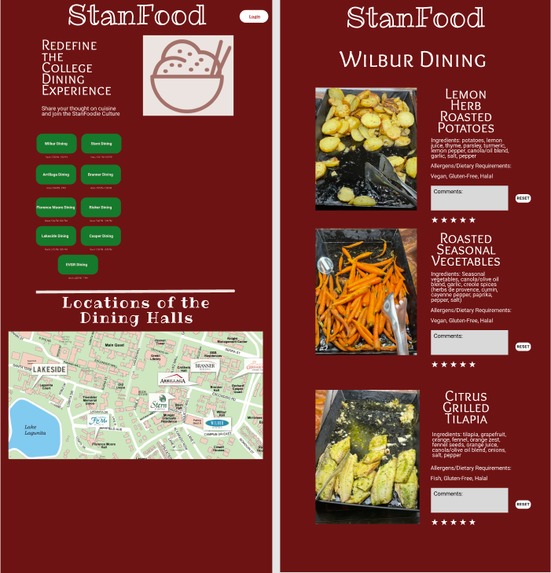
Proposed web UI design
-
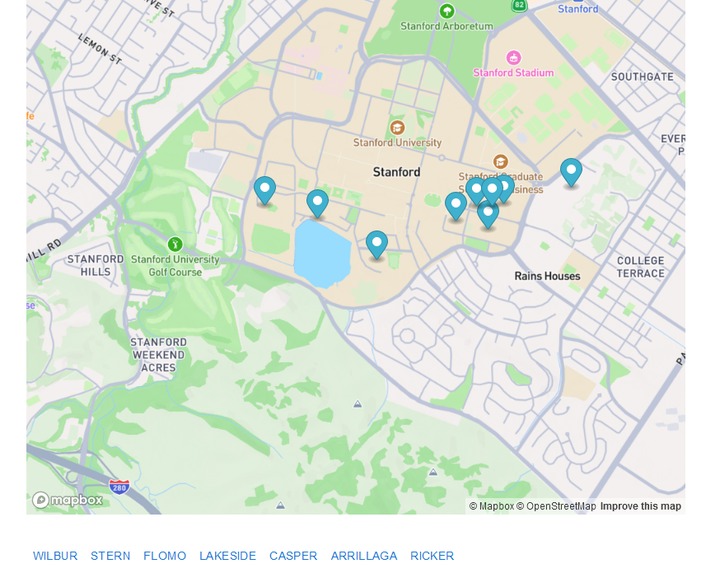
An interactive map allows users to sleect a dining hall
-
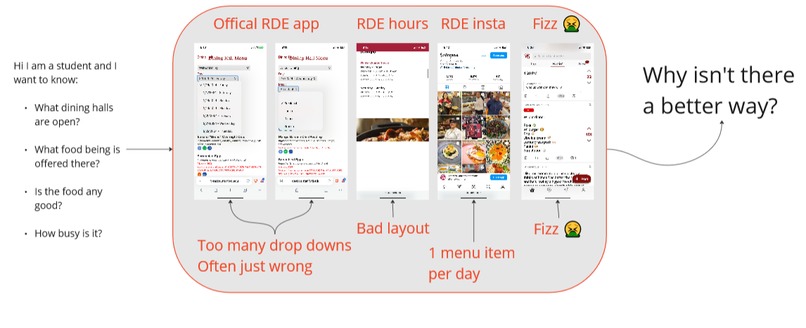
A view into the stanford food landscape
-
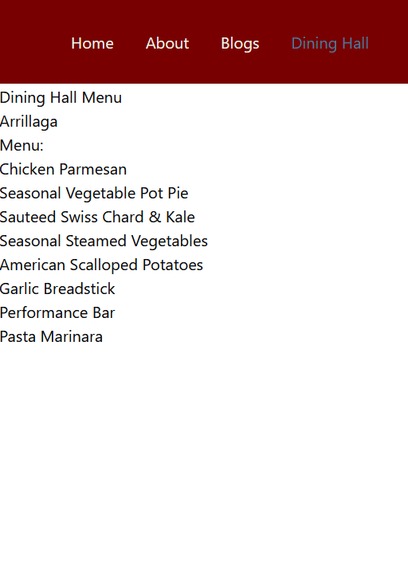
A test of our food database query system


Our tracks: "Most ethically engaged hack": Sponsored by McCoy Center for Ethics in Society "Best Beginner Hack" "Best hack to connect with others through food" sponsored by Ostuka -Valuenex "Best use of Convex" sponsored by Convex
Welcome to StanFood, a food review online platform for students to review quality and share opinions on the campus dining experience. Ethics has been an issue two-fold: ethics in coding and ethics in application. Every engineering endeavor ought to take into account both ethical considerations, in all its shape and forms. Our ethical analysis dives into our identities; continue reading to see how our narratives have shaped our experience with StanFood!
The Origins of StanFood
Our team has lived together for the past couple months, as freshmen who have built a sense of camaraderie through sharing our life experiences and understanding how to care for each other. That’s why when one of our teammates found himself with a broken tibia and fibula days before Tree Hacks, we rushed to his aid. Day after day, he would eat a piece of chicken and noodles, 3 meals a day, 7 days a week. Unsure whether it’s even worth it to go to other dining halls to bring him a hearty meal, we saw his intake of food lessen – an unhealthy circumstance where his well-being came into question. In our struggles to get him quality food, we faced our own unhealthy relationship with food on campus. Another member of the team had to eat pineapple and yogurt for a week because the food wasn’t something he could eat or stomach at the time, another stopped eating anything except leftover vegetables because lines were too long and his motivation to eat hot new lows.
Our relationships with meals aren’t unheard, isolated incidents. Students hoping to have a healthy meal are sidelined when it comes to accessibility and transparency for the food provided. Dietary restrictions also separate experiences with students on campus, leaving students with food alternatives of a lesser standard than another location on campus. As a result, health conditions, mental health issues, and the culture of dining is inherently affected.
Our application, by its implications to affect change for a large ethical dilemma, is a microcosm design of a product designed to fight against food deserts. Through using the Stanford community as an initial, close-proximity test case, we are attempting to inspire conversations on accessibility of quality food, more importantly with empiricism involved. Through marketing means and other various forms of panderings, information on nutritious and good foods is misconstrued to the common community member. Through the usage of platforms which provide input peer-to-peer reviews, we create a transparency in the status quo that bridges a moral gap the food industry has been incapable of bridging in the past few years. Today, nearly 42% of American adults, or around 96.6 million people, face obesity in their daily lives due to the immoral practices of “Big Food”. (Ney, 2022)
Functionality: How Does It Work?
At Stanford, dining halls operate in a neighborhood system, where each assortment of dormitory buildings are combined in small isolated communities with their own individual dining hall. These dining halls operate with different times, different menus, and different dietary restrictions being accounted for everyday. Unfortunately, this information isn’t readily available to students. The current student relies on a lackluster online menu website, which doesn’t actually let users know much about the food being made, the quality of the food, and the cultural value of the food. Furthermore, the menu isn’t even accurate to what is being served and the only way to keep up with the real time changes in the dining halls is the firsthand updates provided by students.
Our intent, for now, is to create an open feedback from students to other students in real time to keep students up to date on the current situation of the food. This works in two distinct ways, one in which historical data is used to generate a rating on the front page. This works on a similar rating system as a lot of other websites, where an average of past ratings are averaged out for a final rating out of 5 stars. The other relies on a comment section to generate dialogue on the food, with more recent comments being added/shown first to create more exigent conversations. In the day to day processes of the application, we envision students to hold these conversations to assess quality across the dining halls (as dining halls are often disproportionate in the quality of certain foods) and to start a larger conversation on the topic of nutrition. Another important issue is sufficiency, where often dining halls run out of food, don’t put out certain foods, or have insanely long wait times that ensure lack of accessibility to certain foods.
Given the current model, StanFood is a scalable product that is envisioned to allow communities to adapt it to the food providers around them. One of the current biggest barriers to the solution of food deserts is the lack of transportation to and from areas containing healthy foods. Ergo, the opportunity cost of going to get fresh groceries is too high to waste on a one time visit. Understanding the quality of each individual product is essential to provide communities to understand the strengths in their fresh produce. Although we all understand StanFood may not solve the entirety of the food desert crisis, we try to lower the risk in travel for groceries to ensure quality returns. In a report to the California Legislature on food access, individuals who were far away from supermarkets were 25 - 46% less likely to have a healthy diet.(California Department of Food & Agriculture, 2012). StanFood works by acting as a solution and as a measure for stores introduced into these food desert areas to be controlled for variety and quality assurance purposes by creating active community dialogue.
The Creation Process:
The creation process had three parts that needed to work in conjunction to create an effective platform: software on menu accumulation from the Residence and Dining Enterprises website, the location services to show the closest dining locations, and the interactive elements of the software.
Data Scraping
From the Residence and Dining Enterprises Menu website, we coded a Python script that sent HTTP requests to parse the data from the HTML response. Using that data, we created a database of the current menu options provided. We also realized that the menu provided was not accurate to what we have seen in the dining hall which we plan to address by incorporating user data reporting. Data reporting will be incentivised with additional social features.
Location
Grabbing the location of the user, we generated a map with the user as the centrepoint through Typescript. From the found location, we can view the locations of the dining halls around the user, giving them a reference on which tab of the dining halls they will choose.
Interactive Elements
The central part of the code focused on the interactive elements of the application. Individuals can click on a button that takes them to the guide on that dining hall's current food options. On the guide, the user can see the ingredients, dietary restrictions, and a visual of the food being served. On the section of the food, there is a star module made through Java Script that allows the user to select their thoughts on the food from a 5 star rating system. The average of the ratings are returned beside the food to show a quantitative measure of how people feel about the food. Furthermore, using Typescript, there will be an open comment section which details the current opinions of the food directly from users.
Barriers We Faced:
Translating UI/UX designs from Figma imports of React Java Script into a code based largely on Typescript without all the libraries downloaded Location and map renderings for the reference section of the app Attempting to scrape from the outdated Stanford Dining Hall menus with random grids littered through the frontend of website Keeping our sanity
How the “journey was the destination”:
Integrating databases with stored dining hall food data The learning curve for coding an application for the first time is not an easy task Power naps are essential for a coder to function
The Future of StanFood
The next step of StanFood is the scalability to more communities for a larger extent. The first step forward would have to be data accumulation for different products in the area. In the current moment, the information for our databases are given through the provided menus for the dining halls and are therefore provided. When it comes to our larger mission of being a solution for food deserts, it requires a data scraper powerful enough to use integrated location services to find food sources nearby the user, look through the items provided in their stock through their website, and provide ample description for dietary restrictions scanning keywords that would provide a contradiction to certain lifestyles. Once we are capable of coding higher-level scrapers to gather website data, we are capable of crossing the first boundary for scalability. Secondarily, there needs to be a cleaner user-interface with an emphasis on easy, accessible products. With the vision to operate in lower income communities to provide input into their next decisions of groceries and food, another emphasis needs to be on how the website needs to translate across all devices and languages as well. A key element of low income communities lies in social factors that have marginalized them and kept them from reaching equitable conditions. Food deserts and accessibility have stemmed from a concept known as “food apartheid”. “Food activists like Karen Washington, Malik Yakini, and Dara Cooper believe that this term more accurately represents the systemic racism and health inequities of a corporate-controlled food system.” (Charles, 2021). Contextually, these communities are filled with POC (people of color), especially affecting the Black communities and immigrant communities. For these marginalized communities, it is essential to provide a sense of nutritional context in the decisions they can make, which entails providing a way to incorporate translations into Spanish or providing information more intensively on the nutritional values of the food. The greatest aspiration of this app comes from the dialogue it aims to start. Food deserts are not an issue with an easy fix, and we also understand we can’t claim to be “the solution” for such a large-scale issue. This issue comes from decades of injustices to communities, and StanFoods is just a way to get a conversation started to create a larger movement towards nutritional equity in the United States. StanFood is a band-aid for the current issue, attempting to lower the risk of traveling to locations for fresh food, yet we don’t bring transportation or directly bring fresh foods into these communities. That is the hopes for the future, to create the influence and work towards ensuring communities dear to us attain the data and unity to work towards overturning marginalizations caused to raise profits for fast food chains and the barriers that keep supermarkets from being in these low income communities. For now, our future goals are set on working on our backend data to curate better scraping techniques to ensure our next goals are attainable. The Ethical Dilemmas: We began this project to mend our unhealthy relationship with food. It was a project in service of ourselves, and it felt disingenuous to use our resources to serve ourselves. This project is a project to pursue healthy eating habits for students and to create a community at Stanford, a healthy camaraderie with our student population through cuisine. The old adage of “the key to our heart is through our stomach” is what rang most true to us. It was then we realized that we can celebrate this thought because we have access to multiple “keys to our hearts”. We have the ability to discuss what our healthiest and yummiest options are. We can go about our days and have carefree conversations around a dining hall table. We can eat nutritious foods, no matter the quality of it, and understand that we will have food on our table for our four years at Stanford.
Simply put, we have access to food.
Others don’t.
Food deserts are one of the greatest inequities to come from policies in the world. In truth, any act that has been steeped in marginalization is the greatest moral sin. To quote Albert Memmi, a sociology professor from the University of Paris, “One cannot found a moral order, let alone a legislative order, on racism because racism signifies the exclusion of the other and his or her subjection to violence and domination. From an ethical point of view, if one can deploy a little religious language, racism is “the truly capital sin”. “(Memmi, 2000) The very foundation of food deserts exists through the mismanagement of urban infrastructures and allowed the continued marginalization today of minorities from accessing necessities. Today, nearly 54 million people don’t have reliable access to food and 23.5 million people live in total food deserts. (Ney, 2021)
Before our project even began, we had a very clear clarification to make. We are immensely privileged people in privileged settings creating a product for those who are underserved. Albeit our backgrounds may come from areas of financial insecurity or other struggles – today, we are students at Stanford University creating a design using Stanford as our microcosm. The most ethical way to go about creating a solution for this issue was simply to create a proof of concept through a lighter, social means to generate an idea of how it would work outside university settings. The ethical prerequisite for any coder at Tree Hacks or any higher educational institute is the acceptance of where we stand in terms of the resources we have available to us and the privileged viewpoints we hold. As such, we accept who we are and affirm the authenticity it takes to create a project solving an issue for the underserved. There can not be a saviorship complex or any other such superiority complex that plays a role in this project, we have only created this project because we care for our fellow community members. We see this issue in the nearby communities of East Palo Alto and we understand that they face a circumstance far different from our own.
Given the clarification of our motives going into the project, we moved into the more difficult conversations that came with coding a project that combined community interactions, personal data, and critiques of an institution. These ethical issues also diverged into two subsets, the first is the more exigent, current model of our project. These ethical concerns are contextual to the now and for how we envision StanFood to operate upon initial launch. The secondary subset is the long-term scalability of StanFood and how we envision that to bring ethical solutions to moral qualms.
Interactions With Residence and Dining Enterprise (RDE) Staff
The first ethical problem we faced while building the product was in the design process. A very large fear of online platforms, especially those directed towards reviews of a certain institution, is a deferral of blame onto the staff at Stanford. Hardworking individuals who put their blood, sweat, and tears into bringing us food might be caught in the crossfire of nasty comments and a campus culture targeted against them.
At first, this ethical question brought distress to us all. How can we ethically create a critiquing platform if workers who have done nothing other than serve us in good grace would come in harm's way? In conversations with our fellow peers, we realized that such a question in of itself misses essential contexts necessary to create a platform. Stanford students have never pointed the finger at the cooking or the staff working in the kitchen, however at the quality of the food itself. The quality brought in by the institution has not been equivalent to the nearly $18 dollars it comes out to be for each meal from the meal portion of tuition.
Secondarily, students and staff have both felt frustration in the way that RDE has structured the system of eating. While in the dining hall, I overheard a frustrated worker exclaim to her coworker, “Mucho trabajo, poco dinero. [Lots of work, little pay]”. The online menu that RDE uses is never 100% accurate to what is actually served at the dining halls, bringing frustration to students. Employees in the dining halls go from helping in the kitchen and with silverware, to cleaning, to other chores that overwhelm them with the sheer amount of labor necessary. According to Forbes, “Higher education is struggling with retention and hiring, as are many industries. College administrators are choosing to prioritize saving money in the short term by keeping wages low for mid-level staff who do most of the hard work at universities.” (Conroy, 2022)
StanFood, thusly, hopes to endorse better conditions for the workers in these stressful circumstances by highlighting the defects in our food system. As Harvard did in the early 2000s, we aim to help create a movement of students and staff alike that begins a dialogue with our institution to alleviate the rising tensions for students and staff both. Our care and concern for workers will actually be brought to a substantial position if the inherent culture around food at Stanford changes. StanFood, as such, sits as a possible catalyst for stronger camaraderie between RDE staff and students.
Privacy Concerns With Location Tracking
The next ethical qualm arose in the rendering of the map of the dining halls in relation to the user’s location. Geolocation tracking laws in the intersection of privacy lines have been a very fine line to walk, however there are clean guidelines to follow. Tracking technologies are permissible when they are used to collect information to analyze a users interaction within a defined context. The most important rule for location tracking is: “Regulated entities are not permitted to use tracking technologies in a manner that would result in impermissible disclosures of PHI to tracking technology vendors or any other violations of the HIPAA Rules.” (U.S. Department of Health and Human Services) In our code, we kept a focus on ensuring no database or storage of any location tracking is used in any sense.
Although the tracking of an individual is crucial to our future goals for StanFood in terms of combating food deserts, we cannot repeat any breach of privacy in any contexts for the future. In the future renditions of this application, the map setting will also have an encryption integrated into the simple geotracking code to ensure active users of the app cannot be tracked through the StanFood servers by ill wishing peoples.
Intersection of Culture, Bias, and The Freedom of Speech
Censorship and technology have hit new highs in the modern day. This remains especially contextual when you take into account 2024 being a presidential election year. In the context of our own application, we were terrified of what students would write on dishes that came from other cultures. Should we allow the expression of free speech in the face of pervasive racial and cultural insensitivities that could negatively impact the identity of another student?
In sharing our own experiences in facing racial adversity, all of us being people of color, we found that we sided with the new proposed “sociology of ignorance” by Professor Jennifer C. Muller from Skidmore College as a basis to understanding what purports the racist and culturally insensitive comments in most settings. In understanding racism as an ethical concern independent of other factors, the whole narrative is not being understood. In a sense, “ignorance appears a bona fide if often vexing social fact. Ignorance is socially constructed, negotiated, and pervasive; ignorance is often socially inevitable, even necessary; and, without a doubt, ignorance is socially consequential.” (Mueller, 2018) Without understanding how racism comes from a lack of knowledge, there can be no hope of understanding the inevitability of ignorance, allowing racism to persevere.
Simple censorship does nothing more than defer someone’s understanding of someone’s identity, here being food as a cultural epithet. If we were to censor comments we found offensive in the comment section, there would be no possibility of retaliation with education. Allowing people to speak their ignorance allows other students to respond. Educational dialecticism synthesizes into newer understanding of the interplay of race, culture, and speech.
In the future, we understand there may be situations involving racial comments that go beyond that of which online dialogue can solve. This can be seen in the attacking of certain foods and companies (for when we scale up to communities) through slurs and racial epithets of a negative connotation. For these words, we hope to scramble slurs so it isn’t possible to write comments with such negative words and a future reporting system if comments go beyond an unwilling ignorance of the student. Yet, to protect the inherent right of each individual to speak and express, the guidelines of such a reporting system and taking down comments ought to be well defined and without a gray area in which censorship may or may not be needed. Censorship of someone’s ideas is not a tool to be used lightly, it is unconstitutional in premise, but may only be used to protect someone else’s rights to life. As such, any such action ought to have a high threshold.
Solutions to Environmental Ethical Issues
Another key issue in food accessibility is the wastage of resources that are provided to us in the current moment. When we complain about the ethics of policies that keep marginalized communities marginalized, it becomes hypocritical to not understand our own roles in such a system if we play one. In the case of food, the role we play is a resource user. StanFood intrinsically evaluates the eating culture on the Stanford campus, making students more conscious about what they consume, when they consume, and in this instance more importantly, how much they consume.
Our dining halls are filled with scales under our trash cans, measuring the amount of food that has gone to waste due to the lack of resonance with students on the food being eaten. We have all watched students throw plates full of food into the trashcan as they taste a food they were surprised with in taste. “The average college student generates 142 pounds of food waste a year, according to Recycling Works, a program in Massachusetts. And college campuses, as a group, throw out a total of 22 million pounds of uneaten food each year, the Food Recovery Network has found.” (Poon, 2015) The sheer amount of food waste on college campuses can be avoided with a simple suggestion in the comments that understand what students want.
In a more institutional way, the way in which students react with food provided puts an ethical burden on the institution to change how food is put out to students. Foods without much eater attention will eventually be siphoned out and unnecessary waste will be avoided.
Ethical Uses and Fears of User Input Databases
For the vision of StanFoods, the two sides of the project bring different fears when it comes to databases and storage. In the case of the long term, storing opinions on foods introduces permanence in someone’s actions on our website. Are we allowed to store someone’s data in our database or does a consent on privacy entail a time limitation? Similarly, does willing data being sacrificed as property of the website allow the politicization of such data, even in the face of political good?
For the first ethical purpose, comments should be archived after a certain point as they don’t reflect the current situation to the fullest ability, however there ought to be a good amount of data to allow the program to work with the fullest ethos and qualifications. Without enough data, the platform falls apart as it has to restart backup every time. When it comes to visible data of an individual, comments ought to be deleted after the two years, allowing data to remain historical to a certain degree, however not falling out of cultural relevance after some time.
The central reason for the question of time limit of data holding is the power such data holds. The issue with food deserts is the concept of isolating these individuals, keeping them incapable of weighing options and having real-time, voiced opinions on such issues. With historical data being stored, and especially used for policy suggestions, StanFood’s peer-to-peer platform serves as the ultimate opinion database on food review in terms of quality, accessibility, and nutritional value. With such data being stored and hopefully utilized, data ethics need to be valued with the highest priority. A few guidelines to consider are: “(1) potential biases in big data collection and interpretation, (2) community and citizen concerns of big data (mis)use in public life and for journalistic purposes, (3) media coverage of national big data projects, and (4) directions for future research.” (Chen and Quan-Haase, 2018) In terms of potential biases in the data collection, this can be especially swayed in the long term through advertising by fast food companies and other restaurants. As a measure against such bias, omitting fast food chains and restaurants will have to be a necessity for the survival of the app as a means to measure accessibility to fresh produce and healthy options. In the exigent periods of the app, the only possible bias is the specials in certain dining halls that give certain dining halls especially high ratings or reputation of dining halls bringing feedback in a disproportionate way. Even with those current possible biases, the data will level out due to how the app functions, as other dining halls will have to change their stock to ensure a fair distribution of food, which will in turn shift the data again.
The next 3 central points (big data use in journalistic settings, media coverage, and future research) and the previously brought up politicization of data concern can all be covered with a strong assertion of transparency and consent. When users join the platform, ideally a cookie that asks for consent of data storing will pop up. This pop-up will have a terms of service that details how the data will be used, for all the previously stated purposes. The transparency will be constant updates of what we do with the data. There will be no underhand exchanges with data of any kind nor is any data we collect for the ongoing program to be kept for any other reason than to function as a food quality review application. Conclusion Our final ethical concern is a false assurance of being the penultimate step before a perfect world without food desert. In all honesty, this app may never fully solve the problem with food deserts. But that doesn’t mean we stop trying. The biggest ethical dilemma was really well put by Hamlet. “To be or not to be, that is the question.” Do we try to be an ongoing driver for positive relationships with food and our surrounding community, or do we buckle under the pressure and choose to wait until someone else comes up with a better idea? By all ethical considerations, it is always moral to fight against injustice in every possible way until it is solved, even if it is inevitable. That is the mission of StanFood, finding the keys to everyone’s hearts through their stomachs.
Bibliography
Alexis, Amber Charles. “Food Deserts: Causes, Effects, and Solutions.” Healthline, Healthline Media, 14 June 2021, www.healthline.com/nutrition/food-deserts. California Department of Food and Agriculture. “Improving Food Access in California.” CDFA, 2012, www.cdfa.ca.gov/exec/public_affairs/pdf/ImprovingFoodAccessInCalifornia.pdf. Chen, Wenhong, and Anabel Quan-Haase. “Big Data Ethics and politics: Toward new understandings.” Social Science Computer Review, vol. 38, no. 1, 14 Nov. 2018, pp. 3–9, https://doi.org/10.1177/0894439318810734. Conroy, Edward. “Higher Education Has a Morale Problem, Opposing Higher Pay Will Make It Worse.” Forbes, Forbes Magazine, 8 Nov. 2022, www.forbes.com/sites/edwardconroy/2022/03/13/higher-education-has-a-morale-problem-opposing-higher-pay-will-make-it-worse/?sh=52576e521d67. Mueller, Jennifer C. “Advancing a sociology of ignorance in the study of racism and racial non‐knowing.” Sociology Compass, vol. 12, no. 8, 18 July 2018, https://doi.org/10.1111/soc4.12600. Ney, Jeremy. “Food Deserts and Inequality.” DataVisualizationLab, DataVisualizationLab, 25 Jan. 2022, www.socialpolicylab.org/post/grow-your-blog-community. Poon, Linda. “When Food Is Too Good to Waste, College Kids Pick up the Scraps.” NPR, NPR, 27 Feb. 2015, www.npr.org/sections/thesalt/2015/02/27/389284061/when-food-is-too-good-to-waste-college-kids-pick-up-the-scraps. Unv. Of Paris, Albert Memmi; RACISM, translated by Steve Martinot, pp.163-165, 2000
Built With
- convex
- css
- javascript
- jsx
- python
- tsx
- typescript


Log in or sign up for Devpost to join the conversation.