-
-
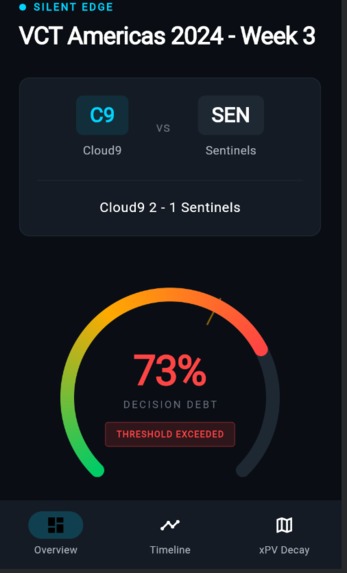
Strategic entropy detection
-
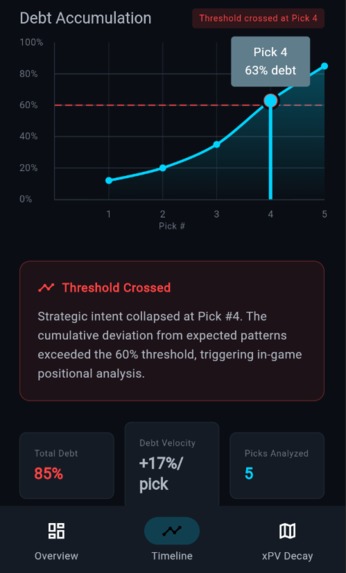
Determining when it all goes downhill
-
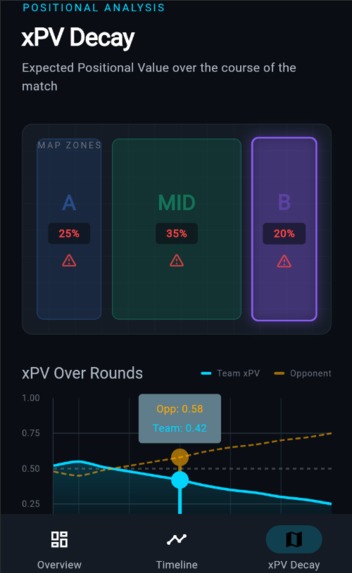
xPV decay analysis
-
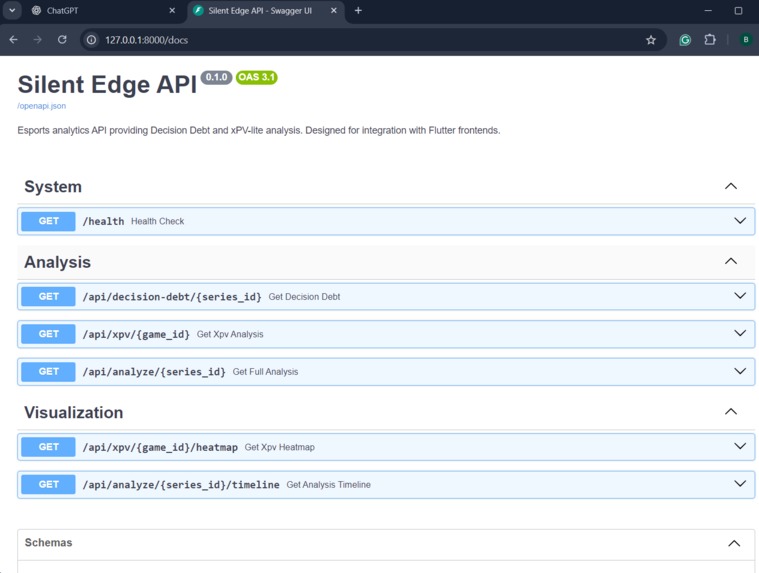
API
-
Coach to coach insights


Inspiration
Esports analysis often explains what went wrong after a loss, but rarely when the loss actually began. Coaches know that many games are effectively decided long before the scoreboard reflects it—sometimes in the draft, sometimes in early macro decisions that quietly remove recovery options.
Silent Edge was inspired by this gap. We wanted to build an assistant coach that identifies strategic failure at its point of origin, not at its visible outcome, using only data that is already publicly available.
What it does
Silent Edge is an esports analytics system that detects strategic failure before mistakes appear.
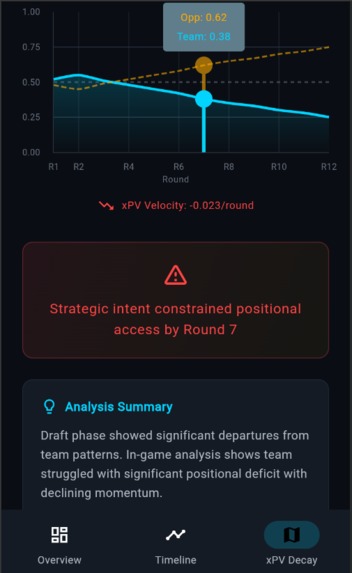
Using public draft and match data from the GRID API, it introduces Decision Debt, a metric that quantifies early strategic deviation during the draft. When draft risk exceeds a threshold, Silent Edge hierarchically fuses this signal with Expected Positional Value (xPV-lite) to analyze how non-obvious decisions propagate into lost map control and declining win probability.
Instead of listing stats or explaining outcomes after the fact, Silent Edge shows when the loss actually began and why recovery became difficult.
How we built it
Silent Edge is built as a modular, deterministic analytics system:
Draft Analysis: Pick/ban data is analyzed against team history and global meta trends to compute Decision Debt.
In-Game Analysis: Match state data is used to estimate xPV-lite across simplified map zones (MID, A, B).
Hierarchical Fusion: Deep positional analysis is triggered only when draft risk exceeds a configurable threshold.
Coach Summary Engine: Deterministic rules convert analytical signals into a single, human-readable coaching insight.
The backend is implemented with FastAPI, using the GRID API for data ingestion, and is designed to return structured JSON suitable for real-time or post-match review tools.
Junie was also used to run doctests and automate test evaluation.
Challenges we ran into
One of the biggest challenges was resisting the temptation to overuse machine learning. Many esports analytics tools become black boxes that are difficult for coaches to trust or interpret.
We also had to carefully balance analytical rigor with simplicity, reducing complex game states into interpretable signals without losing strategic meaning. Designing metrics that were both explainable and useful to coaches required multiple iterations.
Accomplishments that we're proud of
Designing Decision Debt, a novel and interpretable metric for draft-phase strategic risk
Implementing hierarchical analysis that focuses compute and attention only when it matters
Producing coach-readable insights that explain cause, not just correlation
Building a system that relies entirely on public data, requiring no comms, POVs, or player biometrics
What we learned
We learned that the most valuable analytics aren’t the most complex, they’re the ones that help people make better decisions under pressure.
Clear causality, restraint, and explainability matter more than raw predictive power. Coaches don’t need more numbers; they need better framing around when intervention was still possible.
What's next for Silent Edge
Next, we plan to:
Expand hypothetical “what-if” analysis around key decision points
Add opponent-aware context to distinguish self-inflicted collapse from forced losses
Improve zone granularity while preserving interpretability
Integrate Silent Edge into live review and practice workflows for coaching staff
Silent Edge is designed to grow into a true assistant coach, one that helps teams understand not just how they lost, but when it became avoidable.

Log in or sign up for Devpost to join the conversation.