-
-
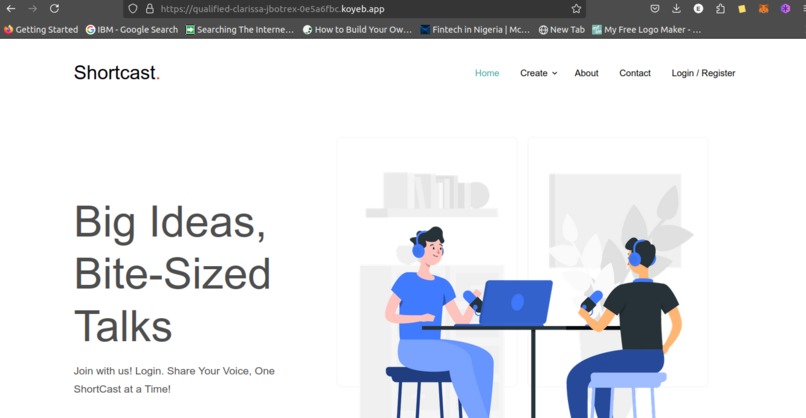
big ideas,bite-sized talks

Inspiration
Communication plays a vital role in understanding concepts and feeling at ease. My journey began when Google Podcasts was discontinued, which was a significant setback. A friend suggested alternative platforms like YouTube Music or Spotify for listening to podcasts, but I found the difference between general-purpose platforms and those tailored specifically for podcasts to be quite evident. After some time, I decided to move forward.
Not long after, another friend emphasized the importance of cloud technology and its potential to enhance software development. Initially, my desire to maintain control over every aspect of my work held me back, but through continued discussions, I became more open to exploring cloud solutions.
This led me to evaluate various cloud service providers, and ultimately, I found Google Cloud Platform (GCP) to be the most suitable. It opened my eyes to the vast potential of cloud services and how they could help us build more efficient and scalable applications. With this newfound understanding, I decided to move beyond the disappointment caused by the discontinuation of Google Podcasts and work towards creating my own podcast platform.
The goal was to create a space where people could engage in meaningful discussions and share content freely. Additionally, I wanted to integrate emerging technologies, such as AI, to enhance the platform's functionality and bring innovation to the experience.
Ultimately, the discontinuation of Google Podcasts and my exploration of cloud technologies inspired me to create a podcast platform that is both scalable and innovative, reflecting my vision for the future of podcasting.
What it does
ShortCast is a micro-podcast platform designed for recording, uploading, and sharing short-form audio content seamlessly. It is also empowered with essential AI features like transcription.
How we built it
ShortCast is a full-stack monolithic application built with Flask as the core backend framework. Flask provided a lightweight yet powerful foundation for handling API requests, user management, and dynamic content rendering.
For audio file storage, we integrated Azure Blob Storage, ensuring scalable and secure storage for podcast episodes and associated media files. Redis was employed as the queue broker for Celery, enabling efficient background task handling for tasks such as audio file processing, notifications, and more. This setup allowed us to manage asynchronous operations without blocking the main application flow.
Although we have not yet moved to Flask-RESTful, I plan to do so in the future to enable seamless integration with mobile clients. This will enhance the ability to expose clean, RESTful APIs for interacting with mobile apps or other services.
The API is designed and documented with Flasgger, ensuring clarity and ease of integration for third-party developers or mobile app clients.
We deployed ShortCast on Railway, a platform that offers seamless server management, scaling, and deployment without the overhead of managing infrastructure manually.
To handle background tasks efficiently, we used Celery for asynchronous task management, coupled with Flower for real-time monitoring. This setup allows ShortCast to perform tasks like audio file processing, notifications, and more without blocking the main application flow.
All components were containerized with Docker, providing an isolated and consistent environment for development, testing, and production.
The UI was built with Flask templates, ensuring a cohesive user experience while maintaining simplicity and responsiveness.
In summary, ShortCast combines robust backend architecture, scalable storage, seamless deployment, efficient caching, and background task handling to deliver a smooth micro-podcasting experience for creators and listeners alike.
Challenges we ran into
One of the primary challenges was handling large audio file uploads efficiently, ensuring smooth uploads without overloading the server, while also managing secure storage on Azure Blob Storage. The jargon surrounding Azure, such as containers, blobs, and SAS tokens, made the initial setup a bit overwhelming, especially since I was unfamiliar with the platform. However, after some research and experimentation, I became more comfortable and successfully integrated Azure Blob Storage with the Flask backend.
Another significant challenge was optimizing the API performance for a seamless user experience. Integrating Redis as a queue broker for Celery helped manage asynchronous tasks efficiently, but configuring it to align with our data structure required careful planning. Deploying the app on Railway also posed challenges, particularly in managing environment variables and ensuring smooth integration with external services like Azure.
Additionally, ensuring that the Flasgger documentation stayed consistent with our evolving API endpoints required continuous updates and validation. Balancing development speed while maintaining clean, scalable code was tricky, but GitHub Copilot played a pivotal role, helping with boilerplate code, debugging, and offering solutions to complex logic problems.
Despite these challenges, each obstacle provided an opportunity to learn and refine our approach, ultimately resulting in a functional and robust ShortCast platform.
Accomplishments that we're proud of
Throughout the development of ShortCast, I’m particularly proud of several key achievements that demonstrate both my growth and the project’s success:
Azure Integration: Despite initially being unfamiliar with Azure, I successfully integrated Azure Blob Storage for secure and scalable file uploads. Overcoming the learning curve of Azure’s ecosystem, especially navigating blob storage and authentication, was a significant accomplishment.
Optimizing API Performance: By integrating Redis as the queue broker for Celery, I was able to offload time-consuming background tasks from the main thread, allowing the app to stay responsive and perform well under load. This was a key step in enhancing the overall user experience.
Smooth Deployment on Railway: Deploying the app on Railway and ensuring seamless integration with external services like Azure and Redis was a complex task. I managed to do this while handling environment variables and securing the app for production, which was a big milestone.
Effective Use of GitHub Copilot: GitHub Copilot was invaluable in accelerating development. It helped me quickly prototype solutions, debug errors, and maintain clean, concise code. It felt rewarding to leverage Copilot to work more efficiently and focus on solving higher-level challenges.
Dockerization: The process of containerizing everything using Docker made it easier to manage development environments and ensure consistency between local development, testing, and production deployments.
Celery Integration: Implementing Celery for background task handling was crucial in maintaining a responsive app. From managing audio file processing to sending notifications, Celery made it possible to run tasks asynchronously without blocking the main app.
Documentation & Frontend Integration: Maintaining Flasgger documentation while aligning the backend with Flask templates for frontend rendering helped me create a well-documented, user-friendly app. Seeing everything come together seamlessly was one of the most fulfilling parts of the project.
Database Design: Designing the database for ShortCast was crucial to ensure data integrity, scalability, and efficiency. I used a relational database (SQLAlchemy with PostgreSQL) to manage entities like users, podcasts, episodes, and media files. By following normalization principles and carefully designing relationships between these entities, I built a robust and scalable structure. Media files are stored in Azure Blob Storage, reducing database load. I also optimized performance by using Redis for caching frequently accessed data.
These accomplishments highlight both my technical growth and the successful execution of the ShortCast platform.
What we learned
Throughout the development of ShortCast, we gained valuable insights and experiences:
Exploring the World of Cloud Systems: I learned a great deal about the vast world of cloud services, especially Azure. Navigating Azure Blob Storage, understanding authentication, and configuring containers taught me how to leverage cloud solutions to handle media files securely and efficiently.
GitHub Copilot as an Incredible Companion: GitHub Copilot proved to be an invaluable tool throughout the project. From generating code snippets to debugging, it acted as an incredible companion, significantly accelerating development and helping solve complex problems faster. Copilot's suggestions allowed me to focus on higher-level tasks while automating repetitive coding tasks.
Celery and Asynchronous Tasks: Using Celery to handle background tasks was an eye-opening experience. It allowed me to offload time-consuming processes from the main thread, enhancing the app’s performance and user experience. Redis as the queue broker helped ensure tasks were processed efficiently, even under heavy load.
Team Collaboration: Working with a teammate for the first time taught me the importance of effective collaboration. Dividing tasks and sharing insights was crucial in achieving our goals within the tight deadline. Communication was key—whether it was syncing on tasks, troubleshooting issues, or providing feedback, clear communication helped us stay aligned and productive.
These lessons have not only enhanced my technical skills but also taught me valuable lessons in teamwork and utilizing powerful tools for development.
What's next for ShortCast
Future Plans
AI-Powered Transcription
One of the future goals of ShortCast is to integrate AI transcription services to automatically generate transcripts for uploaded podcast episodes. By leveraging OpenAI’s Whisper small model, creators will be able to enhance the accessibility of their podcasts, providing valuable text-based content that can be searched, indexed, and translated for global audiences.
Piracy Detection
We plan to incorporate AI-based piracy detection and content verification to prevent unauthorized use and sharing of copyrighted material. This can be achieved by using Azure's Content Moderator and AI models to analyze and flag audio content for infringement. These capabilities will help ensure a safe and legal environment for podcast creators and listeners alike.
Scalability and Containerization
As the platform grows, ShortCast aims to scale by adopting containerized deployments using Azure Kubernetes Service (AKS) for better resource management and fault tolerance. This will enable automatic scaling and resource optimization as the user base expands.
Enhanced Search Capabilities
In the future, we plan to enhance podcast discovery by integrating AI-powered search features. This includes natural language processing (NLP) to allow users to search for podcasts using conversational queries, improving the overall search experience.

Log in or sign up for Devpost to join the conversation.