-
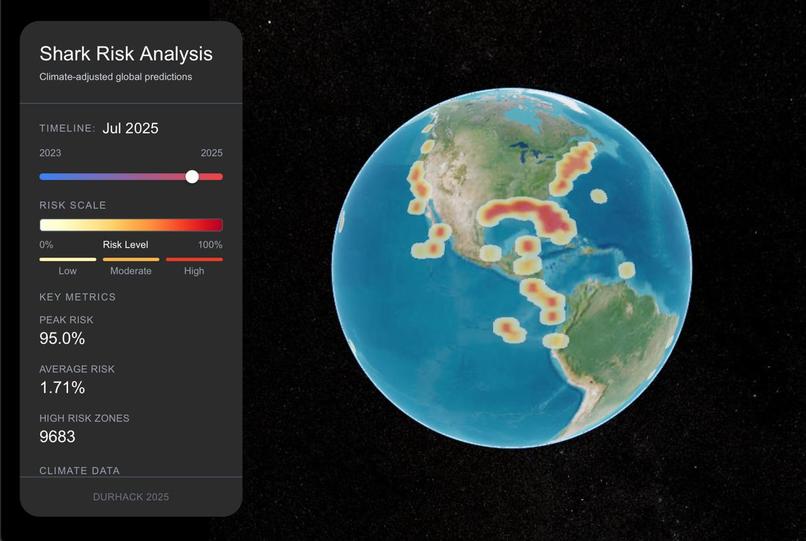
Image demonstrating program usage

Inspiration
We wanted to explore how real-world environmental factors can influence shark activity and whether machine learning could predict areas of high shark-attack likelihood. The idea of combining global data, neural networks, and an interactive 3D visualization felt both quirky and powerful. Also, building a model for shark attacks is awesome.
What it does
Our project predicts the likelihood of shark attacks around the world based on environmental and geographic data. We trained a neural network on historical shark attack data combined with features like sea surface temperature, proximity to coastlines, and nearby population density. The results are displayed on an interactive 3D globe, letting users spin the Earth and explore hotspots where shark attacks are most likely to occur, as well as choosing future dates to see what the results will look like on those days.
How we built it
We gathered real shark data, including shark attacks, their coordinates, the ocean surface temperature at those coordinates, the population, and the shark density. We then also built a negative dataset of random points across the globe. We then trained our model on this data, and tested it to ensure it could predict positions of shark attacks accurately. We then, for each month we were interested in in the future, chose 1,000,000 uniformly spread points across the earth, and used our neural network to determine whether a shark attack is likely to occur there, we then used these predictions to create a heat map, and displayed this on a 3D interactive globe, where the user can choose the date they wish to look at
Challenges we ran into
It was difficult to find relevant data sets, and even more difficult to find datasets that we could link to one another. Since shark attacks are very specific to small regions, the exact coordinates of where each attack occurred was very relevant, but this made it much harder to find things like temperature and shark density. In the end we managed to find datasets involving this information, and link them based on region or coordinates to create one coherent dataset that the model could be trained on
Accomplishments that we're proud of
We're proud that we managed to relate relevant data to the modelling of shark attacks, as well as create a working, interactive 3D globe, which felt like the most effective way to display our results, and was exactly what we were hoping to achieve from the beginning.
What we learned
Finding data sets is not necessarily east, you can't just pick a topic and expect all the information that you want to tbe out there in exactly the format you want it. If you want to be successful then careful data handling is essential to ensure that the model is receiving relevant information so that it can make correct predictions consistently.
What's next for Shark Attack Predictor
If we had more time there are a few features we would've liked to have added, we would have liked to have branched out beyond sharks to other animals, as well as give the user more UI options, such as being able to switch between a 2D and 3D map. While we are very happy with the project we've managed to create, we believe that these additions could take our program to the next level.
Built With
- nextjs
- python
- typescript


Log in or sign up for Devpost to join the conversation.