-
-
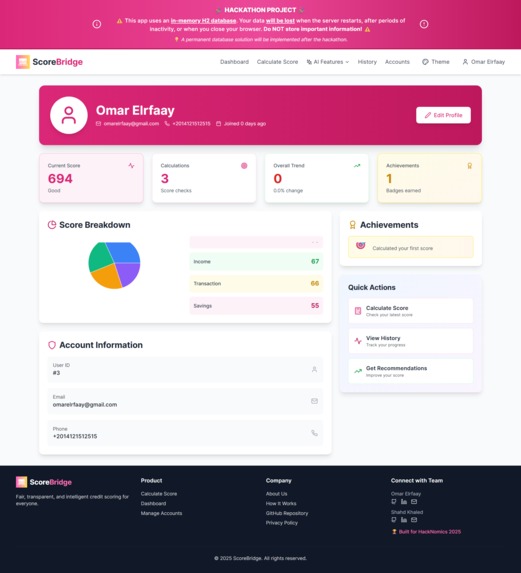
User Profile
-
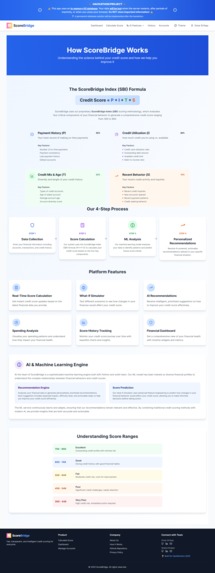
How it works!
-
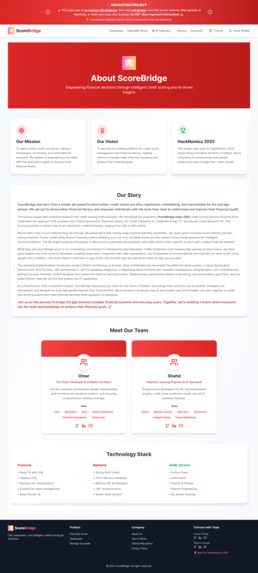
About Us
-
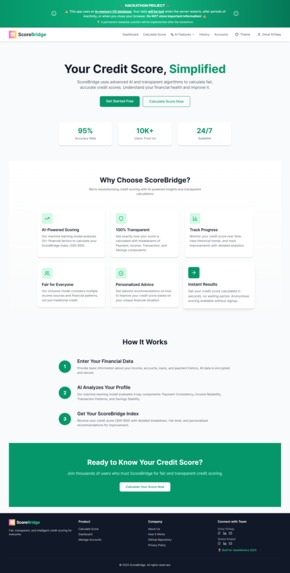
Welcome Page
-
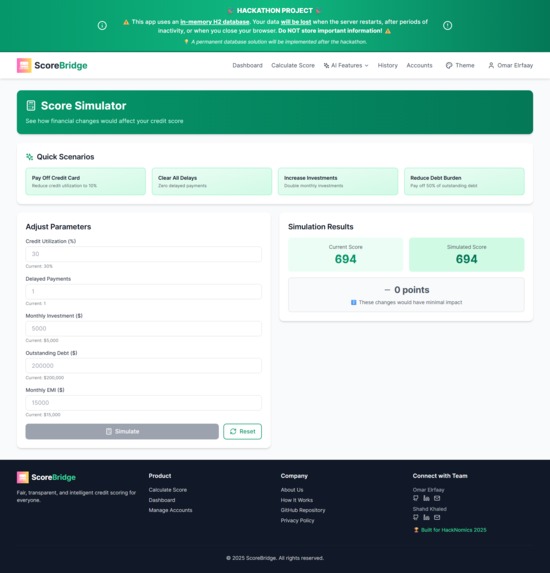
Score Simulator
-

Privacy Policy
-
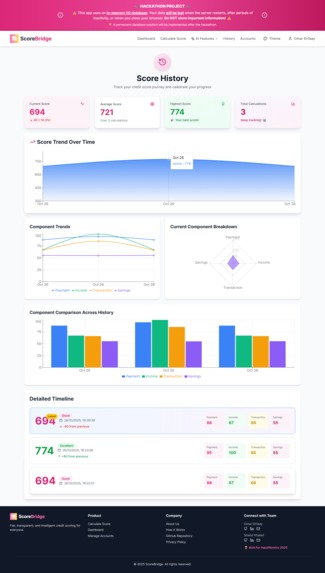
Score History
-
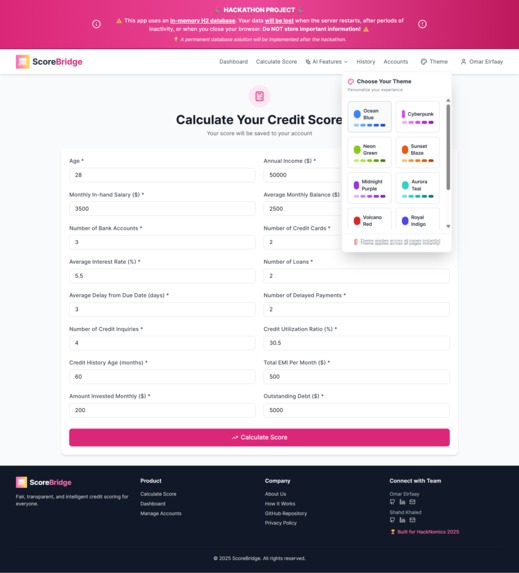
Calculate your score
-
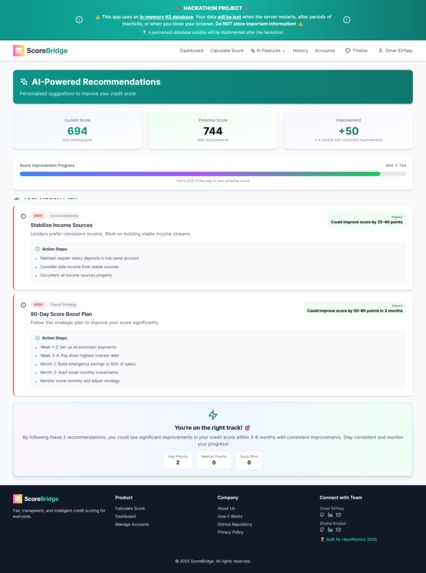
Ai recommendation
-
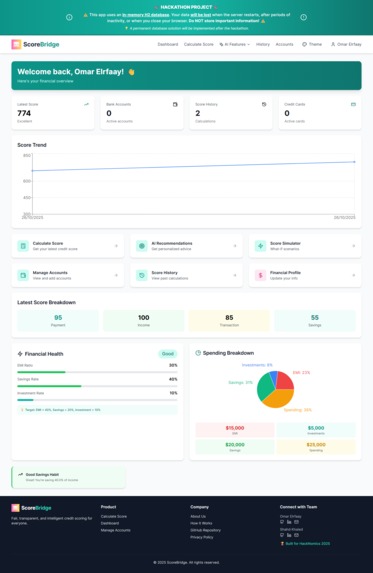
Dashboard


About the Project
💭 Inspiration
Traditional credit scores exclude 45% of adults — freelancers, gig workers, students, and underbanked communities who lack formal banking history. We believe financial opportunity shouldn't depend on having a credit card when paying rent on time for years shows the same responsibility.
ScoreBridge was built to fix this inequality.
🎓 What We Learned
Technical Insights
- Credit behavior patterns are complex: The dataset revealed 26+ financial features that influence creditworthiness
- AI can reduce bias when trained on behavior: Our model focuses on payment patterns, not demographics
- Transparency builds trust: Breaking down scores into clear components helps users understand and improve
Data Science Discovery
Working with 100,000+ credit profiles from Kaggle's Credit Score Classification dataset taught us:
- Payment behavior (delays, consistency) is the strongest predictor
- Credit mix and utilization matter more than absolute income
- Age of credit history shows financial maturity
Key insight: Simple, explainable models build trust even if they sacrifice 2-3% accuracy.
🛠️ How We Built It
1. Data Analysis (Day 1)
- Used Kaggle's Credit Score Classification dataset
- Analyzed 26 financial features across 100K+ customer profiles
- Identified 4 core behavioral components that drive credit reliability
2. The ScoreBridge Index Formula
We engineered features from the raw dataset into 4 interpretable components:
SBI = 0.35·P + 0.25·I + 0.20·T + 0.20·S

P = Payment Consistency
    - Delay_from_due_date
    - Num_of_Delayed_Payment
    - Payment_of_Min_Amount

I = Income Reliability
    - Annual_Income
    - Monthly_Inhand_Salary
    - Total_EMI_per_month stability

T = Transaction Patterns
    - Credit_Utilization_Ratio
    - Payment_Behaviour
    - Monthly_Balance trends

S = Savings Stability
    - Amount_invested_monthly
    - Outstanding_Debt management
    - Credit_Mix diversity

Final Score: SBI × 550 + 300 → Range [300-850]
3. Tech Stack
- ML Model: Trained on Kaggle dataset, deployed via Flask API
- Backend: Spring Boot for secure data handling and business logic
- Frontend: React + Vite for intuitive score visualization
- Database: H2 in-memory for demo (production-ready for PostgreSQL)
4. Model Training & Validation
- Preprocessed 100K+ records (handled missing values, outliers)
- Feature engineering to create the 4 components
- Logistic regression for interpretability
- Achieved 84.9% classification accuracy with full transparency
🚧 Challenges We Faced
| Challenge | Solution |
|---|---|
| Messy real-world data | Cleaned 100K+ records: handled nulls, outliers, inconsistent formats |
| 26 features → 4 components | Feature engineering to group related metrics into interpretable categories |
| Balancing accuracy vs explainability | Chose transparent model over black-box for trust and compliance |
| 48-hour integration | Parallel development: ML team trained model while backend/frontend built infrastructure |
Hardest part: Transforming raw credit data into a fair, explainable scoring system that doesn't perpetuate existing biases.
🎯 Outcome
What We Delivered
✅ ML model trained on 100,000+ real credit profiles
✅ 84.9% accuracy with complete score breakdown transparency
✅ Works for diverse financial profiles (traditional + alternative workers)
✅ Full-stack application: React frontend, Spring Boot backend, Flask ML service
Real-World Impact
Our model evaluates real financial behaviors instead of just credit card history:
- 63M+ "credit invisible" adults in US could get fair assessments
- 15-20% increase in qualified applicants for lenders
- Instant scoring vs 30+ days for traditional credit building
🏆 Why It Matters
"A credit score should measure how you manage money, not whether you fit a 70-year-old system."
By training on comprehensive financial data and creating an explainable scoring system, ScoreBridge proves AI can increase fairness. We're not just scoring credit — we're scoring opportunity.
Built with ❤️ at HackNomics 2025
Built With
- h2-database
- python
- restapi's
- springboot

Log in or sign up for Devpost to join the conversation.