-
-

Sarcasmo
-
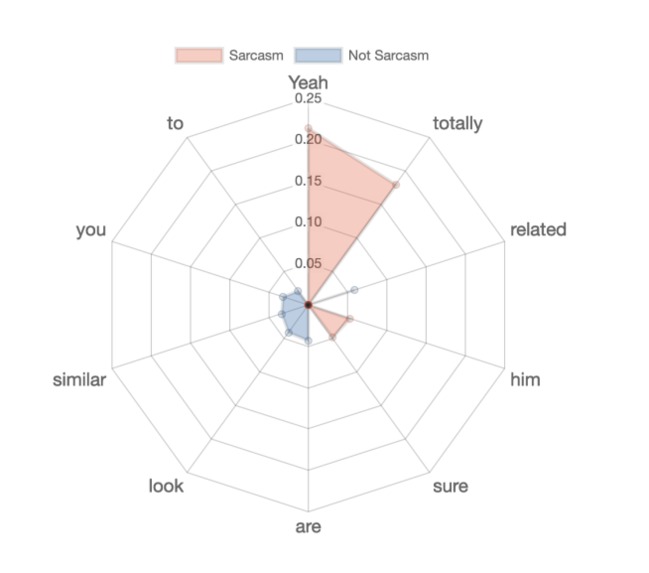
Radar Graph
-
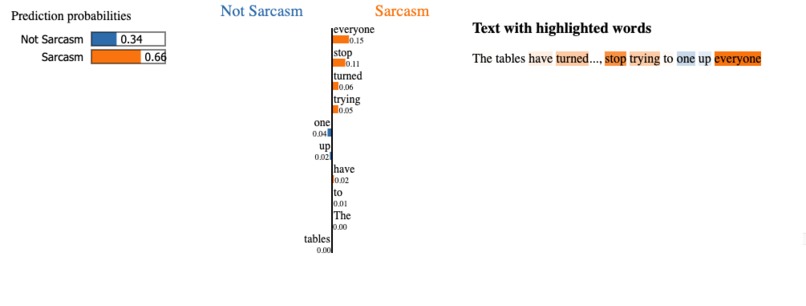
LIME interpretation


Inspiration
We live in a technology-centric world. As communication between people shifts from in-person to online, multiple problems present themselves. One such problem is sarcasm. Sarcasm is easy to detect in person because we can detect tone, sentiment, and meaning all through how a person talks. Over the internet, we can’t, and if the other person can’t tell you’re being sarcastic, you could be in trouble.
What it does
Sarcasmo uses natural language processing to detect sarcasm throughout the web.
How we built it
For the front end, we used Flask in order to run a local host web app. For the model, we used a TF-IDF vectorizer and a Support Vector Machine (SVM). The model interpretations were created by the LIME library. link. The dataset we used was from a research paper called "A Large Self-Annotated Corpus for Sarcasm" link.
Challenges we ran into
We tried to make it a google chrome extension, but ran into compatibility issues. We were limited by how much of our 1.3 million comment data set we could utilize due to low processing power.
Accomplishments that we're proud of
This is one of our first times attempting to use machine learning. We are very happy that we were able to create a machine learning model that we could train and test on 200k comments.
What we learned
We learned how to use machine learning for natural language processing. We also learned how to create a web-app interface between our machine learning model and an HTML page.
What's next for Sarcasmo
We hope to expand this as a tool that chat apps can use in order to label messages sent as sarcasm (at user's preference).

Log in or sign up for Devpost to join the conversation.