-
-
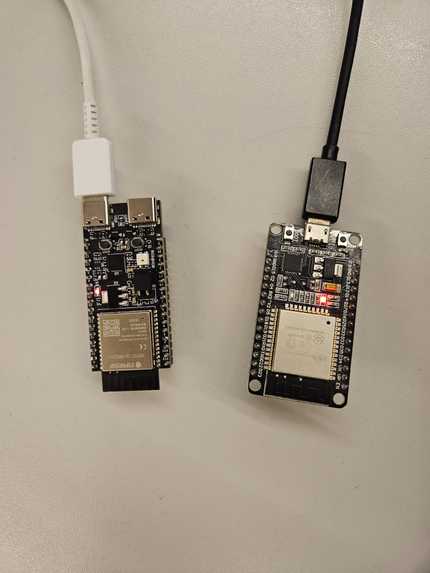
Two ESP32's used as servers
-
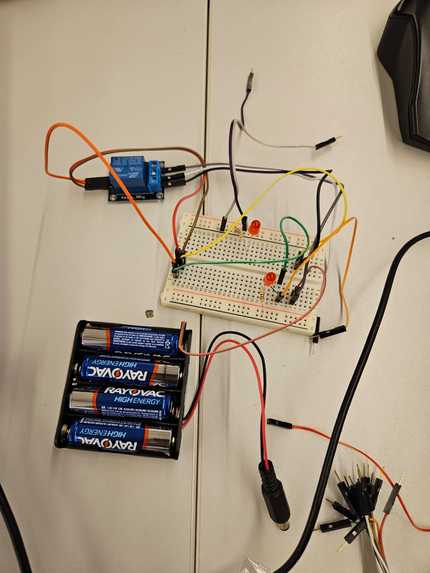
Backup power circuit
-
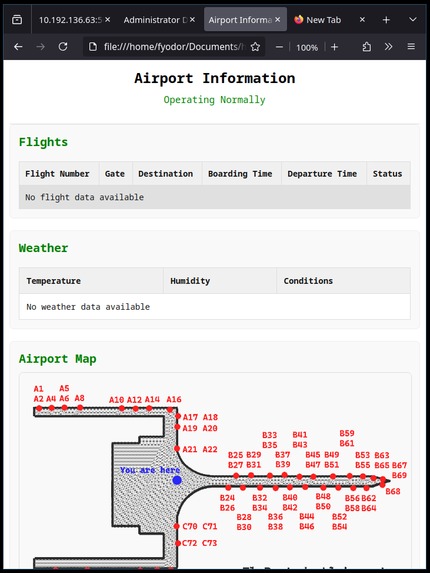
The design of the user frontend
-
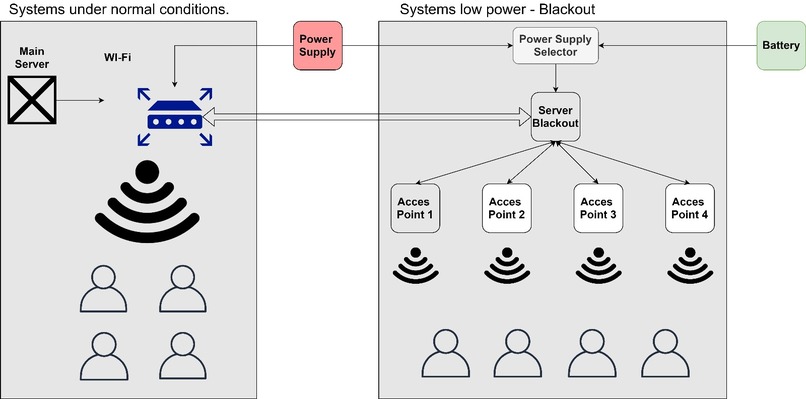
Diagram of the network


Two Computer Science undergraduates, one Embedded Systems Engineering Master's degree and one Mechatronics Master's degree come together to propose a concept of a airport backup information network that would help airline travelers in a scenario similar to the Iberian Peninsula's blackout of Monday 28/04/2025.
What is this network?
A central server located inside an airport uses various APIs to retrieve external information (such as the weather forecast). This information is stored in a database along with all of the flight information and is transmitted to smaller servers (using a low-consumption protocol such as BLE), creating a network that covers the entirety of the airport. Any traveler that wants to consult information regarding their flight (gate and departure time), can do so from anywhere inside, without the need of an internet connection.
The blackout happens. What now?
Blackout mode activates: The information is no longer automatically updated as there is no connection to external APIs. The network is kept operational since it is powered from a reserve battery. The flight information can be manually updated from the central server by an administrator and be propagated throughout the entire network, making sure every traveler knows where they need to go. Other additional critical information can be sent, such as government safety guidelines.
Why we think this is a good solution
Other than facilitating easy communication of critical information, this solution is also:
- Scalable: The network can be used for way more than transmitting information.
- Independent: Total control over the information received by travelers. The network is kept operational regardless of what is happening outside the airport
- Lightweight: Can be optimized for low power critical situations.
- And finally, it is still useful outside of the critical scenario: Someone who does not have an internet connection can use this network to stay updated on the status of their flight.
Downsides and how we can address them
- Low smartphone battery: The webpage that the traveler views from their smartphone can take advantage of OLED technology by applying a dark theme (black pixel = unlit pixel = less power consumption)
And now... About the demo we have built
Our demonstration consists of:
- A server (Laptop) that is connected to the main power grid. This server launches real time information queries and updates its database
- The master server of the backup network (ESP32 Wi-Fi capable microchip), connected to the server (Laptop) and a reserve charge battery. This server synchronizes its database with the server (Laptop) every 60 seconds using Wi-Fi.
- One slave endpoint server (another ESP32) that travelers can connect to and view a webpage displaying critical information.
To simulate a blackout, the server (Laptop) shuts down.
- The master server of the reserve network detects it is no longer powered from the server (Laptop). It switches to the reserve battery and announces a blackout situation to the slave.
- The network is kept operational and an administrator can connect in order to update information, through a special front-end panel.
- Travelers are still greeted with a simple easy-to-use webpage, now a slightly different version that aims to reduce battery usage by taking advantage of OLED technologies.
Please look at the demonstration video! First we demo the connection between the frontend (traveler user interface) and the server doing the API calls to flights and weather information. We use two laptops but you could connect from a phone. Then we showcase a blackout version of the website. Finally, we showcase that when power is lost (blackout situation!!), the master ESP32 switches to a backup power supply and creates a LAN that allows users to continue seeing manual real-time data.
Things to improve
- Use a lower power usage protocol to connect the network. We were not able to implement BLE, as the microcontrollers used do not support it.
- Finish connecting the backend on the ESP32 to the frontend. We had some issues with the hardware, where the ESP32s don't have a stable enough connection to be used as the server. Therefore, the frontend that the user sees was only simulated with the backend of the server (Laptop), even though the initial idea was for the webpage to be hosted by the ESP32s.


Log in or sign up for Devpost to join the conversation.