-

Banner
-
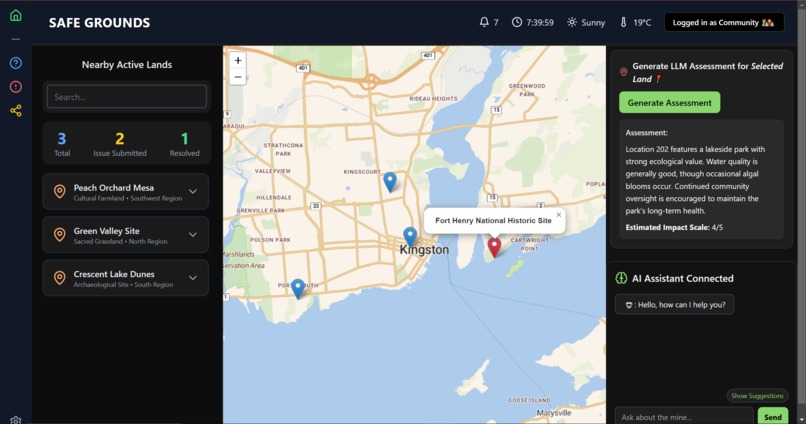
UI
-
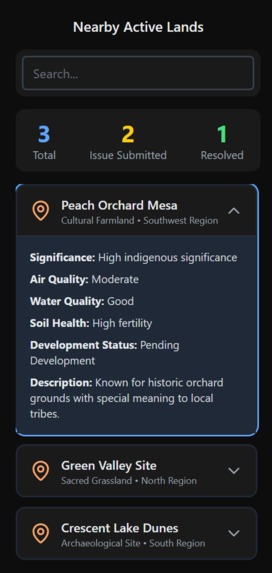
Database
-
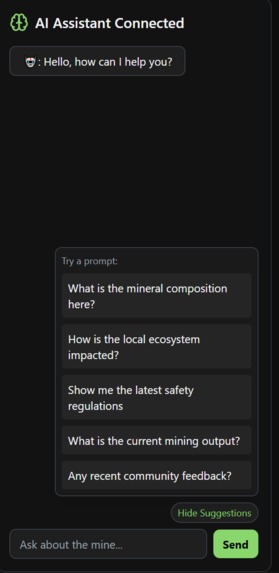
Chat


💭Inspiration💭
In today's extremely active real estate market, the acquisition and development of real estate can (unintentionally) encroach upon sacred lands, cultural sites, and territories historically tied to Indigenous peoples. For investors, balancing their economic interests with ethical duty may be hard due to a lack of accessible tools and resources to identify and respect these lands. Indigenous peoples have long faced displacement and loss of cultural heritage due to land mismanagement and uninformed development.
SafeGrounds addresses this issue by by identifying lands with cultural, historical, or spiritual significance. By empowering investors with transparent, actionable insights, "SafeGrounds" ensures the prioritization of ethical land use and the protection of Indigenous heritage.
🤔What it does🤔
The SafeGrounds website has three types of log-ins: community member, contractors/developers, city representatives. Upon logging in users can see information on nearby plots of indigenous land, including a description of the land, as well as water, air, and soil quality. Community members can submit issues, contractors/developers can respond to the feedback and announce development plans, and city representatives can submit new regulations.
🔨How we built it🔨
- Built with: TypeScript, Python, Flask, SQLite, HTML/CSS
- Libraries used: Next.js, Leaflet, Framer Motion, shadcn, Tailwind CSS
- APIs and Datasets: WebScraped locations & metadata, fed into trained ML Model.
- Other extensions and tools: AWS, ChatGPT-4 API
💪Challenges we ran into💪
- Trouble with retrieving API data.
- Buggy/slow display on map (freezing, crashing)
- Library dependency issues
🏆Accomplishments that we are proud of🏆
We are proud that we were able to achieve our original goal with the application. Implementing and integrating the many components of SafeGround in a time crunch was challenging, and extremely satisfying to complete, especially since it took us more time to come up with the idea than we thought it would.
Beyond simply feeling good that we finished, we take pride in the potential of positive impact that this project has on the future. This achievement strengthens our belief that innovative technology can and should be used to help, whether it is for social and/or economic purposes, or even other sectors, such as education and healthcare. We believe SafeGround is one of many steps in the right direction, combining technology with empathy and ethics to contribute to a greater future.
🎓What we learned🎓
- First, while working on the project, we researched to learn more about indigenous land, and learned some statistics about the amount of sacred land which has been ignored and developed upon.
- Second, through the development process, we also learned (taught ourselves by trial and error) how to properly integrate some some of the tools we used, which were completely new to us, like Leaflet.
- Lastly, as is the case with many team projects, we were reminded of the importance of communication, cohesion, and overall teamwork. By constantly working together and filling in gaps for each other (through different areas of expertise), our team of only two was able to achieve a lot more than if we had each worked individually. Our work combined was, and will always be greater than the sum of our parts.
🔜What's next for SafeGround🔜
No matter how far we go, there is always room for improvement. Some developments that we may soon implement are:
- Develop a web app
- Have an AI recommend and set up deals for investors
- The processing for SafeGround will be further optimized, so that it can take less resources and run more efficiently.
- Better worldwide support, particularly for places that are not so well known.
Built With
- amazon-web-services
- chatgpt
- css
- flask
- framermotion
- html
- javascript
- leaflet.js
- next.js
- python
- shadcn
- sqlite
- typescript


Log in or sign up for Devpost to join the conversation.