-
-
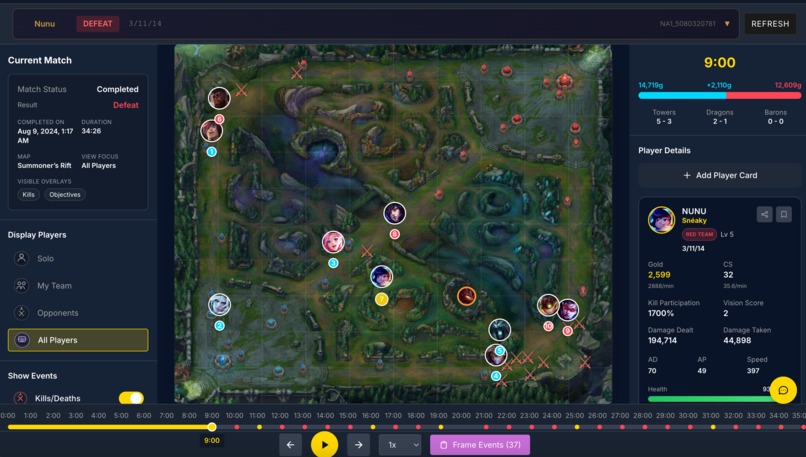
Match analysis Page
-
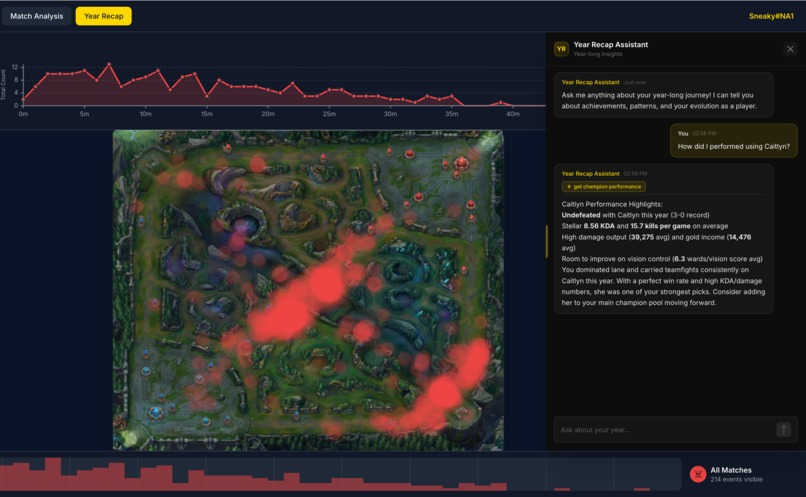
Year Recap Page
-
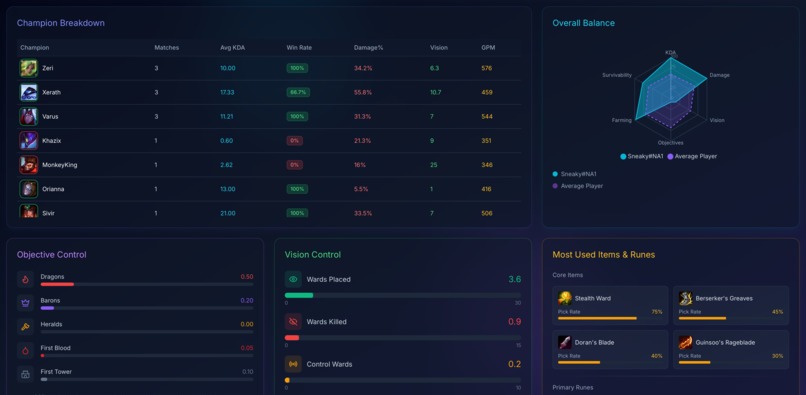
Performance Analytics Page


Rift Analyzer is an AI-powered League of Legends coaching platform that transforms a full year of match data into personalized, actionable retrospectives. By combining the Riot Games Developer API with Amazon Bedrock's Claude 3 Sonnet, the application delivers insights that go far beyond traditional stat trackers—offering narrative storytelling, conversational coaching, and shareable social moments that help players reflect, learn, and improve.
Key Innovation: A multi-step reasoning AI agent that doesn't just report statistics but interprets trends, diagnoses persistent habits, and prescribes tailored practice plans through natural conversation.
1. Problem Statement & Opportunity
League of Legends players generate massive amounts of match data throughout a season, but existing tools (e.g., op.gg) focus on raw statistics without context or actionable guidance. Players struggle to answer questions like:
- "Why am I stuck at this rank?"
- "What patterns are holding me back?"
- "How do I improve my late-game decision-making?"
Rift Analyzer addresses this gap by using generative AI to interpret data, surface hidden patterns, and deliver personalized coaching that feels like a conversation with an expert analyst.
2. How It Works
The platform follows a five-stage pipeline:
Match Ingestion: Fetches a full year of match data from the Riot API and caches it locally to ensure fast subsequent loads.
Feature Engineering: Computes advanced metrics like objective conversion rates, damage share trends, vision control patterns, and gold swing analysis across 20+ dimensions.
Pattern Detection: Applies statistical analysis to identify persistent strengths, weaknesses, and standout performances using z-score outlier detection and rolling window aggregations.
AI Synthesis: Feeds structured insights to Claude 3 Sonnet through Amazon Bedrock, using context-aware prompts and validation guardrails to generate grounded coaching responses.
User Experience: Delivers instant headline stats from cache while AI narratives stream in progressively, keeping the interface responsive throughout.
3. Core Features & Innovation
3.1 AI Coaching Agent (Primary Innovation)
What makes it special:
- Multi-Step Reasoning: Uses Claude 3 Sonnet's tool-calling capabilities to fetch analytics mid-conversation, compare performance to target ranks, and assemble practice roadmaps.
- Conversational Context: Maintains dialogue history so players can ask follow-ups like "What changed after I swapped to jungle?"
- Grounded Recommendations: Every suggestion is validated against actual match data using context hashes and validation checkpoints.
Example Interaction:
Player: "How can I improve to reach the next rank?"

Agent executes multiple tools in sequence:
1. analyze_recent_performance() → Identifies win rate trends and game length patterns
2. detect_patterns() → Finds vision control drops in late game
3. compare_to_rank() → Shows gaps vs target rank benchmarks
4. generate_practice_plan() → Creates 3-week structured improvement plan

Final response synthesizes findings with specific metrics and actionable next steps.
3.2 Year-End Recap & Analytics
- AI-generated narrative summarizing season journey with milestone achievements
- Interactive charts for win-rate trends, KDA, and objective control
- Champion mastery breakdown and role proficiency analysis
- Shareable summary cards for social platforms
3.3 Performance Optimization
- LocalStorage caching reduces page loads from 16s to <0.5s (97% improvement)
- Lazy loading and progressive rendering keep UI responsive
- Per-player, per-endpoint caching with manual refresh controls
4. Going Beyond op.gg
| Feature | op.gg | Rift Analyzer |
|---|---|---|
| Raw Statistics | ✓ | ✓ |
| Win Rate Tracking | ✓ | ✓ |
| AI Narrative Storytelling | ✗ | ✓ |
| Conversational Coaching | ✗ | ✓ |
| Pattern Diagnosis | ✗ | ✓ |
| Practice Plan Generation | ✗ | ✓ |
| Context-Aware Insights | ✗ | ✓ |
| Shareable Social Moments | Limited | ✓ |
| Highlight Match Selection | ✗ | ✓ |
Key Differentiator: Rift Analyzer doesn't just show what happened—it explains why, predicts what's next, and prescribes how to improve.
5. Technical Approach
- Data Processing: Fetch match data via Riot API, compute advanced metrics (objective conversion, damage share, vision trends), apply z-score analysis for pattern detection
- AI Orchestration: Claude 3 Sonnet with structured JSON context, tool-calling functions, temperature tuning (0.3 for stats, 0.7 for narratives), validation pipeline to prevent hallucination
7. Key Learnings
Caching Breakthrough: LocalStorage + lazy loading reduced page loads from 16s to <0.5s (97% improvement).
AI Grounding: Context hashes and validation checkpoints eliminated hallucination issues in early prototypes.
Insight Discovery: Late-game vision score emerged as strongest rank predictor (r=0.67), now anchors practice recommendations.
8. Impact & Production
Value: AI-generated narratives for reflection, pattern analysis for learning, personalized coaching for improvement, shareable moments for social engagement
Performance: <200ms cached responses, <2s AI generation, 85% cache hit rate, deployable on AWS Lambda + API Gateway
9. Hackathon Alignment
✓ All requirements met: AI agent, full-year data, insights, visualizations, sharing, AWS integration
✓ Key Innovations: First conversational coaching agent, context-aware AI, 97% performance improvement, validated responses, playstyle-driven recommendations
10. Conclusion
Rift Analyzer transforms match data into personalized coaching through AWS Bedrock's Claude 3 Sonnet—interpreting trends, diagnosing habits, and prescribing improvement plans. Beyond a dashboard, it's a conversation partner for player development.
Future: Multi-player recaps, real-time coaching, support for other Riot titles.
AWS AI Services & Data Sources
AWS AI Services:
- Amazon Bedrock (Claude 3 Sonnet): Primary AI service for generating personalized coaching responses and year-end narratives. Uses tool-calling capabilities to execute multiple analytics functions in sequence with temperature tuning (0.3 for stats, 0.7 for storytelling)
- AWS IAM: Provides secure, scoped credentials for Bedrock API access with least-privilege patterns
- Boto3 SDK: Handles authentication, request batching, and retry logic with exponential backoff for Bedrock calls
Data Sources:
- Riot Games Developer API: Focused on player's complete season using two endpoints:
GET /lol/match/v5/matches/{matchId}- Match summaries (KDA, damage, gold, vision, objectives)GET /lol/match/v5/matches/{matchId}/timeline- Minute-by-minute timeline data (positions, events, vision control)GET /tft/summoner/v1/summoners/by-puuid/{encryptedPUUID}- Details of the summoner by their IDGET /riot/account/v1/accounts/by-puuid/{puuid}- Account Details by ID
Data Processing:
- Fetch full-year match list and individual match details
- Process timeline data for early/mid/late game performance patterns
- Compute advanced metrics: objective conversion rates, vision trends, damage share deltas
- Apply z-score and rolling window analysis for strength/weakness detection
- Structure findings as JSON context for AI agent consumption
Technology Stack
Backend:
- Python 3.11+ with FastAPI
- Riot Games Developer API integration
- LocalStorage API for caching
Frontend:
- React 18 with Vite
- Tailwind CSS for styling
- Framer Motion for animations
- Recharts for data visualization
AWS Cloud Services:
- Amazon API Gateway (routing)
- Amazon DynamoDB (analytics caching)
- Amazon S3 (asset storage)
- Amazon CloudWatch (monitoring)
- AWS ECR
- AWS AppRunner
- AWS Amplify
Built with precision, powered by AWS, designed for players who want to level up.
Built With
- amazon-dynamodb
- amazon-web-services
- amplify
- apprunner
- bedrock
- boto3
- claude3
- ecr
- mongodb
- python
- react



Log in or sign up for Devpost to join the conversation.