-
-
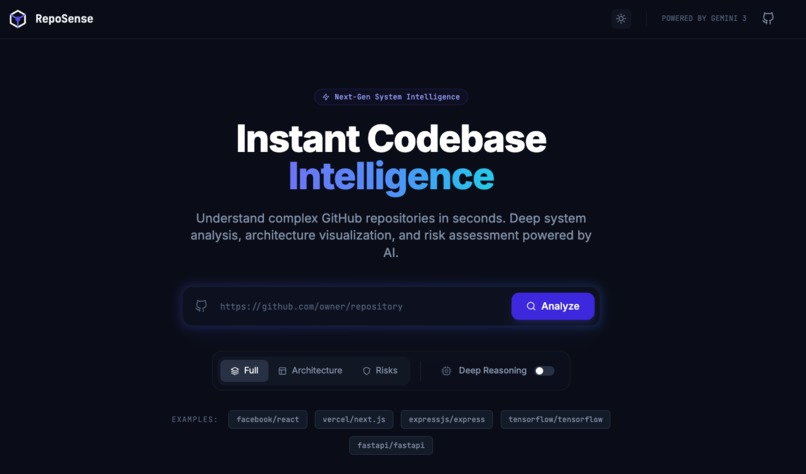
Dark Mode
-
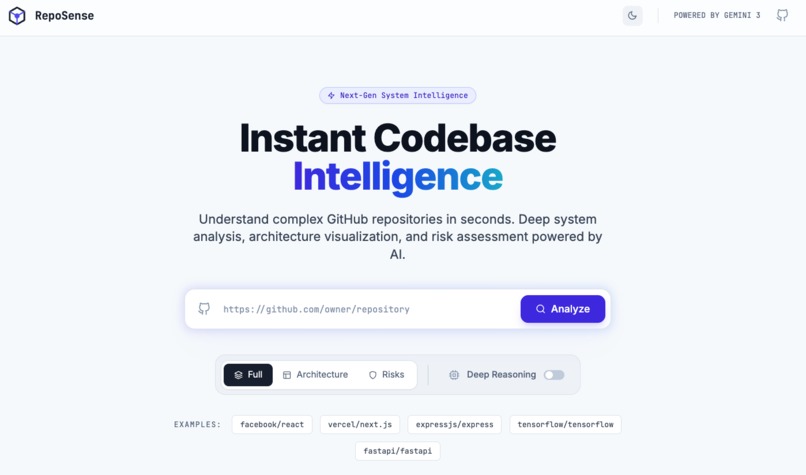
Light Mode
-
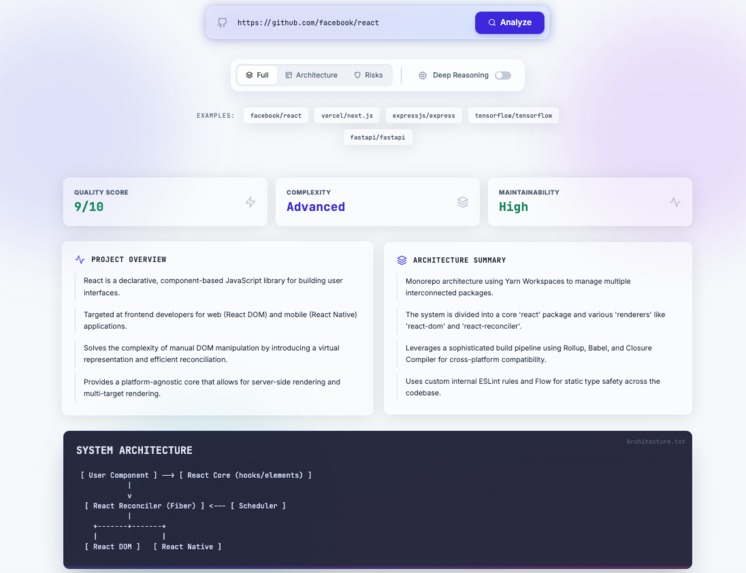
Results


RepoSense — About the Project
Inspiration
Understanding an unfamiliar codebase is one of the most time-consuming and frustrating tasks for developers. Whether onboarding to a new team, reviewing an open-source project, or evaluating a hackathon submission, developers often spend hours navigating folders, tracing data flow, and inferring architectural decisions.
Most existing tools focus on syntax-level or static analysis. They explain what the code does, but rarely explain why a system is structured the way it is.
The release of Gemini 3, with its enhanced reasoning and long-context capabilities, inspired me to explore a different approach: treating a codebase as a system to be reasoned about, not just a collection of files. This idea led to the creation of RepoSense.
What I Built
RepoSense is a Gemini-powered code intelligence tool that analyzes public GitHub repositories and produces system-level insights rather than conversational responses.
Given a repository URL, RepoSense infers:
- The project’s purpose and intended users
- High-level system architecture and design patterns
- Responsibilities of key folders and components
- Data and control flow across the application
- Code quality issues, risks, and anti-patterns
- Actionable improvement recommendations
- A simple ASCII architecture diagram
The output is structured, deterministic, and optimized for rapid understanding.
How I Built It
RepoSense was built entirely using Google AI Studio (Antigravity) with Gemini 3 as the core reasoning engine.
Key design decisions include:
Reasoning-first design
The application avoids chat-style interactions and instead produces structured system analysis.Prompt engineering
Carefully designed prompts guide Gemini 3 to reason holistically about repositories, infer architecture, and avoid generic advice.Interactive frontend
Users can switch between full analysis, architecture-only, and risk-focused views, with an optional deep reasoning mode.Graceful latency handling
Since deep analysis can take time, the UI communicates progress clearly instead of failing or blocking.
No traditional backend is required. Gemini 3 API access and execution are managed securely by Google AI Studio.
Challenges Faced
One major challenge was handling real-world constraints such as GitHub API rate limits when analyzing popular repositories. Instead of exposing raw errors, RepoSense switches to a graceful fallback mode that clearly communicates temporary limitations while still delivering meaningful, inference-based insights.
Another challenge was ensuring that Gemini 3’s output remained precise and non-generic. Achieving this required multiple iterations of prompt refinement to balance depth, clarity, and determinism.
Designing a frontend that felt like a real developer tool—not a demo—was also a key focus, especially around alignment, typography, theming, and dark/light mode support.
What I Learned
Through this project, I learned:
- How to design prompts for long-context, system-level reasoning
- How to build AI-powered tools beyond chat interfaces
- How thoughtful UX can build trust in AI systems
- How to handle API limitations gracefully
- How to translate raw AI capability into a usable product
Most importantly, I learned how powerful reasoning-focused models like Gemini 3 can be when treated as analytical engines rather than conversational agents.
Conclusion
RepoSense demonstrates how Gemini 3 can power next-generation developer tools that reason about complex systems, not just individual code snippets. By focusing on architecture, intent, and system behavior, the project highlights a practical and impactful use of Gemini 3’s advanced reasoning capabilities.
Built With
- 3
- ai
- ai-powered
- analysis
- antigravity
- api
- application
- applications
- architecture
- artificial
- cloud
- code
- css
- dark
- deployment
- design
- developer
- development
- engineering
- frontend
- gemini
- gemini-3
- generative
- github
- github-api
- google-ai-studio
- html
- intelligence
- interactive
- javascript
- language
- large
- light
- long-context
- mode
- models
- prompt
- prompt-engineering
- reasoning
- repositories
- software
- static
- studio
- system-level
- tools
- ui
- ui/ux
- vercel
- web
Log in or sign up for Devpost to join the conversation.