-
-
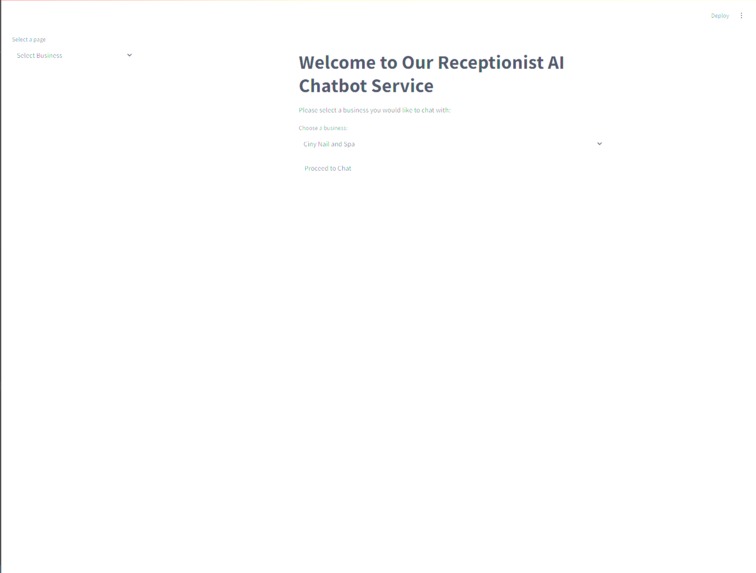
Welcome page
-
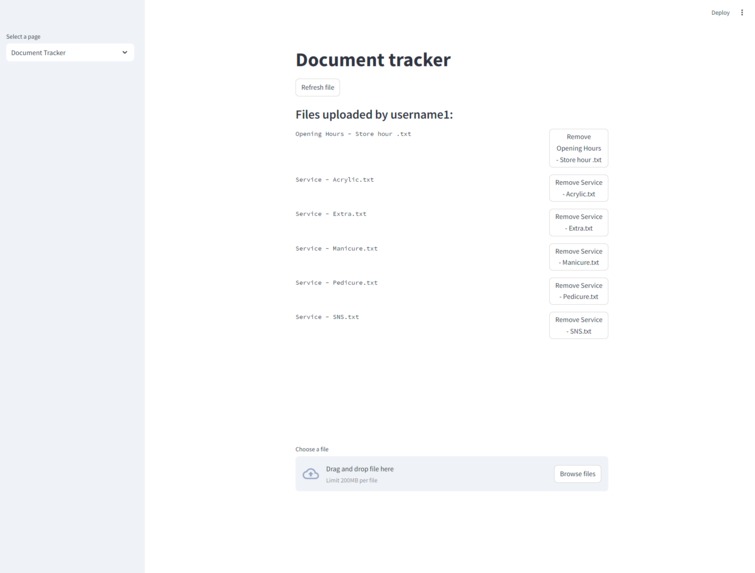
Document Tracker
-
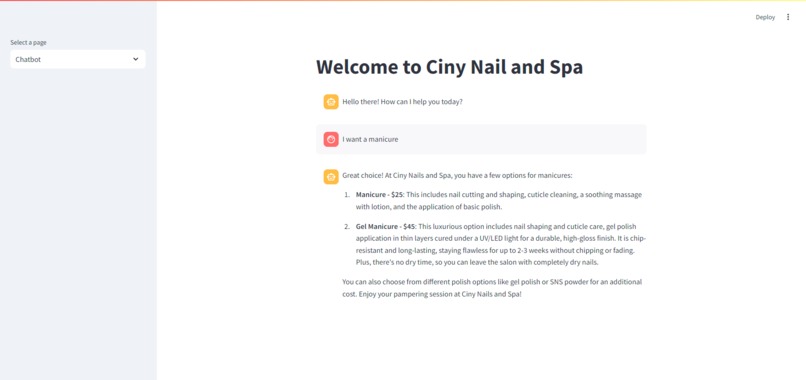
Sample QnA
-
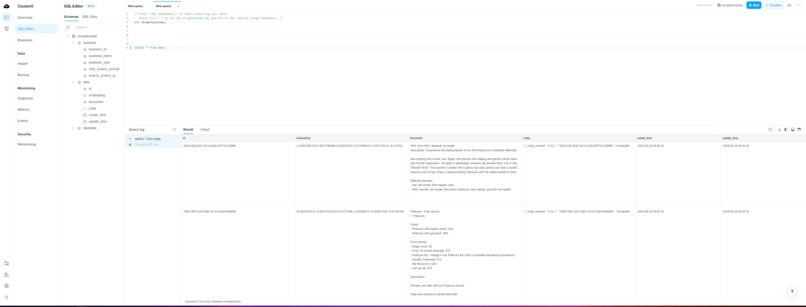
TIDB


Inspiration
During a visit to a nail salon, we overheard the receptionist expressing frustration about having to answer the same questions repeatedly each day. This experience inspired us to develop a chatbot that leverages a Retrieval-Augmented Generation (RAG) model, designed to assist customers by efficiently utilizing the business's documentation.
What it does
This business front desk assistant is designed to streamline customer service tasks, such as answering questions and suggesting additional services based on customer needs to help boost sales. It is adaptable to a wide range of businesses, ensuring that the chatbot responds to customer inquiries based solely on the specific business. Business owners can easily manage their data through a user-friendly interface, allowing them to add new services or remove outdated ones with just a few clicks.
How we built it
Receptionist AI is powered by the GPT-4.0 model integrated with TiDB Serverless, utilizing its Vector Search feature.
To support multiple businesses simultaneously, we customize the index to include business names and IDs. The index stored in TiDB is enriched with metadata indicating which business it belongs to. This allows each business to have its own tailored system prompt, ensuring the chatbot interacts in a manner consistent with the specific preferences and needs of each business.
Challenges we ran into
We encountered some challenges with obtaining the filter index from LlamaIndex. While we were able to retrieve the correct index from the TiDB vector store, the chatbot struggled to adhere to the system messages, resulting in answers that were not as polished as we had hoped. Although the responses were concise and straightforward—which can be advantageous in certain situations—we aimed for a more natural and friendly tone.
Accomplishments that we're proud of
Accuracy We empower businesses to choose the specific data that is fed into the chatbot, enabling them to gain better insights into the chatbot's performance. This level of control helps businesses tailor the chatbot's responses to align with their objectives and better meet their customers' needs.
Data Management The chatbot effectively retrieves accurate information from the TiDB database and provides professional responses. Additionally, it can subtly recommend higher-priced services when appropriate, catering to users' needs without being overly aggressive—a task that is often overlooked by human receptionists during busy times at the salon.
What we learned
Prior to this hackathon, we were not fully aware of the impressive capabilities of TiDB. Its user-friendly interface has made data interaction remarkably straightforward. Additionally, we've gained valuable experience working with LlamaIndex and Streamlit, further deepening our understanding of Retrieval-Augmented Generation (RAG) models
What's next for Receptionist AI
We have outlined a few key steps for the development of Receptionist AI:
Resolve the filtered index issue. Develop an interface for new businesses to sign up. This interface will allow businesses to select their business ID and review a system prompt overview. We will provide a suggested system prompt, which they can customize as needed.
Built With
- llama
- mysql
- openai
- python
- sqlalchemy
- streamlit
- tidb


Log in or sign up for Devpost to join the conversation.