-
-
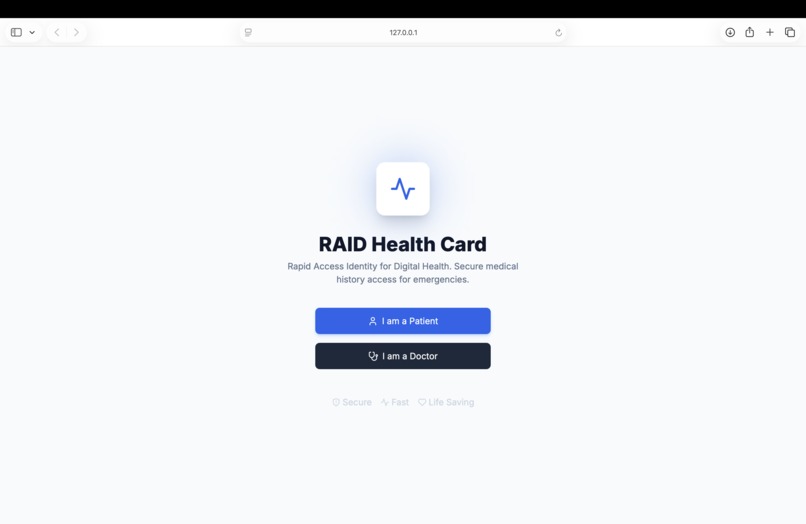
DashBoard
-
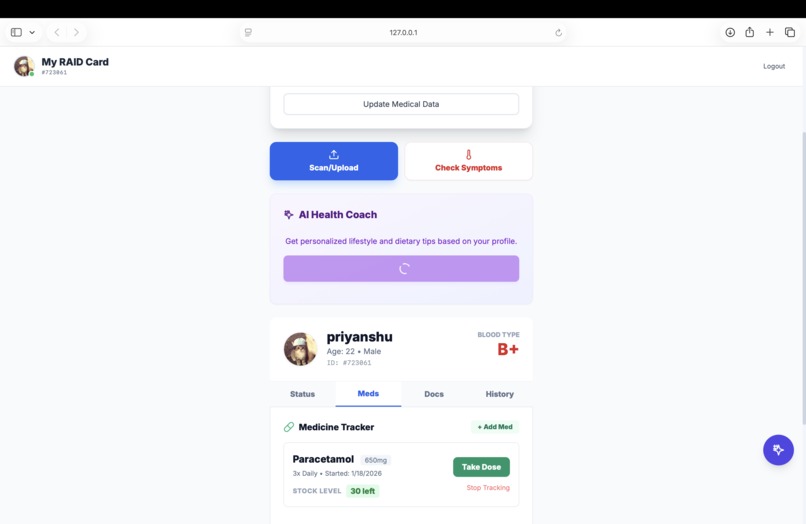
Med Tracker feature
-
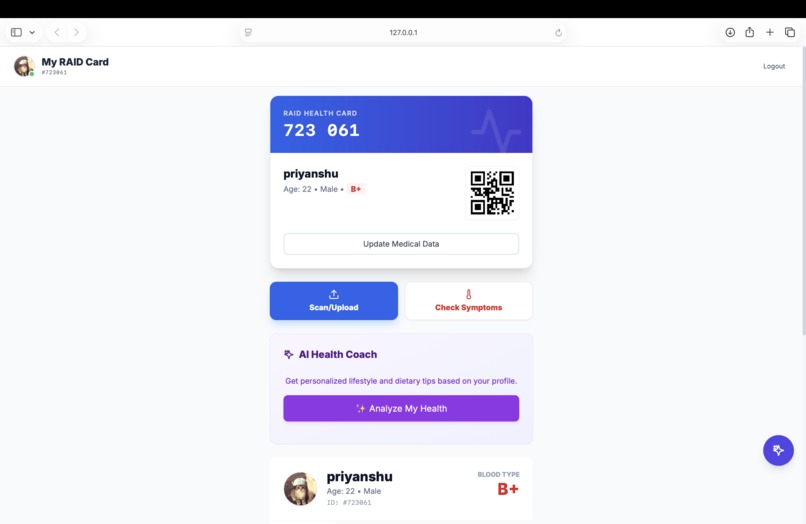
Patient Side
-
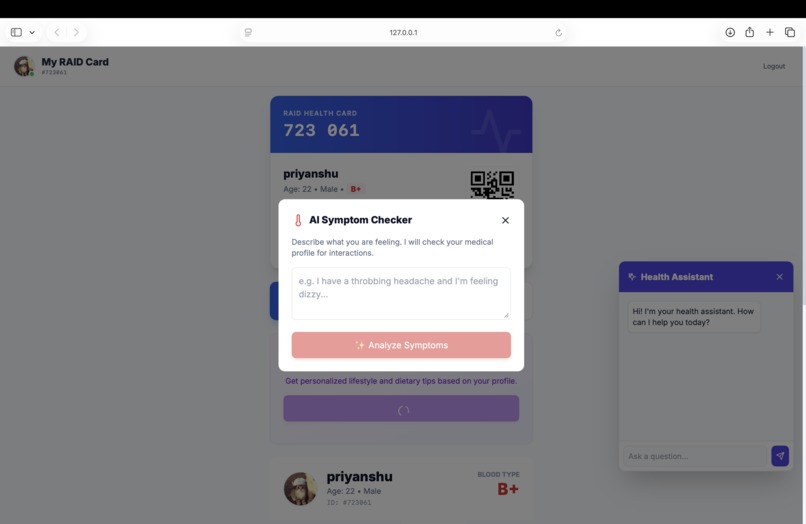
Ai symptom analyzer
-
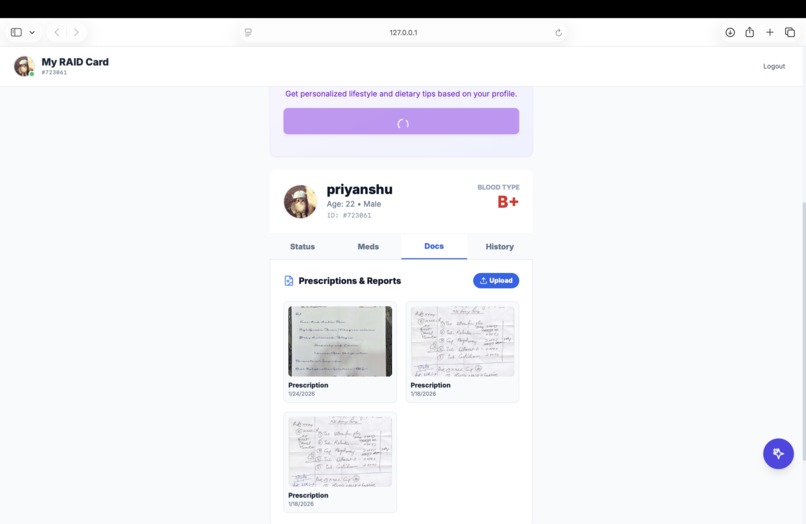
Prescription history feature


Inspiration
In the critical "Golden Hour" following a medical emergency, accurate information is often the difference between life and death. Yet, patients frequently arrive at emergency rooms unconscious, confused, or unable to recall complex medical histories. We realized that while financial transactions have become seamless with UPI, medical identity remains fragmented and inaccessible when it matters most.
We asked ourselves: Why isn't there a "UPI for Health"—a single, secure, and rapid way to transfer critical context from patient to doctor?
This question drove the creation of RAID (Rapid Access Intelligent Data). We wanted to build a bridge that speaks for the patient when they cannot speak for themselves, ensuring that a lack of information never becomes the cause of a medical error.
What it does
RAID Health Card is a secure digital medical identity system designed for speed, privacy, and intelligence.
- Instant Identification: It assigns users a unique RAID ID and dynamic QR code. When scanned by a medical professional, it instantly retrieves vital stats: Blood Group, Allergies, and Chronic Conditions.
- Consent-First Access: We implemented a "Consent Mode" using a secure Access PIN. While basic trauma data is accessible quickly, sensitive data (like detailed history or Aadhaar numbers) requires explicit permission.
- AI-Powered Doctor Assistant: We integrated Google Gemini to act as an intelligent layer. It analyzes the patient's unstructured history to generate:
- Concise Summaries: Clinical abstracts for quick reading.
Differential Diagnosis: AI-driven insights based on presented symptoms.
Audit Trails: Every time a record is accessed, it is logged in the Access Log System, giving users complete transparency.
How we built it
We built RAID with a focus on real-time availability and security.
- Backend & Auth: We utilized Google Firebase for its robust real-time database capabilities and secure authentication. This ensures that when a user updates their allergies, the change is propagated instantly across all endpoints.
The AI Engine: The core intelligence is powered by the Google Gemini API. We engineered specific prompts to sanitize and summarize medical text. The model processes the unstructured medical notes ( M ) to produce a structured summary ( S ):
Interoperability: To ensure we aren't creating another "walled garden," we adopted the HL7 FHIR (Fast Healthcare Interoperability Resources) standard. Users can export their full medical history in standard JSON format.
Security: We implemented a role-based access control (RBAC) model where access is granted only if public or verified:
Challenges we ran into
- The Privacy Paradox: Balancing "Rapid Access" with "Data Privacy" was our biggest hurdle. We had to architect the Consent Mode to ensure that while blood type is public (for emergencies), sensitive history remains locked.
- Standardizing Medical Data: Mapping user-entered data to the complex HL7 FHIR standard was difficult. We had to write custom parsers to convert simple text inputs into complex, nested JSON objects.
- AI Hallucinations: Early tests with the AI sometimes produced generic health advice. We had to fine-tune our system prompts to strictly ground the AI's responses in the provided user data.
Accomplishments that we're proud of
- Functional AI Integration: Successfully getting Gemini to act as a "triage assistant" rather than just a chatbot was a major win.
- The Access Log: Building a transparent logging system that lets users see exactly when their data was touched builds massive trust.
- Standard Compliance: Successfully generating valid FHIR-compliant JSON exports puts RAID in a professional league of health-tech tools.
What we learned
- Data Sovereignty: We learned that users care deeply about owning their data. Features like "Export to JSON" aren't just technical features; they are trust features.
- Prompt Engineering is Engineering: We learned that crafting the right context for an LLM is as critical as writing the backend code itself, especially in high-stakes fields like healthcare.
What's next for RAID Card
- Offline Mode (PWA): Enabling critical data access even without active internet connectivity using local caching.
- Wearable Integration: Syncing real-time vitals (Heart Rate, SpO2) from smartwatches directly into the RAID dashboard.
- ABHA Integration: We aim to link RAID with the Ayushman Bharat Health Account (ABHA) ecosystem to make it a nationally viable solution.

Log in or sign up for Devpost to join the conversation.