-
-
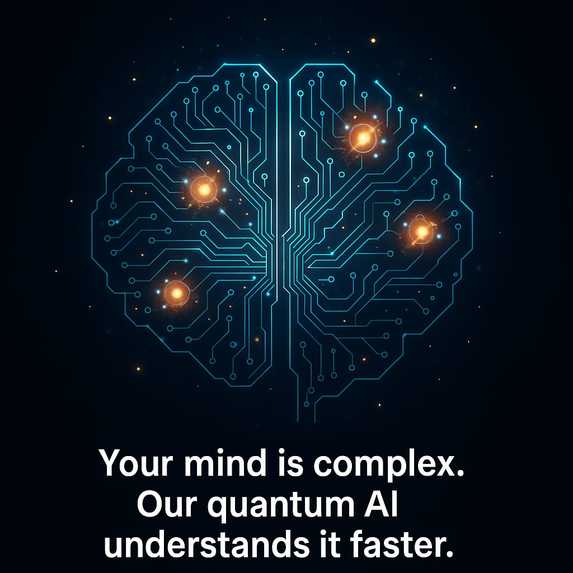
Q-Mind

Inspiration
Mental health issues are often overlooked until they become critical and they becoming increasingly common. We were inspired by the question: Can we catch emotional distress earlier using quantum-powered AI?
Q-Mind was born from the desire to fuse mental health care with cutting-edge technology, building a system that doesn't just react to crises but helps predict and prevent them.
What it does
Q-Mind is an AI mental health assistant that uses quantum machine learning (QML) to analyze user data like voice tone, written text, and biometrics to detect early signs of mental distress. It classifies emotional states (e.g., stress, anxiety, fatigue) in high-dimensional space using quantum-enhanced algorithms like Quantum Support Vector Machines. This enables proactive support for students, professionals, and patients all while respecting user privacy.
How we built it
This was a conceptual build focused on combining deep tech with real-world impact.
Our steps:
Mapped out a data flow pipeline:
Inputs: Voice, text, heart rate
Feature extraction and normalization
Quantum kernel embedding
Classification via Quantum SVM
Designed use cases for schools, clinics, and workplaces. Created presentation visuals to illustrate potential real-world integration.
Challenges we ran into
-Explaining quantum concepts in a simple way for a broader audience. -Finding real datasets with enough granularity to model emotion classification. -Simulating quantum workflows using open-source tools like Qiskit, without access to real quantum hardware. -Balancing ambition and feasibility we aimed for something visionary but grounded in existing tools.
Accomplishments that we're proud of
-Developed a cohesive mental health use case for quantum computing -Created a clear pipeline from data collection to quantum classification -Learned to model Quantum SVMs and represent them visually -Made a highly visual, accessible presentation that communicates deep tech simply
What we learned
-How quantum computing can be used beyond cryptography in emotional pattern recognition -The structure and math behind QML algorithms, especially Quantum SVMs and kernels -The importance of ethical design and data privacy in mental health tech -How to ideate and communicate deep technical ideas in a clear, engaging way
What's next for Q-Mind
-Prototype Q-Mind using small-scale emotional datasets and PennyLane or Qiskit Machine Learning -Integrate feedback from therapists and educators on what signals matter most -Develop a mobile frontend that connects to wearable data (e.g., heart rate, journaling) -Explore quantum-secure data encryption to ensure user privacy at scale -Long-term goal: Position Q-Mind as a personal wellness assistant embedded in smart devices
Built With
- ai
- canva
- powerpoint
- qiskit


Log in or sign up for Devpost to join the conversation.