-
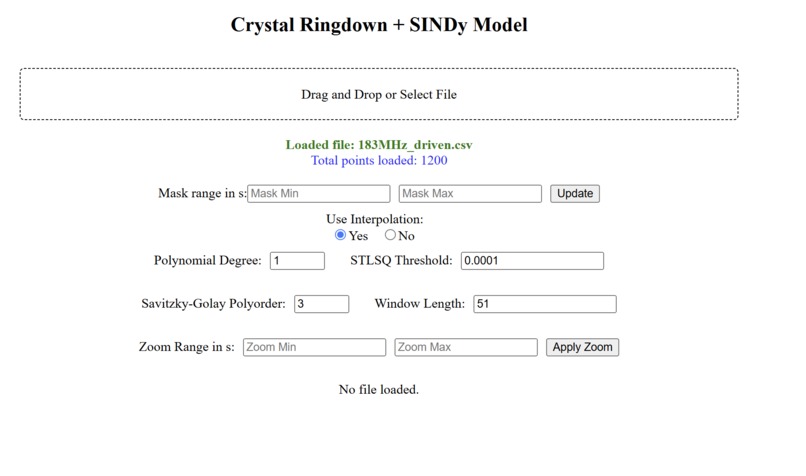
GUI
-
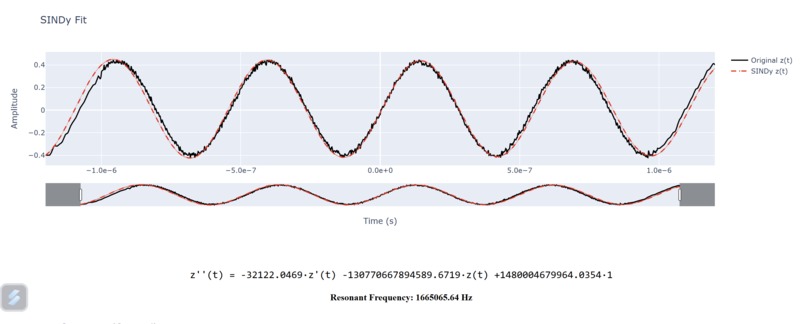
Normal + SINDy displayed governing equation (and plots)
-
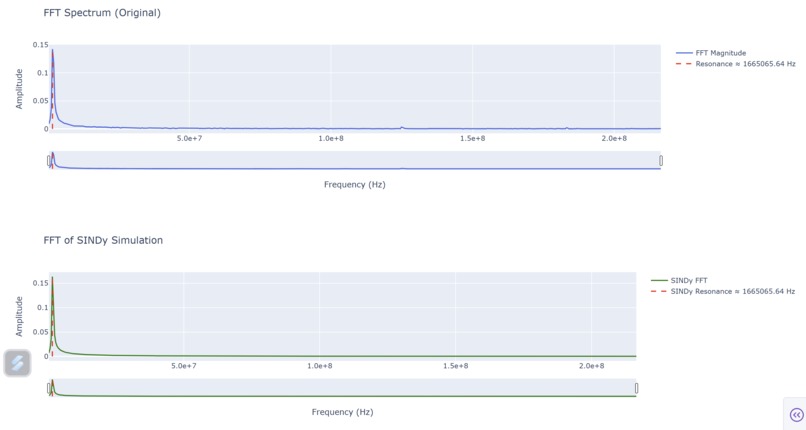
FFT of both and their quality factor (Q)


As a researcher working in the photonics industry, I saw engineers struggling with manual crystal resonance analysis, which is critical for laser systems and quantum devices. I built an AI-powered tool that automatically discovers governing physics equations from experimental data using SINDy (Sparse Identification of Nonlinear Dynamics) and the help of Bolt.new.
The application combines advanced signal processing (FFT analysis, Savitzky-Golay filtering, Hilbert transforms) with machine learning to identify differential equations like z''(t) = -ω²z(t) - γz'(t) without prior assumptions. Users upload CSV data, and the system automatically extracts resonant frequencies, quality factors, and underlying physics models. This can be done for any particular data as long as it's taken as a two dimensional time + displacement z(t) analysis.
Key challenges included handling noisy experimental data, ensuring numerical stability in derivative estimation, and building intuitive controls for complex mathematical parameters. The interactive Dash interface allows real-time parameter tuning and comparison between original and simulated signals. Bolt really helped a lot on creating and guiding the program for the right parameters for better sparse identification.
Bolt.new was crucial for rapid prototyping - instead of weeks setting up environments, I focused on core algorithms and UX. The instant preview and seamless package management enabled quick iteration on complex scientific visualizations.
This democratizes advanced physics analysis for the $4B+ photonics market, letting engineers discover system dynamics automatically rather than spending hours on manual curve fitting.


Log in or sign up for Devpost to join the conversation.