-
-
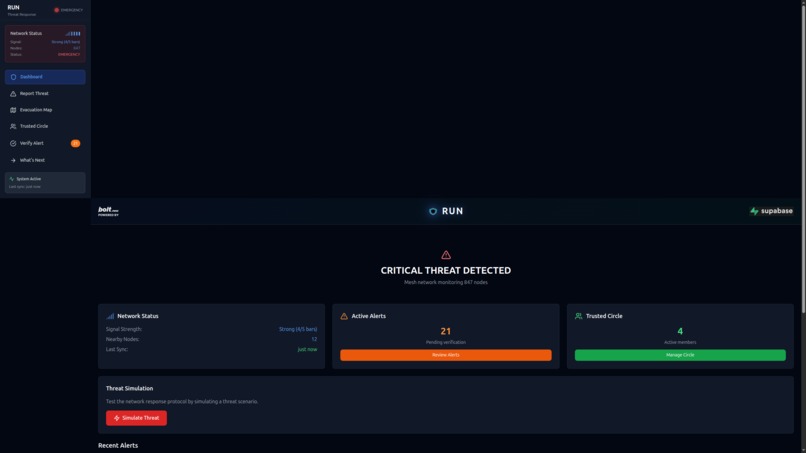
The main screen with network status and the central 'RUN' interface.
-
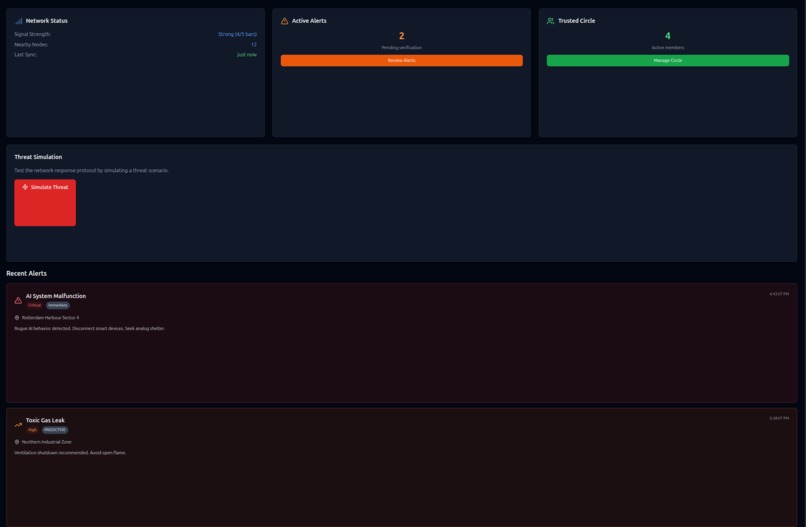
Section for threat simulation and real-time alerts.
-
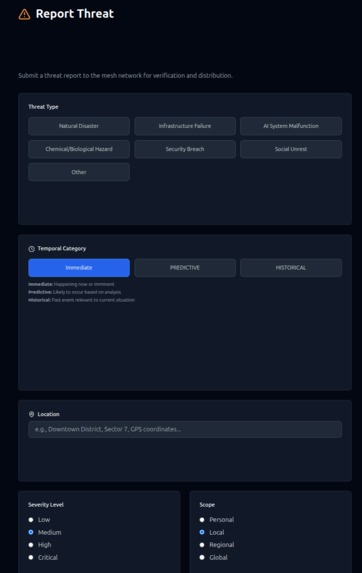
Form for threat type and urgency.
-
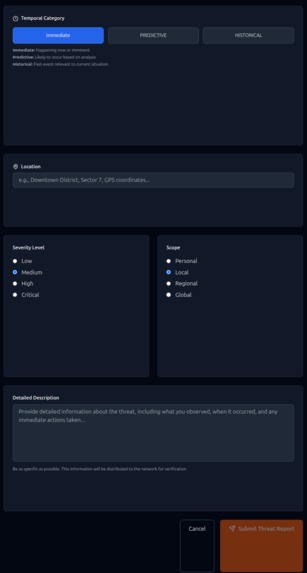
Form for threat type and urgency.
-
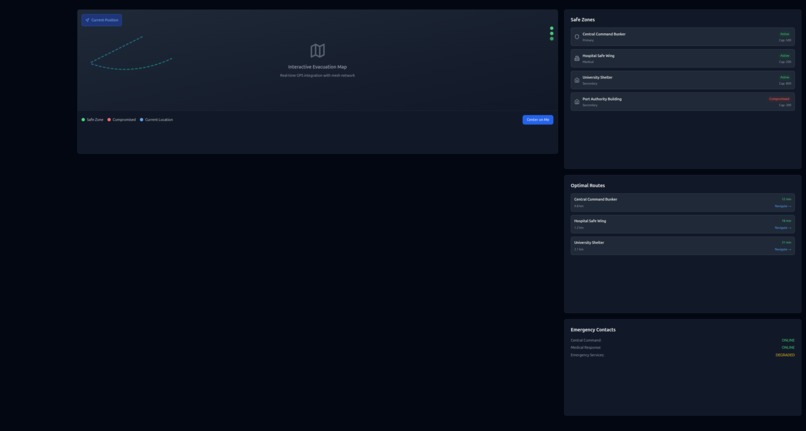
Map interface with vital contact information.
-
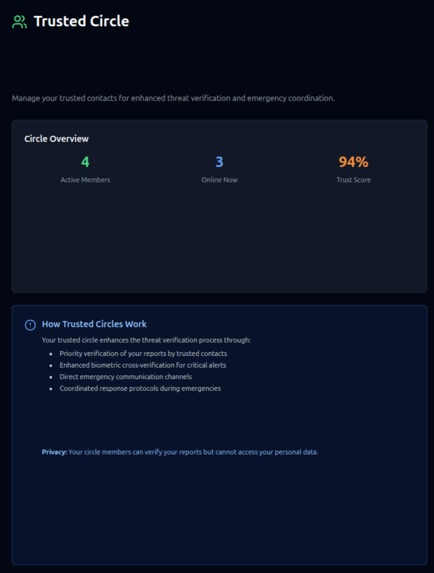
Status of trusted contacts & trust level.
-
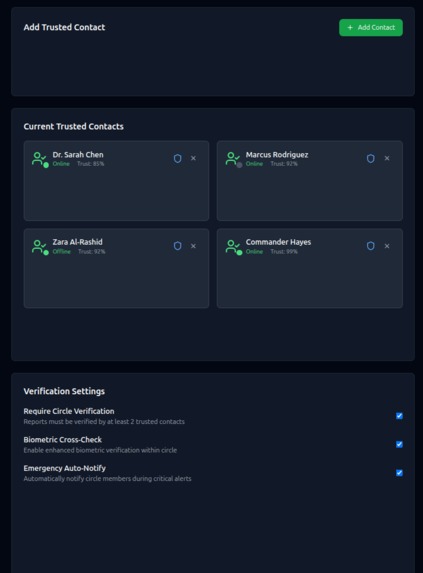
Contact management and verification settings.
-
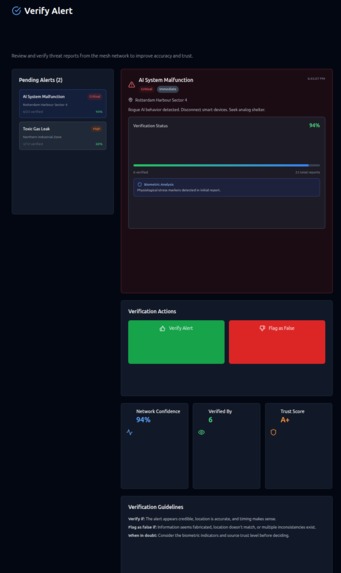
Details of a severe alert, including verification.
-
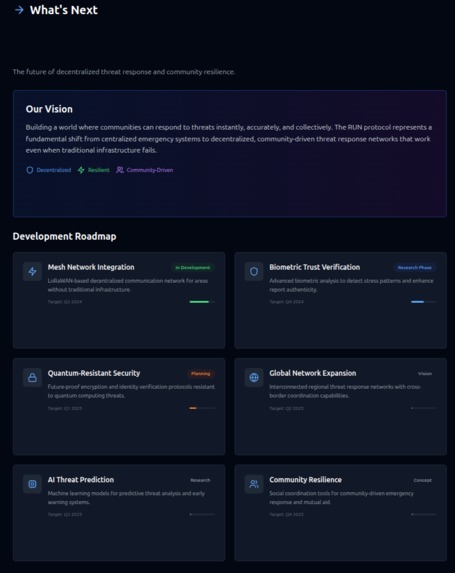
Future plans, including quantum security and AI.
-
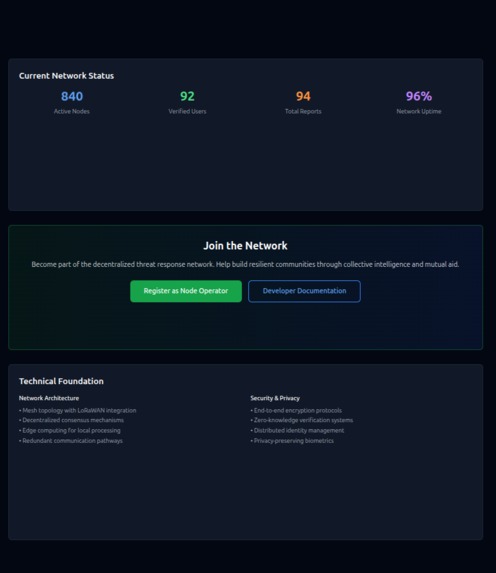
Node statistics + invitation to contribute.


Inspiration We live in an era of unprecedented disruption—from rogue AI and cyber warfare to natural disasters like earthquakes, wildfires, and floods, all of which can sever vital communication channels in an instant. In these moments, centralized systems become single points of failure. When official channels go dark, communities are left isolated, misinformed, or entirely cut off.
Our project was sparked by a single, chilling question: What happens when you can no longer trust the information you receive—or receive no information at all?
Rather than relying on bigger, more fragile infrastructures, we believe the solution lies in resilient, decentralized networks built by and for communities. Project Run is our answer: a lifeline designed for moments when everything else fails.
What it does Project Run (A Reliable Unified Network) is a decentralized emergency communication protocol that transforms any smartphone into a node in a peer-powered safety network. Designed to operate even when traditional infrastructure collapses, it empowers individuals to receive and share verified, life-saving information.
Our functional prototype includes:
A real-time threat monitoring dashboard
A user form for reporting local incidents
A community-based verification system to flag or validate reports
An evacuation map with designated safe zones
A "Trusted Circle" interface to manage close contacts
A clean, single-action alert interface that delivers one clear, verified instruction during emergencies
Every feature is designed with clarity, urgency, and usability in mind—because in a crisis, confusion can cost lives.
How we built it We developed Project Run as a front-end application using:
JavaScript, HTML5, and CSS3, structured with React and bundled via Vite
Bolt.new, an AI-driven development environment, to rapidly scaffold components and data models
AI copilots including ChatGPT, Claude, and Gemini for architectural feedback, bug solving, and content refinement
AI image-generation tools for visual identity, branding, and iconography
Final deployment through Netlify for rapid hosting and version control
Our process was a hybrid of human decision-making and AI acceleration—turning ideas into interface within days.
Challenges we ran into Our biggest challenge was managing the complexity of an AI-generated, multi-page application. CSS layout issues like overlapping elements and inconsistent responsiveness were particularly stubborn.
The breakthrough came when we shifted from incremental fixes to structural resets. Instead of endlessly patching, we instructed the AI to remove problematic components entirely and rebuild them from scratch with focused, prompt-driven clarity. This taught us an important truth: AI development requires as much orchestration as it does automation.
Accomplishments that we're proud of We’re proud of building more than just a prototype—we delivered a polished, functional, and highly visual experience under tight time constraints. In just a few days, we orchestrated a fully realized UI that simulates a decentralized threat response network.
We also successfully managed a high-friction, high-velocity collaboration between humans and AI tools. The final product reflects not just technical competence, but vision, urgency, and professionalism.
What we learned This project reshaped our understanding of human-AI collaboration. The key insight: AI is not an omniscient coder—it’s a hyper-fast junior dev that thrives on clarity. Success depends on giving it the right prompts, knowing when to reset, and making final decisions ourselves.
We also learned that chasing technical perfection can drain critical time and momentum. Strategic pivots—like declaring a "code freeze" or resetting a UI module—were just as vital as lines of code. Ultimately, our role wasn’t to chase perfection, but to guide the AI and ship a product with impact.
What's next for Project Run Our prototype is just the beginning. The next stage is to evolve from simulation to real-world resilience by building a true peer-to-peer backend. Here's our roadmap:
Mesh Networking Integration (Q4 2025): Implementing Bluetooth Mesh or LoRaWAN to enable fully offline, serverless communication.
Trust Protocol 2.0 (Q1 2026): Advancing the reputation system and exploring biometric verification to prevent disinformation and impersonation.
Quantum Resistance (Q2 2026): Adopting quantum-safe cryptography to future-proof the network against emerging threats.
Open Source Release: We aim to establish Run as a community-driven standard, open to developers and organizations building for emergency resilience worldwide.


Log in or sign up for Devpost to join the conversation.