-
-
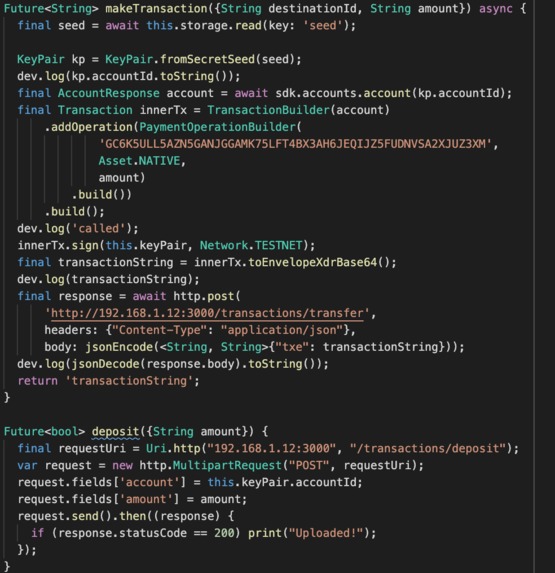
Flutter Transaction Logic
-
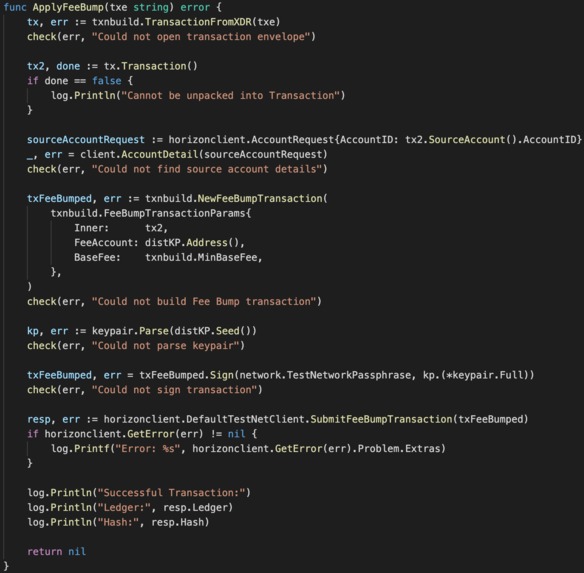
Applying Fee Bumps on Transaction Envelopes
-
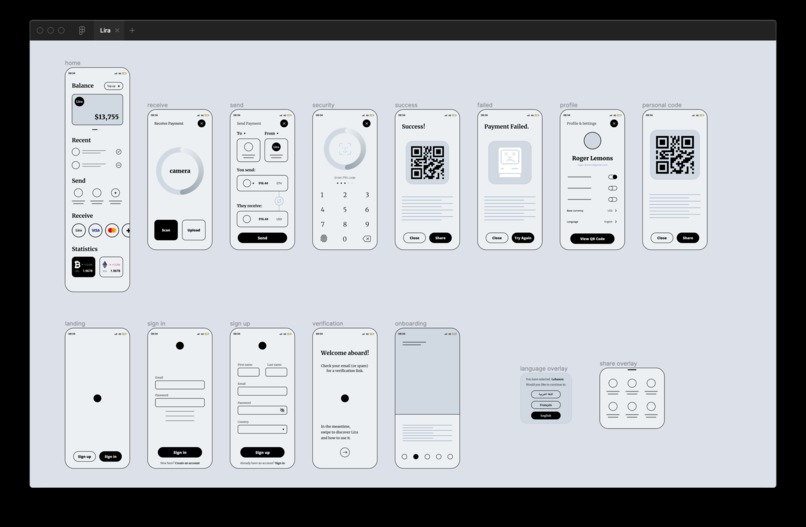
Initial Wireframes
-
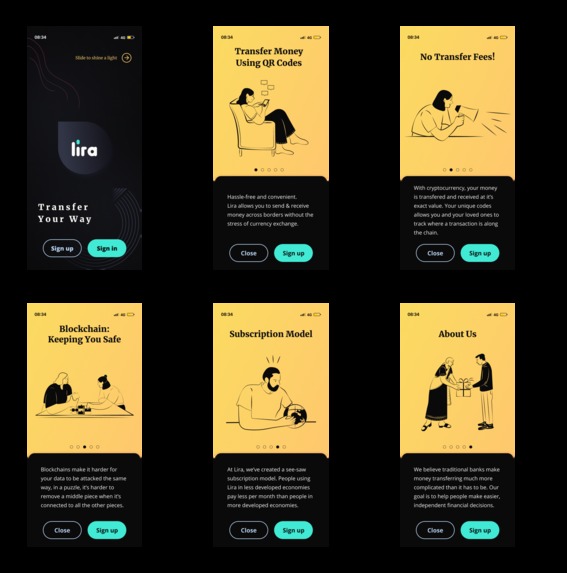
Onboarding Experience


Inspiration
Lira is inspired by a shared desire to alleviate the Lebanese struggle. Since 2019, Lebanon’s currency has been plummeting due to mismanagement by banks and corrupt government officials. With a shortage of hard dollars in the banks, the Lebanese people have no choice but to turn to the black market where prices can inflate in a steep and unpredictable manner. Given the large portion of Lebanese diaspora that send remittances, we sought to bridge the gap between families spread out across various countries.
What it does
As a crypto-wallet, Lira allows users to send and receive currency tokens using QR codes with a guarantee that the value of money sent is the same value as the money received on the other end. What's more, we refuse to charge transaction fees, and instead implemented a See-Saw Subscription Model. Under this model, people using Lira in poorer economies pay less than those in healthier ones. Regardless of location, each user is assigned a unique profile code so adding new payees or requesting payments is simple and efficient.
Digital Product Pricing Model
Lira,like any other service based platform, required a special pricing model based on a number of key factors such as: value based pricing and a recurring pay what you can subscription model. After our market research we discovered that not many platforms offer the same service as Lira. Therefore, instead of pricing our product based on production costs we decided that our prices should reflect the true essence of our service which is financial freedom. Hence, we developed a completely unique subscription model where users of our platform will pay a different subscription fee based on their geopolitical existence. In counties such as UK, Canada, USA, Ireland, Singapore and Japan the monthly subscription fee would be 10 Pounds a month. Whereas, in Lebanon this fee would be 1 Pound a month.
By using this unique subscription model, we were able to extract our revenue based on an economy of scales model, where users in complex economies will offset the cost for those in developing economies.
The case for battling inflation
Pegging the exchange rate can lower inflation by inducing greater policy discipline and instilling greater confidence in the currency. Empirically, both effects are important.Policymakers have long maintained that a pegged exchange rate can be an anti-inflationary tool. Two reasons are typically cited. A pegged exchange rate provides a highly visible commitment and thus raises the political costs of loose monetary and fiscal policies. To the extent that the peg is credible, there is a stronger readiness to hold domestic currency, which reduces the inflationary consequences of a given expansion in the money supply. This is why we've decided to peg the value of the Lira token to $1/1500, the original value of the LBP lira before hyperinflation had set in, this would make the token easily interpretable to our target users while ensuring that their funds stay protected. This would allow free interop between local financial institutions and cash vendors while aiding the banks maintain liquidity in a cash based economy.
How we built it
We built the frontend using Flutter with the additional assistance of the community-maintained Flutter SDK. The backend consisted entirely of Golang. We used the CoinMarketCap API to fetch information about conversion rates between lumens and USD, so that we an abstract the details away from the user. We organised our work around common UX tasks such as Design Thinking and affordant design, we were also able to leverage the powerful product discovery framework Jobs To Be Done to organise an extremely productive Sprint over the course of a week.
Challenges we ran into
The Flutter Stellar SDK proved to be difficult to use due to bugs around nonces used to sign transactions. Additionally, recreating transactions from their XDR envelope was also a challenge that we managed to surmount just in time. Additionally, coming up with a convenient solution that fitted our user personas was only possible due to our highly committed cross-functional team spanning finance, business development, engineering and design.
Accomplishments that we're proud of
As our group is spread out across 3 countries, it was quite a feat to accomplish Lira is a short timespan. Solid teamwork allowed us to create an interesting financial model, craft a unique brand personality, get to know our target users better and feel pride in building a product that could help people overcome crises out of their control. Mostly, we’re proud to create a product we could see being used by ourselves, our families and our communities.
What we learned
While we drew mostly from personal experiences in creating Lira, we each gained more knowledge from our peers about specific challenges. Our developers gained more knowledge about financial models, and our designer about blockchain. We also learned a lot more passive subjects along the way. In wanting to make a simple solution, we learned about how to make ourselves seem trustworthy to new & skeptical users.
What's next for Project: Lira
We believe there are numerous ways cryptocurrency can help make people’s lives easier. Mainly, we want to make Lira a beneficial option for business vendors in cash-based economies to use. For example, if a grocer were to post their stock on Lira’s marketplace, they could instantly receive payment that isn’t subject to inflation and devaluation by traditional banks.
We also plan to implement the SEP 24 and SEP 31 protocols for international payments as well as integrating KYC apis, we envision a payment processing system that purchases XLM using an api and deposits those into a pool of funds that we could use to fund transaction fees in future. We would also love to implement Claimable Balances in order for users (such as parents of overseas students) to be able to create transactions that other users can claim by scanning (or uploading) a QR code.


Log in or sign up for Devpost to join the conversation.