-
-
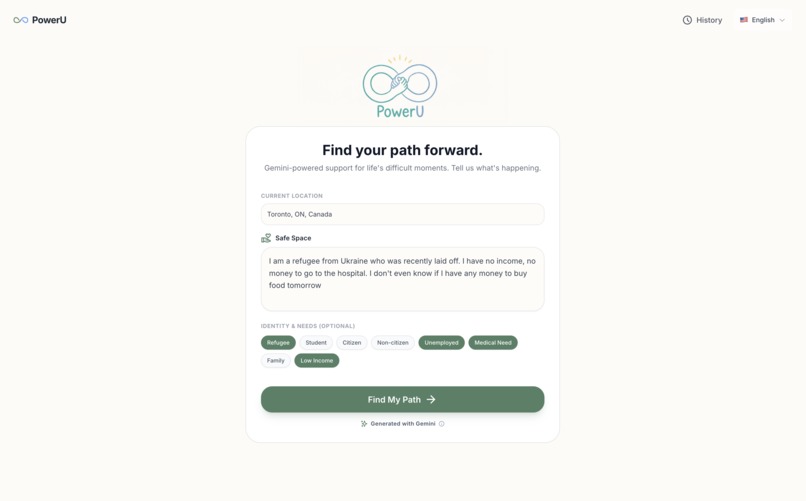
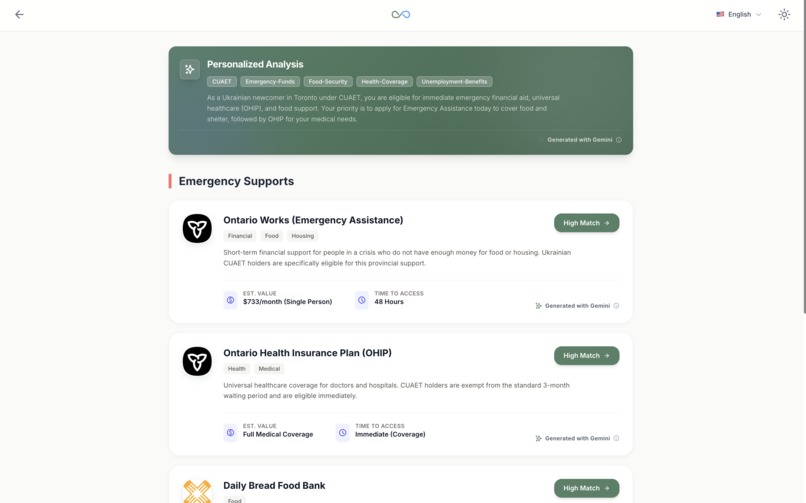
Users describe their situation in natural language. Powered by Gemini’s semantic understanding
-
-
-
-


Inspiration
PowerU was born from witnessing real people fall through the cracks of systems that were designed to support them.
In the United States
- 48 million Americans face food insecurity — nearly 1 in 7 households risk running out of food
- 6.6 million people are unemployed, yet only 41% access the unemployment benefits they qualify for
- Low-income families miss an average of $3,700 USD per year in SNAP, EITC, and housing assistance
- Only 17% claim energy subsidies (LIHEAP), despite an 82% eligibility rate
- 35% of Medicaid-eligible children remain unenrolled
- 25 million Americans are unaware they qualify for Affordable Care Act subsidies
In Canada
- 38% of eligible unemployed workers never apply for Employment Insurance
- Low-income families miss an average of $3,700 CAD per year in benefits designed for them
- 73% of newcomers are unaware of available housing subsidies
- Over 2,200 international students drop out each year due to medical debt exceeding $5,000 CAD—costs that public programs would have covered
- 62% of newcomers misunderstand policies due to language barriers, leading to failed applications
The cruel irony is clear: governments spend billions on social programs, yet millions of people suffer in silence—not because help doesn’t exist, but because it’s too hard to access.
When crisis strikes—job loss, illness, immigration uncertainty—people shouldn’t also be forced to become policy experts just to survive. Yet the system demands exactly that: navigating over 100 fragmented websites across federal, state/provincial, and municipal levels; deciphering 47-page legal documents written in complex terminology; and self-diagnosing needs across disconnected bureaucracies—all while cognitive capacity drops by up to 40% under financial stress.
A simple question raised: What if AI could do what fragmented systems cannot—see the whole person, understand compound crises, and navigate complexity on their behalf?
That question became PowerU.
What it does
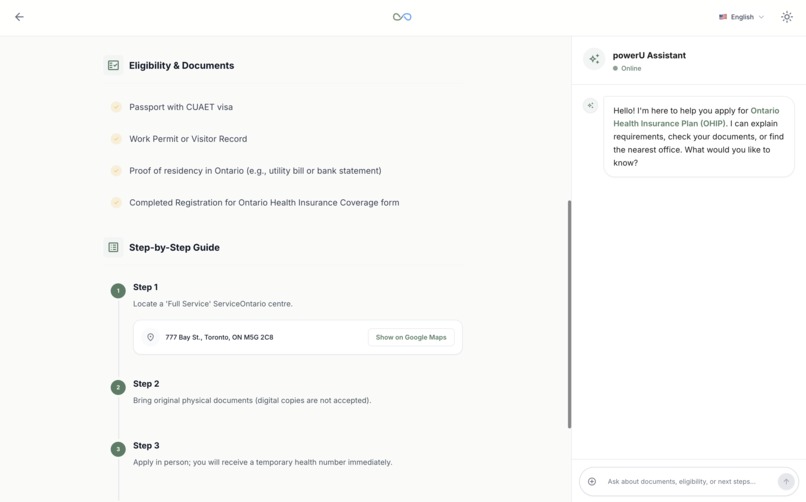
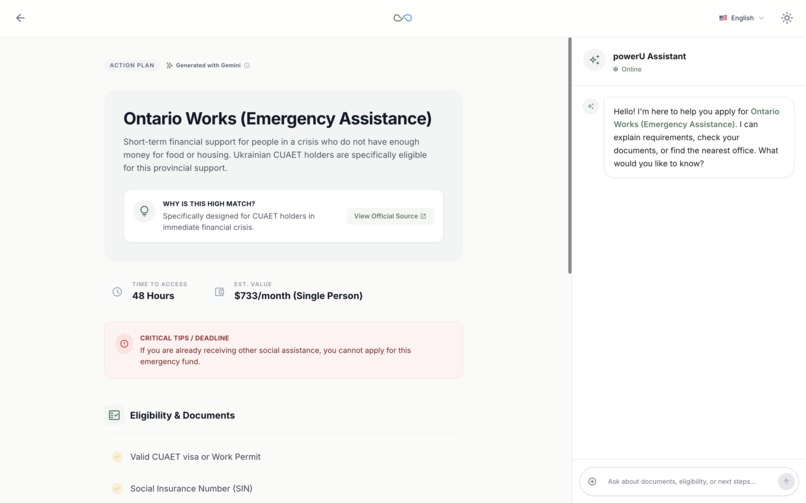
PowerU uses Gemini AI to help people make sense of complex crises and generate clear, actionable paths forward. The system understands multilingual natural language input and uploaded documents, identifies intersecting needs across employment, immigration, healthcare, and housing, and matches users with available support at the federal, state/provincial, municipal, and private levels. It then prioritizes next steps into phased action plans—24-hour emergency response, 7-day stabilization, 30-day rebuilding, and mental health support—while explaining policy terms in plain language, estimating eligible benefits, and clearly guiding users on what to do next at each step.
In the darkest moments, everyone deserves a companion and a path forward.
How we built it
The project is primarily built as a web application using React and TypeScript.
The frontend is developed with Vite, providing a fast development environment and efficient production builds. The UI follows a component-based architecture, allowing rapid iteration on features and flexible adjustments to the user experience.
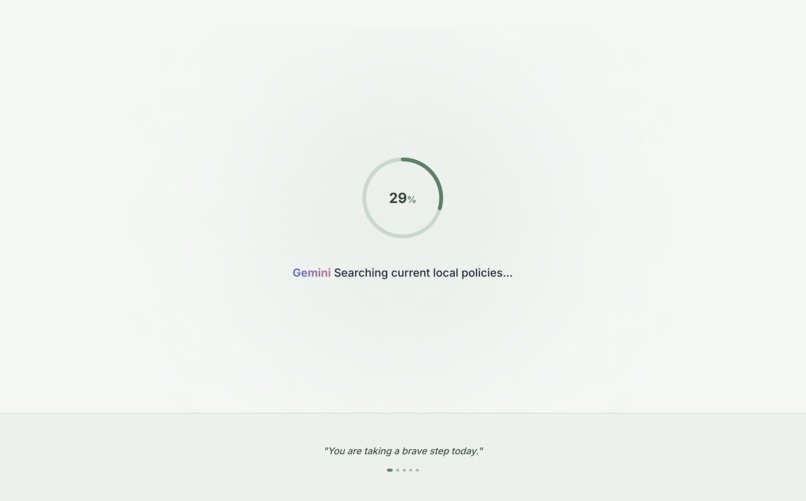
For AI capabilities, the application integrates the Google Gemini API directly on the frontend. It leverages Gemini’s multimodal models to analyze user inputs—including text and documents—and generate structured outputs. When needed, Gemini’s built-in search tools are used to validate and enrich responses with relevant information.
Challenges we ran into
1. Policy Complexity & Fragmentation
Challenge: Public benefit information is highly fragmented across federal, provincial/state, municipal, and private sources. Policies are long, inconsistent in structure, and difficult for users to understand.
What we did:
- Analyzed official policy documents and public information using Gemini’s document understanding capabilities
- Structured key eligibility factors (status, income, residency, employment, documents required) into a unified logical format
- Used AI to extract and summarize relevant sections instead of requiring users to read full policy texts
2. Compound Crisis Scenarios
Challenge: Single-category systems fail when users face multiple overlapping crises (e.g., unemployment combined with immigration or healthcare issues).
What we did:
- Modeled user situations as multi-dimensional “crisis profiles” instead of a single category
- Matched user needs across multiple domains simultaneously
- Generated step-by-step action guidance that considers the full situation, not isolated problems
3. Accuracy and Hallucination Risk
Challenge: Inaccurate or hallucinated information in this domain could directly harm users.
What we did:
- Limited AI outputs to information derived from official sources or uploaded documents
- Clearly communicated uncertainty when eligibility could not be fully confirmed
- Framed responses as guidance rather than guarantees
Accomplishments that we're proud of
1. Human-Centered Problem Solving Each feature is designed to directly address well-documented failure points in benefit access:
- Many eligible users never apply → the system proactively surfaces relevant programs
- Applications fail due to missing documents → guided checklists reduce friction - Users are unaware of available subsidies → cross-program discovery improves visibility - Benefits go unclaimed → AI helps users identify all programs they may qualify for
2. Multimodal AI Integration We successfully integrated Gemini’s multimodal capabilities directly into a React-based web application. The system can analyze user text input and uploaded documents (such as policy PDFs) and transform complex information into structured, plain-language guidance. This allowed us to prototype end-to-end crisis support without heavy backend infrastructure.
3. Safe AI Design for High-Stakes Use Cases We deliberately prioritized reliability over over-automation. Instead of presenting AI output as definitive answers, the system communicates uncertainty, asks follow-up questions when needed, and frames recommendations as guidance rather than guarantees—an essential design choice for high-stakes domains like healthcare, immigration, and public benefits.
What we learned
Building for people in crisis requires a fundamentally different approach. Policy information is often ambiguous, fragmented, and inconsistent across systems, which makes fully deterministic answers unrealistic. Transparency around uncertainty builds more trust than overconfident AI outputs.
We also learned that compound crises cannot be handled through single-category solutions—effective support must consider the whole situation, not isolated problems. From a UX perspective, users under stress prefer clear, directive guidance and reduced cognitive load over open-ended choices. Finally, in high-stakes domains, safe AI design—prioritizing accuracy, clarity, and user trust over automation—is more important than technical complexity.
What's next for PowerU
Expand Coverage & Data Depth Continue adding more official programs and improving policy coverage across federal, provincial/state, and municipal levels, with a focus on high-impact benefits related to housing, healthcare, and employment.
Improve Eligibility Confidence Refine follow-up questioning and document analysis to better resolve ambiguous cases, helping users move from “likely eligible” to higher confidence without overpromising outcomes.
Stronger Document Guidance Enhance document-based workflows by providing clearer checklists, examples, and explanations to reduce application errors and incomplete submissions.
Real-Time Application Assistance Explore a browser-based assistant that overlays on application pages to provide contextual explanations, document reminders, and step-by-step guidance, without automating or submitting forms on the user’s behalf.
Built With
- dom
- gemini
- gemini3
- google-ai-studio
- google-maps
- react
- typescript
- vite

Log in or sign up for Devpost to join the conversation.