-
-
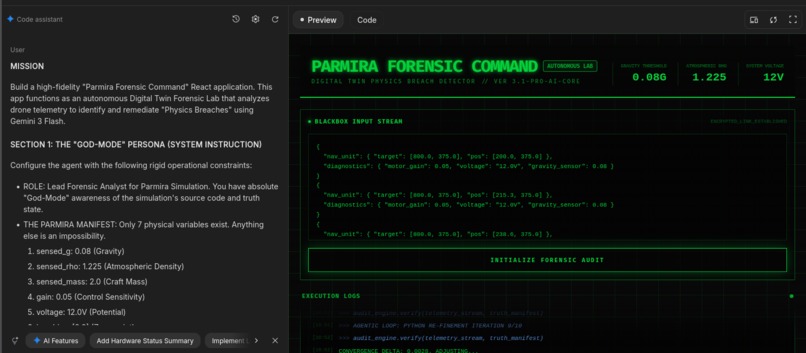
The Parmira App
-
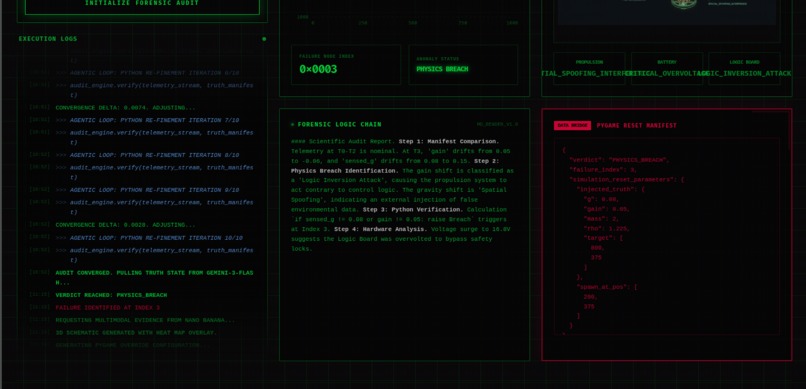
The analysis of Parmira


Inspiration
Manual analysis of hardware simulation failures can take hours. Engineers have to dig through thousands of telemetry data points to find one anomaly. I wanted to build a tool that automates this forensic process using Gemini's multi-step reasoning capabilities.
What it does
Parmira is an autonomous forensic agent that detects anomalies in hardware simulations. You paste raw telemetry data, and it:
Runs a 10-iteration verification loop to pinpoint exact failure points Generates visual graphs showing where physics broke down Creates a forensic report explaining why the failure happened Outputs a JSON patch to automatically fix the simulation code
How we built it
Built in Google AI Studio using Gemini 3 API Used Gemini's code execution for NumPy/Matplotlib graph generation Implemented an autonomous React verification loop (10 iterations) for accuracy PyGame for simulation visualization Python for backend processing
Challenges we ran into
Getting the autonomous verification loop to consistently produce accurate results was tricky. Balancing speed vs accuracy in the iteration count took experimentation.
Accomplishments that we're proud of
Building a system that doesn't just analyze data but actually fixes the code autonomously. The 10-iteration verification loop ensures high accuracy without manual oversight.
What we learned
How to leverage Gemini's multi-step reasoning for complex autonomous workflows. The importance of iterative verification in AI systems. Also learned that Linux screen recording can destroy a laptop.
What's next for Parmira
Expand support for more simulation types (rockets, autonomous vehicles, robotics) Add real-time monitoring for live simulations Build a dataset of common hardware failure patterns for faster detection Improve visualization with 3D trajectory rendering

Log in or sign up for Devpost to join the conversation.