-
-
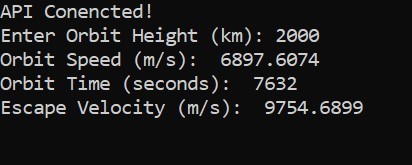
Testing of a sample API client
-
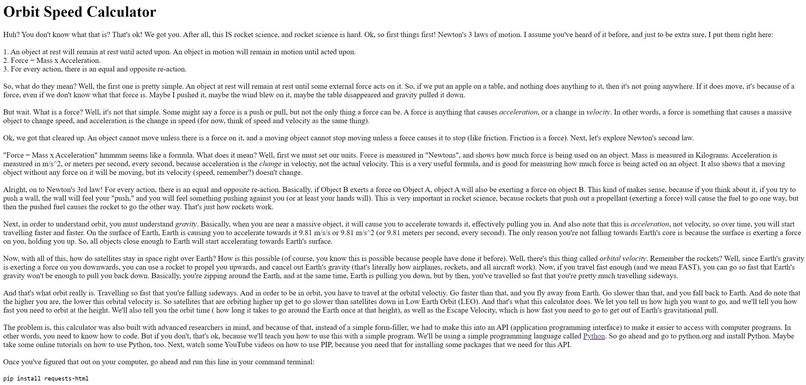
Our main website page, which explains Newtonian physics and orbital mechanics, as well as how to use our API


Inspiration
This project was inspired by nearby high school CubeSat teams. They were planning to build a satellite and launch it into space, and although it's too late to help them, we thought it would be a good idea to make software that can help aspiring CubeSat teams brainstorm ideas, criteria, and constraints for their project. This was also inspired by a middle school Science Bowl team meeting, when the teacher taught us about physics and how they explained it so well.
What it does
On our main website page, we have an introduction page, with a couple paragraphs explaining Newtonian physics, what our program does, and how to use it. Then, we have an API page that can be used by a Python web scraping module. Given a target orbit altitude as input, the API can calculate the recommended orbit velocity, average orbit time, and escape velocity of a satellite at the said altitude.
How we built it
We started out with a Node.js server to host an html page with a form to submit as inputs. However, we soon realized that without AJAX or PHP plugins, such a site would not be possible. Then, we took the html, simplified it, and sent it into the Node.js server as a string to write. We changed the planned form GUI into an API for researchers to program for ease of access to programming languages like Python. Then, on the main page of the site, I also added a page of information explaining Newtonian physics and Orbital mechanics.
Challenges we ran into
One of our main challenges was that the majority of us had little experience in JavaScript, and most of us weren't familiar with orbital mechanics. Some of us knew neither. Therefore, the majority of our time was spent either getting the Node.js server set up or researching orbital mechanics. Also, there was a lot of lack of cooperation on our part, we failed to set up a reliable code sharing site and had to rely on a custom Discord bot to git pull and such.
Accomplishments that we're proud of
Despite our challenges, we are pretty proud of our final product, partly because of the slogan we made ("This is Rocket Science") and partly because in the end, we managed to make a working site with a functioning API and domain connection. We are also proud that we were able to provide a tool to experienced researches as well as create a learning tool for beginning scientists.
What we learned
Overall, we learned quite a lot of things, some technical, some moral. The first thing we learned is that NEVER bite off more than we can chew. Learning an entire new language for a hackathon isn't easy, and it's far from desirable. However, the second thing we learned is to not give up. In the middle, some of our teammates have considered multiple times to "turn in a damn html page and get over with it," but after persevering, we managed to create a functional site.
What's next for Orbit Speed Calculator
If we are to continue the development of our website, one of the things we would consider adding first is a good Graphical User Interface, so people who aren't researchers and don't know how to code can use our site. The next would be to add new calculating assets, so we might be able to increase the functionality of our calculator (e.g. adding new parameters). Next, we might focus again on the graphical part, and add a real time graphical rocket launch animation, and add better style to our site in the process. There are many more possible updates in the foreseeable future, but those are the ones we would work on first if we were to continue development.


Log in or sign up for Devpost to join the conversation.