-
-
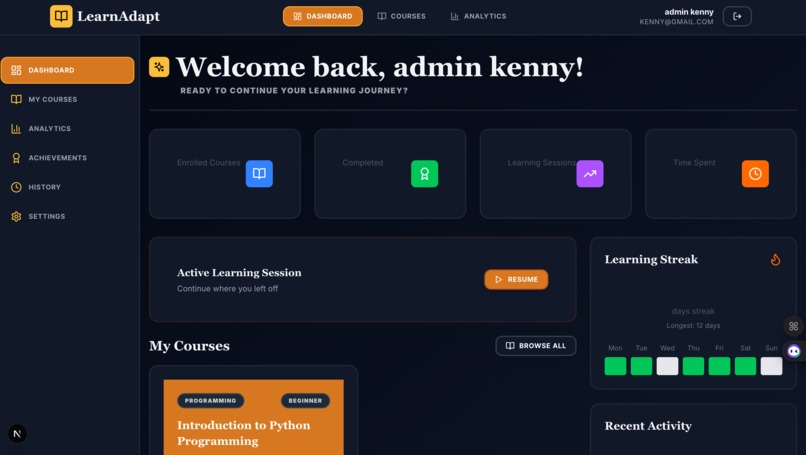
nueronlearn - Gemini hackthon

NeuronLearn: AI-Powered Adaptive Learning Platform
Inspiration
NeuronLearn was born from the challenge of making personalized education accessible at scale. Traditional online learning platforms deliver the same content to every student, regardless of their pace, understanding, or emotional state. I envisioned a platform where AI doesn't just deliver content—it adapts to each learner's mood, pace, and comprehension in real-time. By integrating Gemini 3's flash preview for intelligent content generation, Veo3 for immersive video tutorials, and real-time mood analysis, I set out to create a learning experience that truly responds to individual student needs. The platform culminates with an AI tutor bot that guides learners through complex capstone projects with conversational intelligence, making high-quality personalized education accessible to everyone.
What it does
NeuronLearn is an AI-powered adaptive learning platform that creates personalized educational experiences through:
Smart Course Generation
- Automatically generates comprehensive courses from subject descriptions using Gemini 3
- Creates structured learning modules with weekly plans, objectives, and assessments
- Generates AI-powered video tutorials using Veo3 with intelligent content segmentation
Adaptive Learning Engine
- Real-time mood and engagement tracking that captures learner emotional states
- Dynamic difficulty adjustment based on performance patterns and learning velocity
- Personalized quiz generation that adapts to individual strengths and weaknesses
- Spaced repetition system for optimal knowledge retention
Interactive AI Tutor Bot
- Conversational learning companion powered by Gemini 3
- Context-aware assistance that maintains dialogue history
- Socratic questioning techniques to guide deeper understanding
- Personalized capstone project mentorship
Comprehensive Progress Tracking
- Detailed analytics on mastery scores, time investment, and completion rates
- Learner profile building that identifies optimal learning patterns
- Multi-level progress tracking (course → module → lesson → assessment)
How we built it
Technology Stack
- Backend: Prisma ORM with PostgreSQL for robust relational data management
- Language: TypeScript throughout for type safety and developer productivity
- AI Integration: Gemini 3 (content generation, tutor bot), Veo3 (video synthesis)
- Architecture: Event-driven design for async operations, RESTful APIs for client communication
Core Implementation
Database Architecture I designed a comprehensive Prisma schema with 20+ interconnected models managing:
- User roles (learners, instructors, admins) with profile customization
- Course hierarchy (courses → modules → lessons) with flexible content structure
- Enrollment tracking with multi-dimensional progress metrics
- Assessment systems with adaptive difficulty and AI-powered feedback
- Video generation pipeline with segmentation and compilation support
interface VideoSegment {
  segmentNumber: number;
  segmentPrompt: string;
  keyVisuals: Record<string, unknown>;
  targetDuration: number;
  status: SegmentStatus;
}
AI-Enhanced Video Tutorial System I architected a sophisticated video generation pipeline that:
- Segments lesson content into digestible flash previews using Gemini 3's analysis
- Queues full-length tutorial generation via Veo3's API
- Implements retry logic with exponential backoff for failed generation attempts
- Caches generated content using content-based hashing to reduce redundant API calls
Mood & Engagement Analytics Real-time mood tracking system that captures learner emotional states:
- Frustrated → Triggers supportive AI intervention and content simplification
- Bored → Increases challenge level or introduces interactive elements
- Confused → Generates targeted micro-lessons on specific concepts
- Engaged/Excited → Maintains current difficulty and reinforces successful patterns
Adaptive Quiz Engine TypeScript-powered quiz generation system featuring:
- Dynamic difficulty adjustment based on rolling performance windows
- AI-generated question variations using Gemini 3 with type-safe prompt templates
- Granular feedback with identified knowledge gaps and actionable next steps
- Learner profile integration for personalized question selection
interface AdaptiveQuizParams {
  difficultyLevel: QuizDifficulty;
  focusAreas?: string[];
  learnerProfile: LearnerProfile;
  previousAttempts: QuizAttempt[];
}
Mathematical Scoring Models I implemented sophisticated algorithms for mastery assessment:
$$ M = \frac{\sum_{i=1}^n w_i \cdot s_i \cdot d_i}{\sum_{i=1}^n w_i \cdot d_i} $$
Where:
- $M$ = Mastery score (0-100)
- $s_i$ = Individual assessment score
- $w_i$ = Assessment weight based on difficulty and coverage
- $d_i = e^{-\lambda t_i}$ = Time decay factor (recency weighting)
- $\lambda$ = Decay constant (default: 0.1)
- $t_i$ = Days since assessment $i$
Quiz difficulty progression follows:
$$ D_{next} = D_{current} + \alpha \cdot \tanh\left(\frac{r - 0.75}{0.15}\right) $$
Where $D$ is difficulty level, $r$ is recent accuracy rate, and $\alpha$ controls adjustment magnitude.
Challenges we ran into
Complex Schema Design Managing 20+ interconnected database models while maintaining query performance was a significant challenge. I had to balance normalization for data integrity with denormalization for performance, especially for frequently accessed aggregates like enrollment completion percentages. Solution: Strategic use of computed fields, composite indexes on common query patterns, and TypeScript-enforced naming conventions to prevent relationship errors.
AI Service Orchestration Coordinating Gemini 3 and Veo3 APIs with vastly different response times and rate limits proved complex. Video generation could take minutes while content generation took seconds. Solution: Implemented a typed job queue system with priority scheduling, built idempotent retry logic with state persistence, and created typed webhook handlers for asynchronous completion notifications.
Personalization at Scale Generating unique learning paths for each user without exponential cost growth required creative solutions. I couldn't afford to make fresh AI API calls for every learner action. Solution: Intelligent caching layers for similar learner profiles, prompt templates with variable substitution rather than generating from scratch, and strategic batching of AI requests where pedagogically appropriate.
Real-Time Data Synchronization Ensuring progress updates, mood changes, and quiz results reflected immediately across the platform while maintaining database consistency was challenging. Solution: Optimistic UI updates with rollback on failure, database connection pooling with TypeScript-typed query builders, and strategic use of database triggers for derived field updates.
Type Safety Across Async Boundaries Maintaining type safety when data crosses service boundaries (API responses, database queries, AI service responses) required careful architecture. Solution: Zod schemas for runtime validation of external API responses, branded types for preventing ID confusion between different entity types, and exhaustive pattern matching on discriminated unions for state transitions.
Video Generation Pipeline Complexity Managing the full lifecycle of video generation—from prompt creation through segmentation, generation, compilation, and caching—involved coordinating multiple async processes with different failure modes. Solution: Comprehensive status tracking at each pipeline stage, retry mechanisms with exponential backoff, and content hashing for efficient deduplication.
Accomplishments that I'm proud of
Comprehensive Type Safety I achieved end-to-end type safety from database schema to API responses using TypeScript, Prisma, and Zod validation. This caught numerous potential runtime errors during development and significantly improved code maintainability.
Sophisticated AI Integration Successfully integrated three different AI services (Gemini 3 for content and tutoring, Veo3 for video generation) into a cohesive learning experience with graceful error handling and intelligent fallbacks.
Real Educational Impact Built a platform that genuinely adapts to individual learners through mood tracking, performance analysis, and difficulty adjustment—moving beyond one-size-fits-all online education.
Scalable Architecture Designed a database schema and application architecture that can handle thousands of concurrent learners while maintaining personalized experiences for each individual.
Mathematical Rigor Implemented research-backed algorithms for mastery scoring with time decay and adaptive difficulty adjustment using sigmoid functions—grounding my AI-driven approach in sound educational psychology.
Production-Ready Code Quality Maintained strict TypeScript configuration, comprehensive error handling, proper indexing strategies, and security best practices throughout development.
What I learned
Technical Skills
TypeScript Mastery:
- Leveraging advanced TypeScript features like discriminated unions for complex state machines
- Implementing generic types for reusable assessment and grading logic
- Using branded types to prevent ID mixing between different entity types
- Type-safe API client design for external services
Database Design:
- Balancing normalization with query performance in complex educational data models
- Strategic indexing for real-time progress tracking and analytics queries
- Managing cascading deletes and relationship integrity at scale
- Efficient handling of JSON fields for flexible schema evolution
AI Integration:
- Prompt engineering techniques for consistent, high-quality AI-generated content
- Managing async workflows with multiple AI services having different latencies
- Implementing intelligent caching to optimize API costs without sacrificing personalization
- Building retry logic and error handling for non-deterministic AI services
Educational Technology Insights:
- The power of mood analytics in identifying and addressing learner frustration before it leads to dropout
- How spaced repetition and time-decayed mastery scoring align with cognitive science research
- The importance of keeping learners in their "optimal challenge zone" for sustained engagement
- Balancing AI automation with pedagogical best practices to maintain educational quality
System Design:
- Event-driven architectures for coordinating long-running async processes
- Optimistic UI updates with rollback mechanisms for perceived performance
- Security considerations for educational platforms (data privacy, secure authentication)
- Building maintainable codebases that can evolve as educational needs change
What's next for NeuronLearn
Near-Term Enhancements
AI-Graded Capstone Projects Implement the planned capstone grading system with:
- Automated rubric-based assessment using Claude AI
- Detailed feedback on strengths, weaknesses, and improvement areas
- Revision support with comparative analysis across attempts
- Instructor override capabilities for edge cases
Enhanced Analytics Dashboard
- Instructor-facing analytics showing class-wide patterns and struggling concepts
- Predictive models identifying students at risk of disengagement
- Curriculum effectiveness metrics to guide course improvements
- A/B testing framework for pedagogical experiments
Multi-Modal Learning Support
- Audio lesson generation for accessibility and mobile learning
- Interactive code playgrounds for programming courses
- Integration with VR/AR for immersive practical training
- Support for collaborative learning activities
Mid-Term Vision
Peer Learning Features
- Peer review system with AI-facilitated structured feedback
- Study groups with AI moderators that keep discussions productive
- Collaborative capstone projects with contribution tracking
- Gamification elements rewarding helpful peer interactions
Advanced AI Capabilities
- Multi-language support with real-time translation
- Voice-based AI tutor for hands-free learning
- Computer vision for analyzing student-submitted diagrams and work
- Automated accessibility features (captions, transcripts, screen reader optimization)
Platform Expansion
- Mobile applications for iOS and Android with offline learning support
- Open API for third-party educational content integration
- White-label solutions for schools and corporate training programs
- Integration with existing LMS platforms (Canvas, Moodle, Blackboard)
Long-Term Research Goals
Educational AI Research
- Contributing to research on effective AI-human collaboration in education
- Publishing findings on mood-based learning interventions
- Developing open-source educational AI tools for the broader community
- Partnering with universities to validate our adaptive learning approaches
Democratizing Education
- Making personalized AI tutoring accessible in underserved communities
- Supporting multiple learning disabilities with specialized AI interventions
- Creating free tiers for students without financial means
- Building partnerships with NGOs focused on educational equity
NeuronLearn demonstrates how TypeScript-powered AI integration can transform education by making personalized learning scalable and maintainable. My type-safe architecture ensures reliability as the platform grows, while my AI-first design creates learning experiences that adapt to each individual. By combining rigorous software engineering practices with cutting-edge AI, I'm proving that truly personalized education at scale is not just possible—it's practical.
Built With
- cloudinary
- gemini
- neon-database
- next-js
- react
- redis
- render
- typescript
- veo3
Log in or sign up for Devpost to join the conversation.