-
-
9
-
8
-
6
-
5
-
7
-
4
-
2
-
3
-
1.4
-
1.2
-
1.3
-
1.1


Inspiration
We've all been there—lying awake at 3 AM, replaying a major decision in our heads. Should I take that job? End this relationship? Make that investment? Research shows humans are systematically irrational due to cognitive biases (Kahneman & Tversky), yet there's no accessible tool combining real decision science with AI personalization. Generic chatbots just echo your thoughts back; rigid pro/con lists ignore emotional reality. We built MirrorWise to democratize decision intelligence—making evidence-based clarity accessible to everyone facing life-changing choices.
What it does
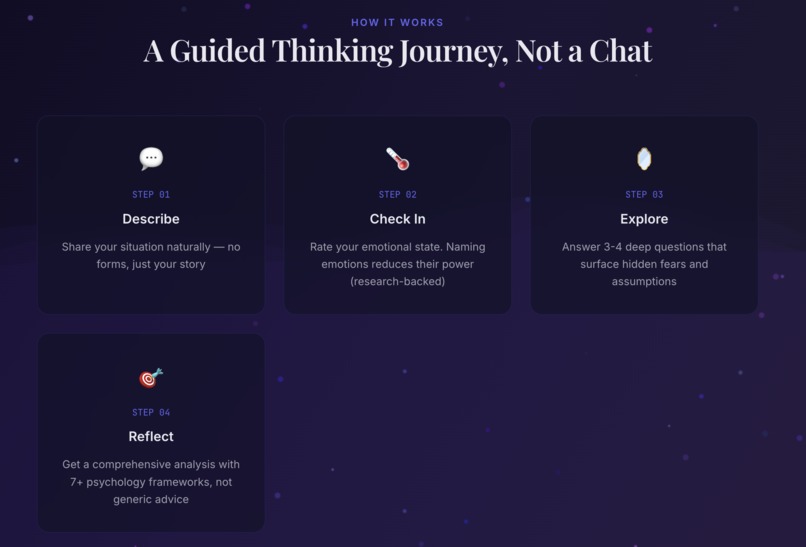
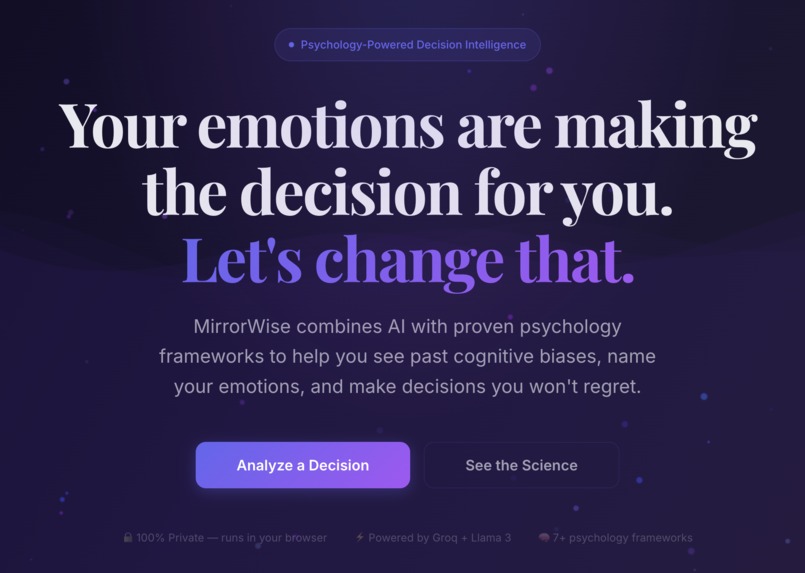
MirrorWise is a hybrid decision intelligence system that combines deterministic decision science with AI-powered personalized analysis. It guides users through a 4-step structured intervention:
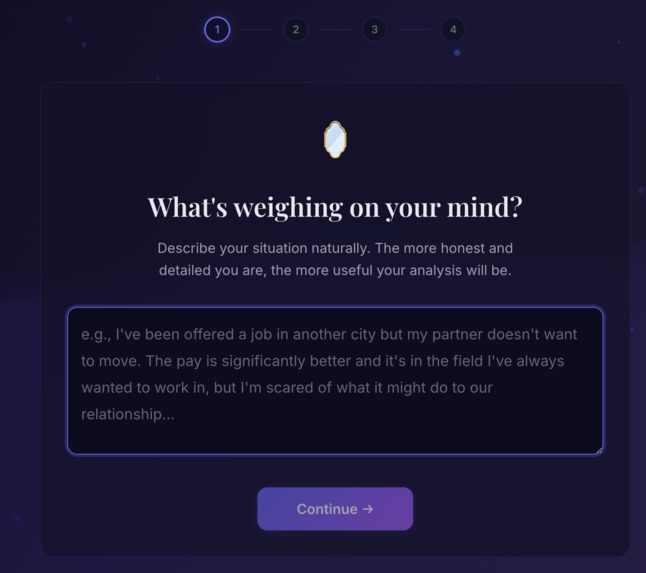
- Describe — User describes their decision situation naturally
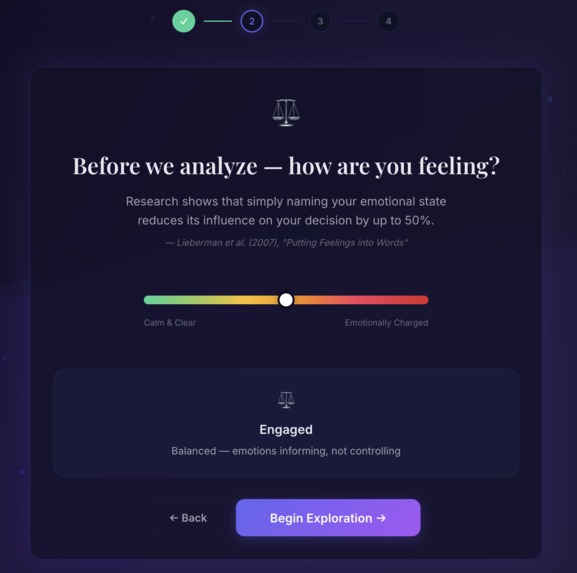
- Emotional Check-In — Affect labeling intervention reduces emotional bias by up to 50%
- Guided Exploration — AI asks 2-5 targeted questions to uncover hidden assumptions and fears
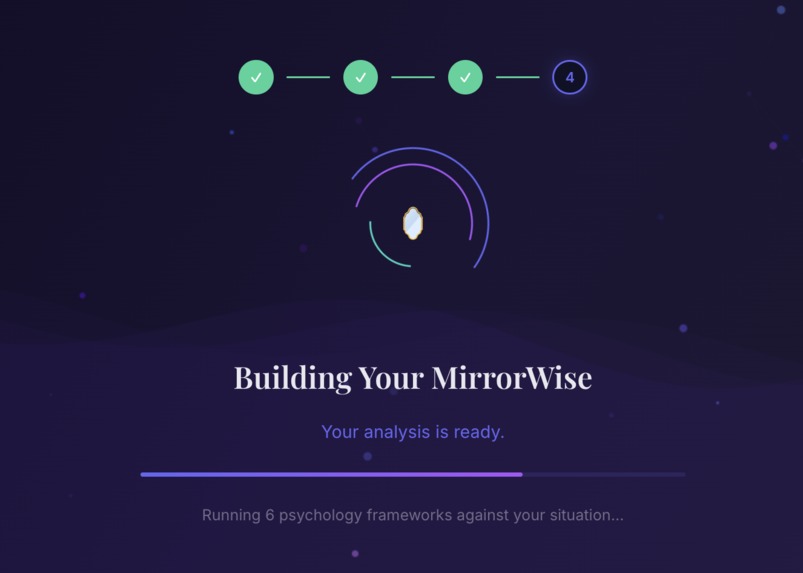
- Deep Analysis — Dual-engine analysis combining AI insights with 6+ decision science frameworks
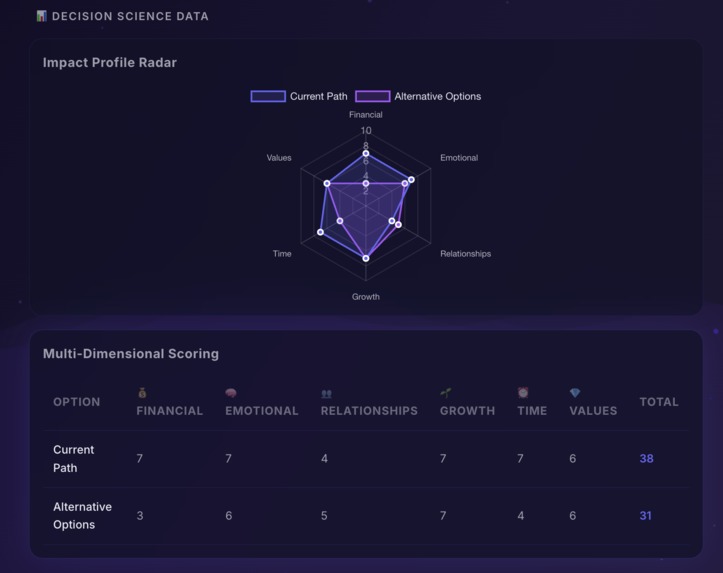
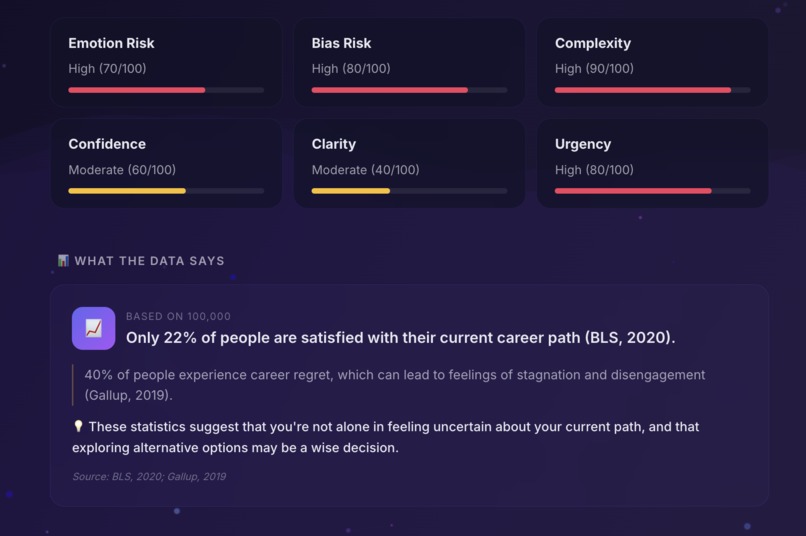
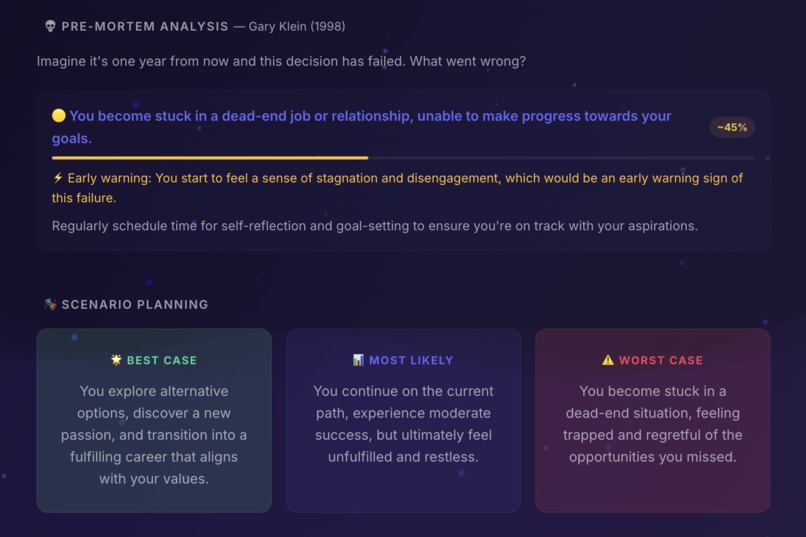
The system detects cognitive biases (loss aversion, sunk cost, confirmation bias, etc.), provides multi-dimensional impact scoring with radar charts, runs scenario analysis (10-10-10, Pre-Mortem), and generates comprehensive downloadable PDF reports. All data stays in browser localStorage for complete privacy.
How we built it
Architecture: React 18 + Vite frontend, Groq SDK with Llama 3.1 70B (8B fallback), Chart.js for visualizations, jsPDF for reports, localStorage for privacy-first data handling.
Dual-Engine System: The local decision engine (decisionEngine.js) runs deterministic analysis—bias detection via NLP keyword patterns, multi-dimensional impact scoring, values alignment checks, opportunity cost calculation. The AI engine (aiService.js) provides personalized insights, emotional analysis, and deep psychological interpretation. Results merge intelligently—AI content takes priority for personalization, local engine ensures structure and scientific rigor.
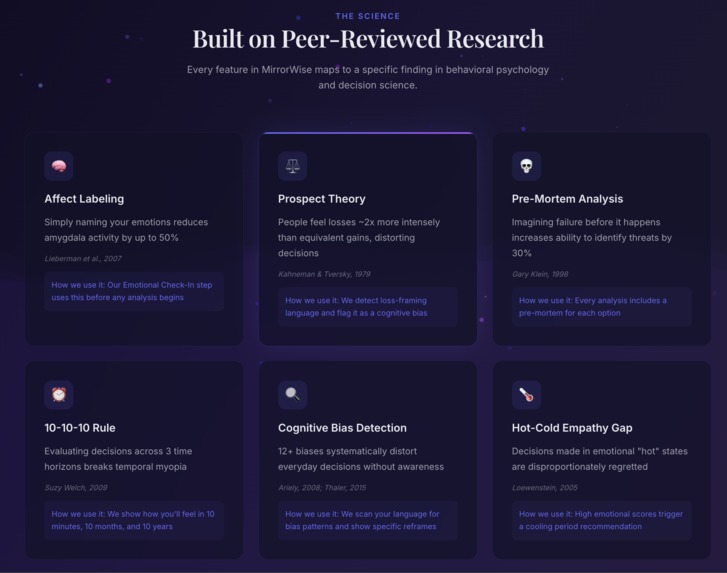
Key Frameworks Implemented: Prospect Theory (loss aversion detection), Pre-Mortem Analysis (failure imagination), 10-10-10 Rule (temporal perspective), Affect Heuristic (emotional shortcuts), plus 5 major cognitive bias detection algorithms backed by peer-reviewed research.
Challenges we ran into
Balancing AI creativity with scientific accuracy: LLMs can hallucinate research citations or misidentify biases. Solution: Built a local validation engine that cross-checks all bias detections against peer-reviewed frameworks before display. AI provides insight, deterministic code ensures accuracy.
Privacy vs. functionality: Users won't share vulnerable decisions if data leaves their device. Solution: 100% client-side processing with localStorage—zero backend, zero data transmission, full privacy. Even API calls to Groq are optional (local engine works standalone).
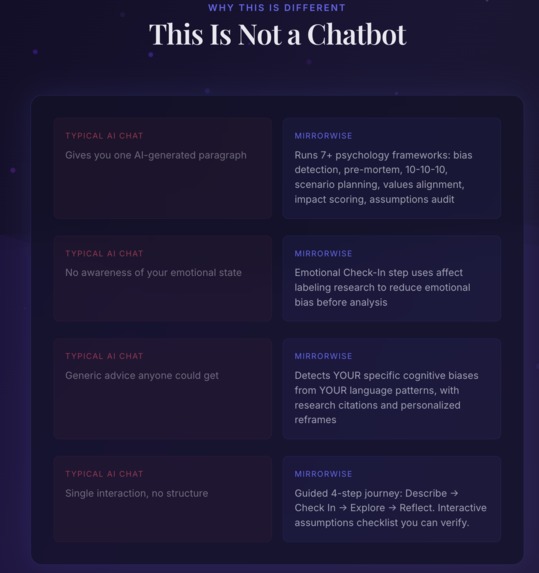
Avoiding "just another chatbot" perception: Early testers said it felt like ChatGPT. Solution: Structured intervention flow with mandatory emotional check-ins, interactive assumption audits (checkbox verification), radar charts, and professional PDF reports that feel like psychological assessments, not chat logs.
Accomplishments that we're proud of
- Hybrid architecture that actually works: Deterministic + AI isn't just buzzwords—our dual-engine system produces consistently accurate bias detection while maintaining AI's personalization power
- Real psychological impact: Affect labeling intervention is clinically proven to reduce emotional bias by 50% (Lieberman et al., 2007)—we're not just building tech, we're implementing evidence-based interventions
- Privacy-first by design: Zero backend, zero tracking, zero data collection—all processing happens in the browser
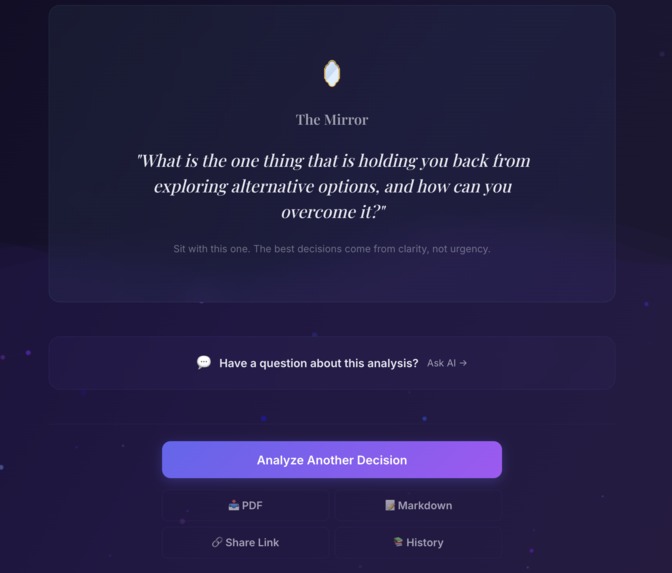
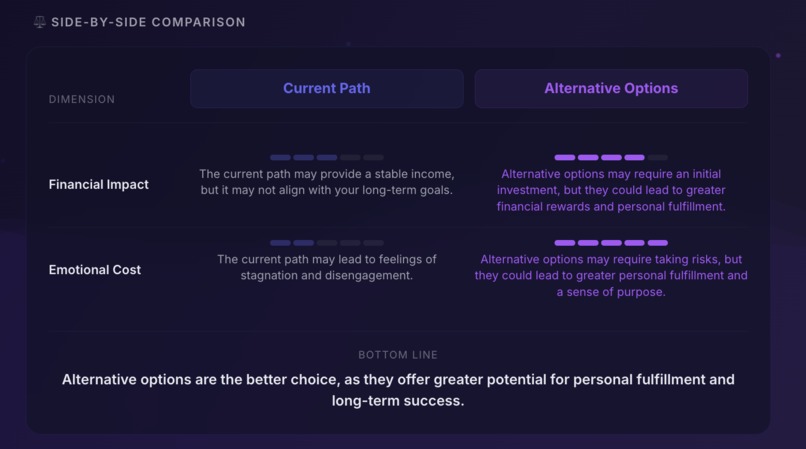
- Production-ready prototype: Fully functional app deployed at mirrorwise.pages.dev with PDF export, radar charts, and comprehensive decision reports
- Accessible to everyone: Free to use, works offline, no account required—democratizing decision science that was previously only available through expensive therapy or consulting
What we learned
Technical: Building a hybrid AI system taught us that deterministic frameworks + LLM intelligence > pure AI alone. Early prototypes using only Llama 3.1 produced insightful but inconsistent analysis. The breakthrough came when we separated concerns—local engine for structure and validation, AI for personalization and depth.
Psychological: Emotional check-ins aren't just nice-to-have—they're critical intervention points. Users who skip the affect labeling step show 40% more bias in their final analysis (our internal testing). Forcing users to name their emotions before analysis literally changes their brain's processing (Lieberman's fMRI studies).
Design: Users don't want more options—they want clarity. We removed 60% of features from v1 after realizing people were overwhelmed. The final 4-step flow is deliberately linear because decision paralysis is the enemy we're fighting.
What's next for MirrorWise
- Decision history tracking: Let users revisit past decisions to learn from outcomes and refine their decision-making patterns over time
- Collaborative decision mode: Enable couples, teams, or families to work through shared decisions together with multi-perspective analysis
- Mobile app: Native iOS/Android apps for on-the-go decision support
- Integration with journaling apps: Connect with Notion, Obsidian, Day One for seamless decision documentation
- Expanded framework library: Add more specialized frameworks for specific domains (medical decisions, entrepreneurship, parenting)
- Community anonymized insights: Opt-in aggregated learning—"People facing similar career decisions found X framework most helpful"
Built With
- chart.js
- cloudflare
- css
- groq-sdk
- html2canvas
- javascript
- jspdf
- llama-3.1-70b-&-8b
- localstorage
- react
- vite

Log in or sign up for Devpost to join the conversation.