-
-
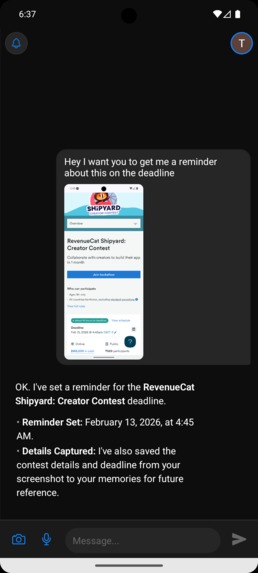
Creating reminders and memory based on inputs
-
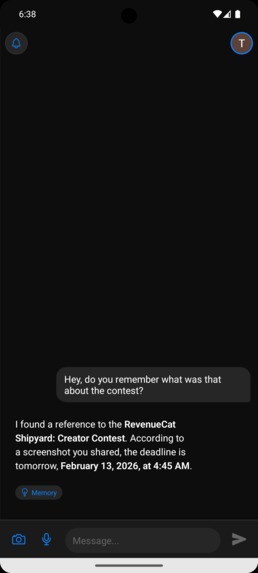
Recall
-
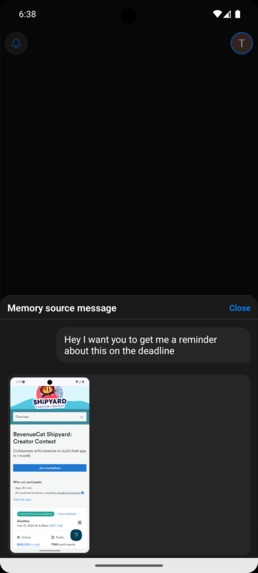
Recall sources
-
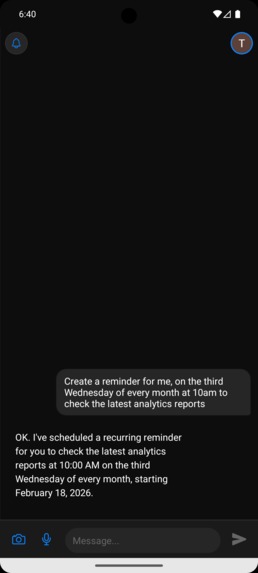
Complex recurrent reminder creation
-
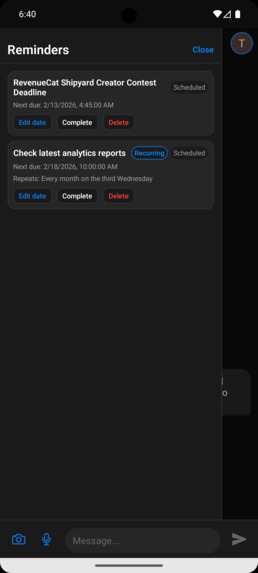
Complex recurrent reminder creation


What Inspired Us
We were dealing with constant internal disorganization: information spread across documents, notes, voice memos, photos, and multiple apps that never quite talked to each other. The real cost wasn’t lost data, it was lost attention. We spent more time deciding where something should go than actually using it.
We wanted a system where capturing information was immediate and natural, and where recalling it later didn’t depend on perfect structure, careful tagging, or remembering how something was saved. That gap between capturing information and being able to use it later is what led directly to MindHook.
🧠 What It Does
MindHook functions as a private, on-device surrogate memory. Users can capture information as text, voice, or photos without making decisions about organization at the moment of capture.
Everything is stored locally and remains usable offline. When connectivity is available, MindHook synchronizes across devices so information captured on one device is available everywhere else without manual transfer or duplication.
MindHook interprets what users save, understands how pieces of information relate over time, and brings the right context back when it matters, whether that means answering a question, resurfacing something previously captured, or turning raw input into a reminder. The focus is on reducing upfront friction and making stored information usable later, without mental bookkeeping.
The goal is simple: capture information when it appears, and trust that it will be available when it’s needed.
🛠️ How We Built It
MindHook is a React Native application designed to work reliably both online and offline, with a deliberately minimal, distraction-free interface. Every design decision prioritizes speed, reliability, and low cognitive overhead.
The application is intentionally lightweight. Core functionality runs locally so capture and recall are always available, even without a connection. Synchronization happens in the background when possible, keeping devices aligned without interrupting use.
This approach allows MindHook to fit naturally into existing workflows instead of forcing users to adopt a new system or maintain complex structures.
⚠️ Challenges We Ran Into
One of the main challenges was translating interpretation into dependable, on-device behavior. Captured information needed to turn into concrete outcomes: answers, surfaced context, reminders, without delay or unpredictability.
Balancing offline reliability with background synchronization required careful iteration to ensure consistency across devices without sacrificing responsiveness.
🏆 Accomplishments We’re Proud Of
MindHook quickly became something we relied on daily, even in early alpha and proof-of-concept stages. It crossed an important threshold: it stopped feeling like a prototype and started functioning as a tool we trusted across devices.
That shift validated both the problem we were solving and the decision to keep the product focused and restrained.
📚 What We Learned
We learned that usefulness comes from clarity and restraint. Tools are most effective when they stay out of the way and surface information only when it’s relevant.
When users don’t have to manage the system or worry about connectivity they can focus on their work. That principle guided every iteration.
🚀 What’s Next for MindHook
We’re moving beyond proof-of-concept and into production. The next phase focuses on strengthening reliability, refining an already minimal interface, and expanding device-level integration while preserving offline-first behavior.
The direction remains consistent: make MindHook faster, quieter, and more dependable so it feels less like an app and more like an extension of the user’s own memory.

Log in or sign up for Devpost to join the conversation.