-
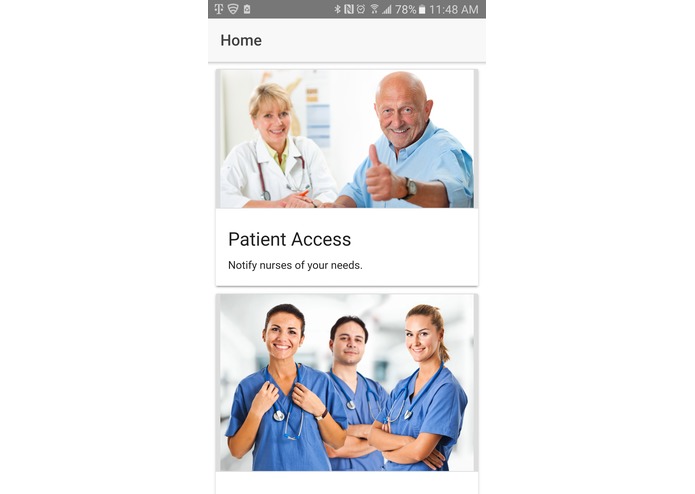
Opening
-
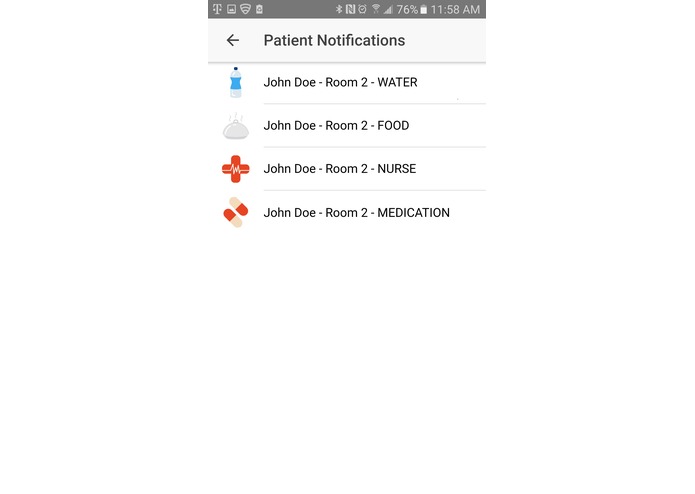
Notification
-
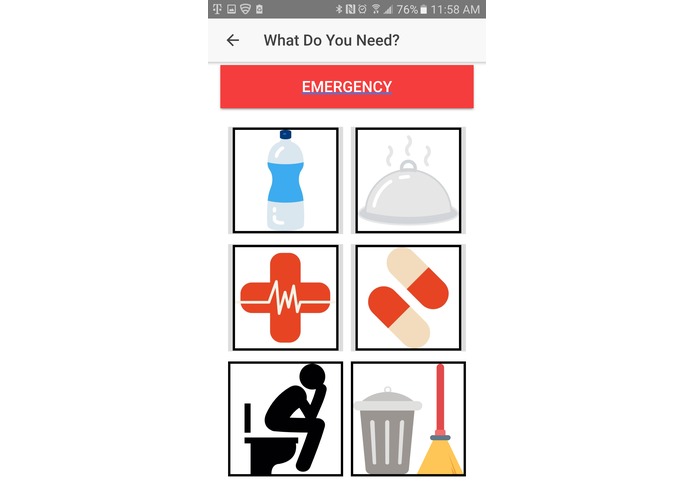
Choices


Med-Care
Inspiration
Many patients’ basic needs are managed poorly, causing unnecessary expenditures on legal interventions and poor customer ratings. On the other hand, part of the nurses’ strategic approach to address patients’ demands is to prioritize the tasks based on Maslow’s hierarchy of needs, which places physiologic need as a top priority. Communication barriers put patients’ safety in jeopardy. Some patients cannot express their needs because they are either physically in too much pain or simply cannot communicate due to not being proficient in the language that the doctors and nurses in the hospital speak. Such, is the case for one of our fellow group members who is currently part of a lawsuit due to medical malpractice. If the nurses could have been more attentive or aware of the situations, our group member’s father could potentially still be alive today. Nevertheless, the product is extremely viable. Imagine, taking your elderly grandma or grandfather who cannot speak the language of the area or may not be able to speak properly due to pain. This fine line is what inspired Med-Care. The desire to make communication between patients and their nurses inspired a product that will aid nurses in knowing what is going on with the patient as well as allowing patients to be served in a proper manner. Take the situation in an emergency room where the stakes are high and patients need to be taken care of urgently. In the E.R., anyone’s job becomes difficult and stressful because the possibility of death lingers between the doors and the patient's room. Imagine an extremely busy day, the nurses are running around attempting to accommodate for every patient. Out of nowhere a loud yelp is released asking for help. The nurses run to the patient to attempt to aid the patient while avoiding lawsuits for neglects. When they arrive to the patient, they discover that all the patient needed was a glass of water. These are situations that could potentially distract nurses from aiding a patient that needs more help than another one. In order to save lives and avoid lawsuits the best product for a situation like this is something that will make the communication between nurses and patients safer and qualitative.
What it does
Med-Care is an app that can be downloaded onto your phone. The application is supposed to show patients six simple options in the form of icons: food, water, bathroom, clean-up, medicine, and nurse assistant needed. When an icon is pressed, the app will send a notification depending on the icon clicked to all surrounding nurses. The nurses will then decide amongst themselves who will complete the task. Once a nurse has called the task, the nurse will have to complete the task. Once the task is completed, the nurse will need to scan the QR code on the patient in order to notify all other nurses that the task has been completed.
How I built it
The night began with an extensive amount of brainstorming. We started with highlighting the problem and creating possible solutions to the problem of lack of communication between patients and their nurses. Once we identified exactly what we wanted to do, we began downloading and finding the necessary resources to complete the task. We began by opening Ionic Framework and shaped how our app would look like. The idea first involved having a separate clicking mechanism that would connect via Bluetooth to the nurse’s phone or in-house electronic device. However, that quickly had to be thrown out as we had no such device on us. So, we decided to continue with making an app that both the nurse and patient could use. We prioritized the fact that the patient may not be able to speak the language of their environment. So, instead of having typed in commands, we included basic pictures of actions and request a patient may need during their hospital visit. These pictures are sent up as a link between the patient and nurses nearby. The nurses receive the notification, and the added API (in this case a QR scanner) is used to shut off the notification once one of the nurses has accomplished the task for the patient. The app runs on HTML, CSS, and Typescript.
Challenges I ran into
Throughout the process of developing the app, there were various challenges we faced, with one of the first ones being which project to do. We had multiple ideas and had various approaches to solving the problem. However, once an idea was decided, the rest became easier. The next biggest challenge was the programs we used. For some odd reason, certain programs did not want to run on some of our laptops; if they did run, sometimes they would crash. This made coding extremely difficult. In the end, we were only able to use one laptop for the coding of the whole design. Another large challenge we faced was in the design of the product itself. We wanted to have a separate device (such as a clicker) that would connect to the WiFi of the hospital. However, we did not have the technology to do so. So, instead of giving up on the whole idea, we made the whole product into a single app.
** Accomplishments that I'm proud of**
The team that created Med-Care was not previously built in preparation for the hack-a-thon. The team was spontaneous and was created the day of the actual event. Many of us came with our own ideas and did not have a lot of experience in hack-a-thons. 75% of our team was made of first timers. Therefore, one of the biggest accomplishments for the team was actually being able to complete an idea. Ideas do not always get made, but for once, the idea of Med-Care escaped the realm of imagination and moved into the world of reality. That is definitely something that we can all take pride in accomplishing: actually making something!
What I learned
One of the biggest lessons we all learned is that planning, collaboration, and time management are crucial for an event that has a short time limit. Being a team composed of strangers, collaborating was awkward at first because we did not know each other at all. However, due to the time limit, we looked the other way on the stranger’s thing and got straight to work shooting down each other’s ideas as well as agreeing with the good ones. The planning component was a significant lesson to be learned. Coming into the event, we all understood that it was 48 hours and in that time frame, we would need to create something viable. We learned quickly that we needed to plan ahead for the two days. That meant having hourly checkups and scheduling naps. The planning lesson also taught us a lot about time management. Knowing that we were confounded to the time period given to us, we knew that we would need to manage our time, especially if we were going to collaborate with each other. Being able to quickly learn how to apply planning, time management, and collaboration with a bunch of strangers are lessons that will follow us through our careers.
What's next for Med-Care
In the future, we hope to be able to implement new technologies to hospital experiences. One of the main components we would like to implement into our design is the use of a clicker so patients are not required to download anything and the only ones who would need to download anything are the nurses. We would also like to add a translator to the system so in case the patient needs to explain something specific to the nurse, the nurse could use the in-app translator. However, because hospitals require a live and certified translator, we would also like to create a database that holds access codes to those translators. This process would decrease the time to reach a translator for the patient and therefore increase the efficiency of the hospital. Another aspect we would like to add on top of that is a feature that numerically calculates the time that nurses take to respond to the patients' needs. This feature will then provide the hospital with reliable and relevant information that could be used to promote the benefits of going to their hospital. Lastly, Med-Care would like to expand into the world of artificial intelligence. As we grow progressively closer to having homes such as that of Mark Zuckerberg of Facebook where he lives with his Artificial intelligence Jarvis, we begin to notice that we can also begin to integrate hospitals in that way. For example, using something like the Density API, we can monitor when patients attempt to leave their bed and check to see if they are in some sort of discomfort. This in return will yield positive effects, as hospitals will become safer and inevitably lead to fewer deaths and less lawsuits.
Built With
- blood
- css
- framework
- html
- ionic
- javascript
- sweat
- tears
- type-script

Log in or sign up for Devpost to join the conversation.