-
-
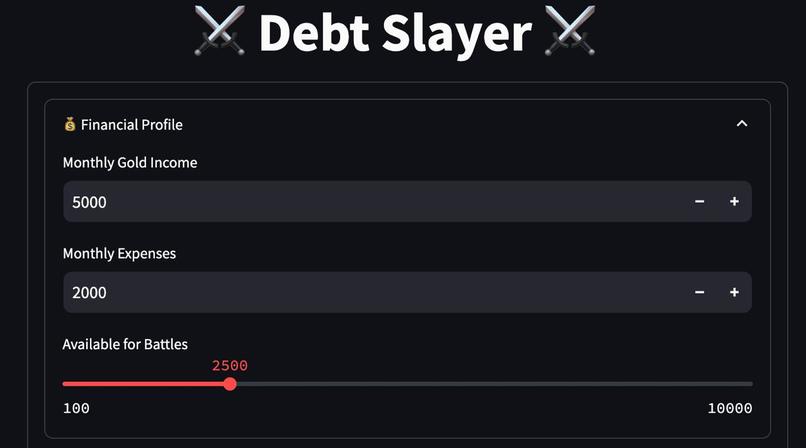
user enters financial profile
-
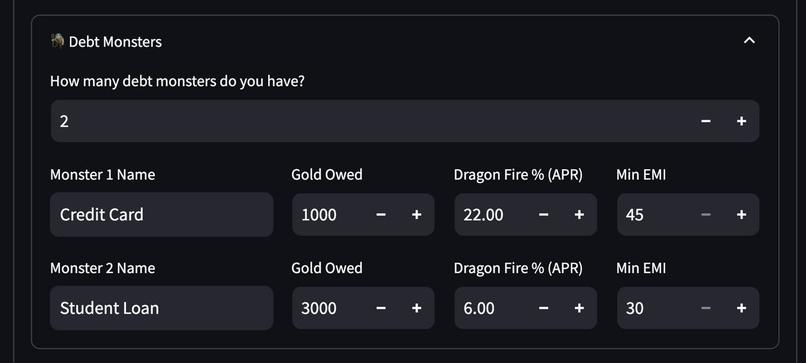
user enters debt information
-
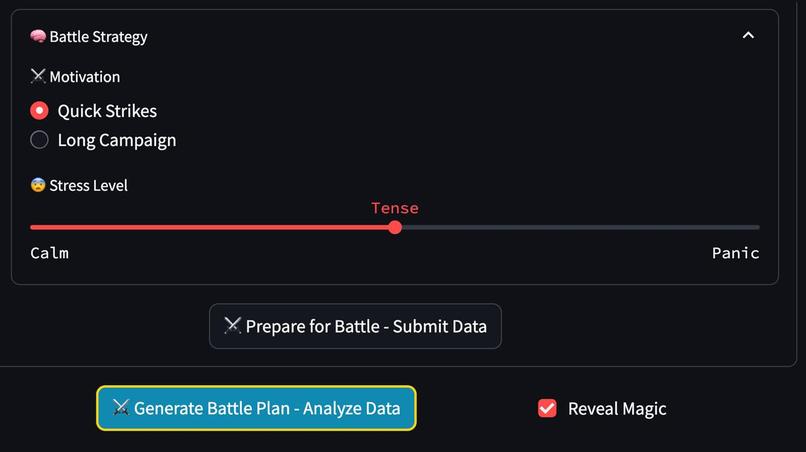
user selects strategy and motivation
-
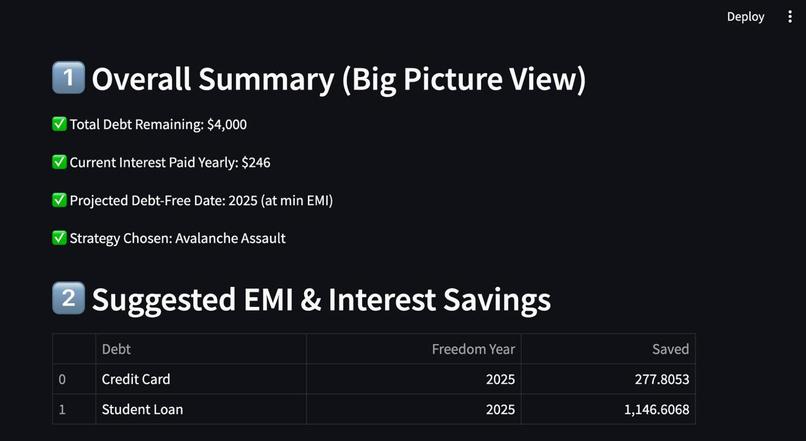
Summary generated by Debt Slayer
-
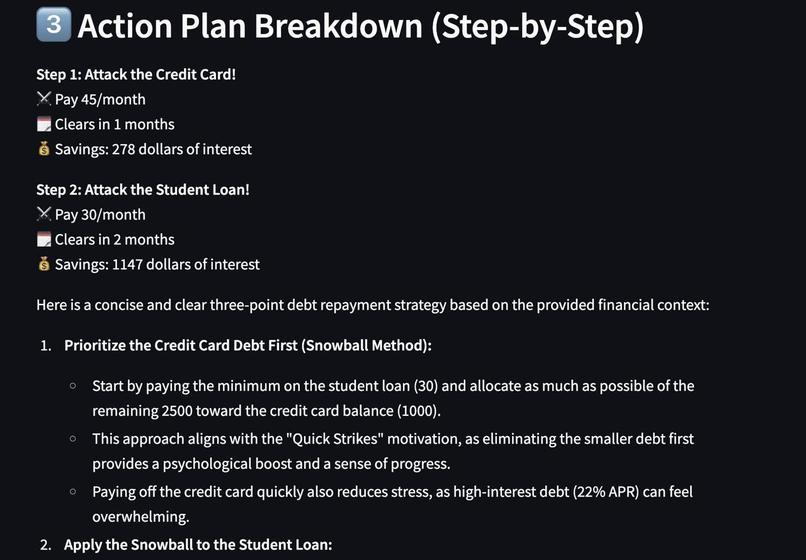
Step by Step Action Plan
-
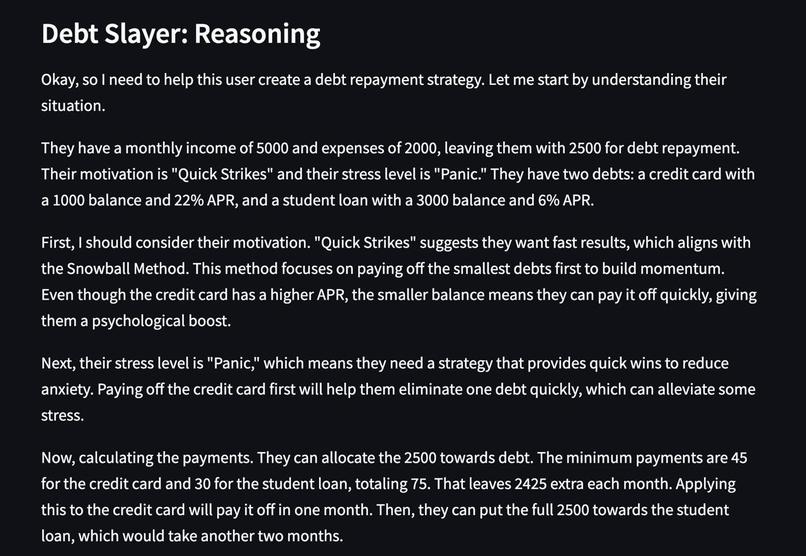
Debt Slayer's Reasoning about generated feedback
-
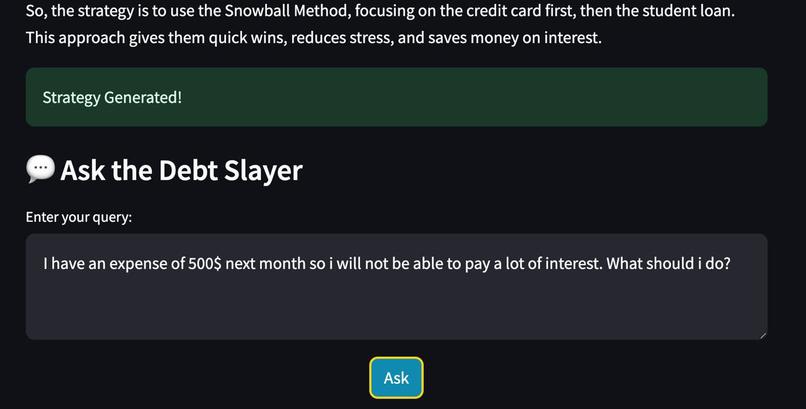
user asks follow-up questions to Debt Slayer


Inspiration
According to data from the Federal Reserve Board, approximately 77% of households in the USA are struggling with rising debt. This has led to increased financial stress, limited savings, and a reduction in financial freedom. The absence of personalized, actionable strategies contributes to prolonged debt repayment and higher interest costs. This makes it essential to develop smarter solutions to help individuals regain control over their financial well-being.
What it does
Debt Slayer is an innovative, LLM-powered application designed to empower users to take charge of their financial future. It crafts personalized debt management strategies based on individual factors like income, expenses, loans, and financial goals—helping users navigate the path to financial stability. Built using a Retrieval-Augmented Generation (RAG) pipeline, Debt Slayer delivers highly accurate and contextualized responses, providing users with smarter, data-driven insights that enhance decision-making capabilities.
How we built it
- Developed a RAG pipeline for generating personalized, intelligent responses to user queries.
- Utilized a HuggingFace model to create vector embeddings and employed deepseek to generate responses due to its advanced reasoning capabilities.
- Leveraged MongoDB for storing vector embeddings to enhance data retrieval accuracy and speed.
- Created a seamless, interactive, and user-friendly interface using Streamlit for an engaging experience.
Challenges we ran into
- This was our first time working with the RAG framework, which had a steep learning curve. Understanding the architecture and proper implementation was a challenge.
- While Streamlit is easy to use for building UIs, it has some limitations compared to more advanced web UI frameworks in terms of functionality and customizability.
Accomplishments that we're proud of
- We successfully developed a fully functional, end-to-end LLM-powered application for debt management.
- Overcame technical hurdles in the implementation of the RAG pipeline and integration of deepseek. We were able to successfully employ MongoDB as a vector database.
- Created a seamless user experience with a smooth and intuitive interface despite the challenges with Streamlit.
What we learned
- Gained insights into the workings of the RAG framework, including how to fine-tune it for specific use cases.
- Developed strong time management skills to balance multiple aspects of the project.
- Improved coordination within the team, effectively dividing tasks and managing dependencies.
- Learned to work with open-source models and integrate them into real-world applications.
- Gained experience in using version control systems for better collaboration and code management.
What's next for Debt Slayer
- Behavioral Debt Management: We plan to integrate behavioral finance techniques to help users identify and overcome emotional spending habits, as well as maintain long-term motivation to pay off their debts.
- Integration with Banking & Budgeting Apps: We aim to seamlessly connect Debt Slayer with financial institutions to allow real-time tracking of income, spending, and loan payments.
- Dynamic Debt Repayment Methods: Debt Slayer will introduce AI-driven, dynamic debt plans that adapt to changes such as fluctuating interest rates, income adjustments, or unexpected expenses, ensuring users always have the best strategy to tackle their debt.


Log in or sign up for Devpost to join the conversation.