-
-
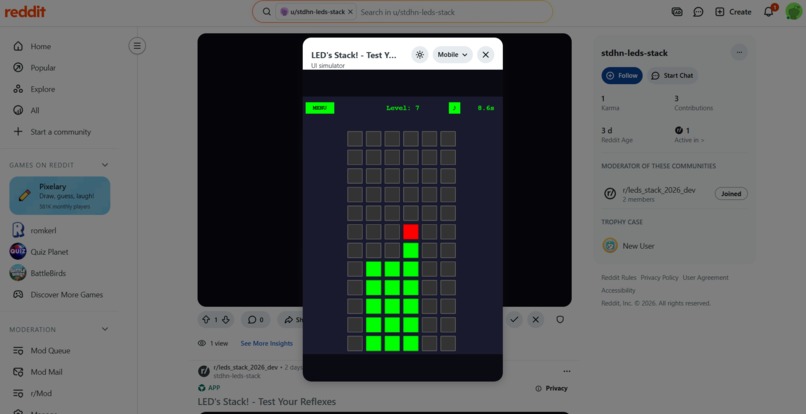
Gameplay
-
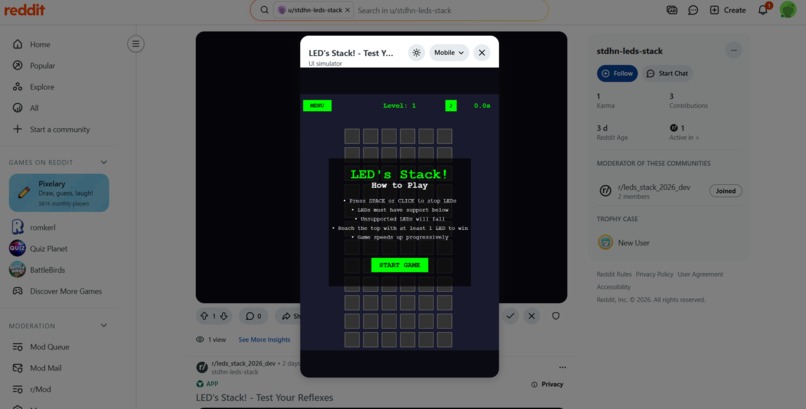
Instructions
-
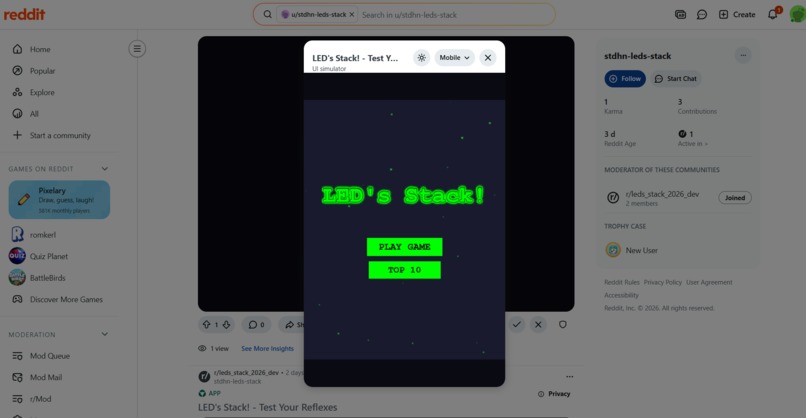
Menu


Inspiration — Where did LED’s Stack come from?
LED’s Stack was inspired by a nostalgic love for classic arcade stacking games and a fascination with retro LED aesthetics. I wanted to create something that felt both familiar and fresh — a game that is easy to understand but hard to master.
The core idea is simple: stack LEDs on a 6×12 grid until you reach the top. What makes it engaging is that each level becomes more challenging — the LEDs move faster, and you have fewer opportunities to place them correctly, creating constant tension for the player.
What it does — What is the game about? How does the main mechanic work? The goal is to reach the top of the grid by carefully stacking LEDs. The player must stop moving LEDs and stack them with precision. If an LED does not have support underneath, it falls. This forces the player to be careful and strategic with every move.
How does the sound work?
Instead of using pre-recorded audio files, all sound effects are generated in real time directly in the browser. Every action has its own sound: a “tick” while moving, a “drop” when placing, and special effects when failing or winning. There is also a small victory melody when the player reaches the top.
How does the difficulty increase?
With each level, the game gets faster. At the same time, the number of active LEDs decreases, making each placement more critical. The speed increases gradually so the challenge feels fair but intense.
What kind of animations does it have?
When the player wins, the game plays a celebration sequence with flashing lights, color waves, and sparkle effects across the screen before resetting the board.
How we built it — How was it developed?
The game was built using Phaser 3, which handles rendering, animations, and the main game logic. Everything runs directly in the browser without requiring any installation. A Redis database is used to store and update the global leaderboard in real time, allowing players to compare their performance with others.
Challenges — What problems did we face and how did we solve them?
- Touch and keyboard input
Problem: The game needed to work smoothly on both desktop and mobile. Solution: Dual input controls (keyboard and touch) were implemented, ensuring they wouldn’t trigger at the same time accidentally.
- Browser audio restrictions
Problem: Many browsers block sound until the user interacts with the page. Solution: The audio system is activated when the player presses “Start” for the first time.
- LEDs at the edges of the board
Problem: Sometimes LEDs could go partially out of bounds. Solution: The placement logic was adjusted to keep all LEDs within the playable area.
- Performance during animations
Problem: Too many animations at once could slow down the game. Solution: Animations are triggered with small delays so everything runs smoothly.
Accomplishments — What are we proud of?
Creating an addictive experience with simple mechanics. Generating all sound effects in real time. Designing visually impressive victory animations without performance issues. Making the game work well on both desktop and mobile.
What we learned — What did we take away?
LED’s Stack shows that a game can be easy to learn but difficult to master. It was also a great opportunity to explore game design, animations, and web-based audio.
What’s next for LED’s Stack?
New game modes Difficulty selection (easy, normal, hard) Possible competitive mode or global leaderboard More visual effects and LED styles
Log in or sign up for Devpost to join the conversation.