-
-
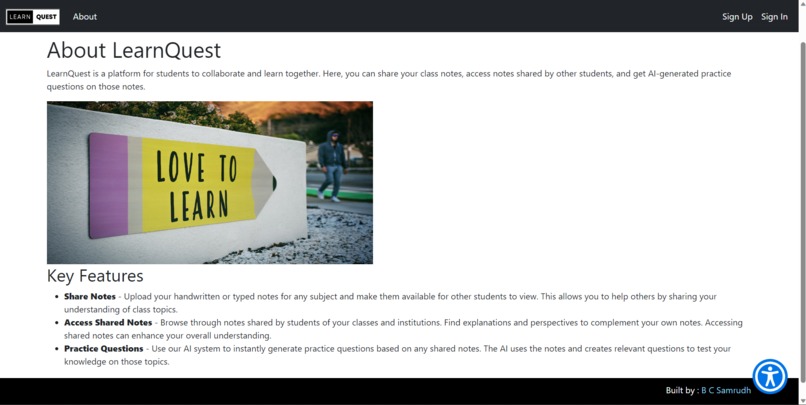
About Page
-
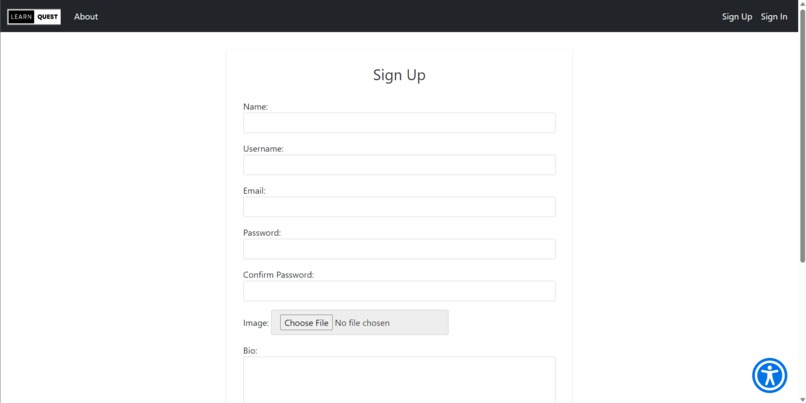
Sign Up Page
-
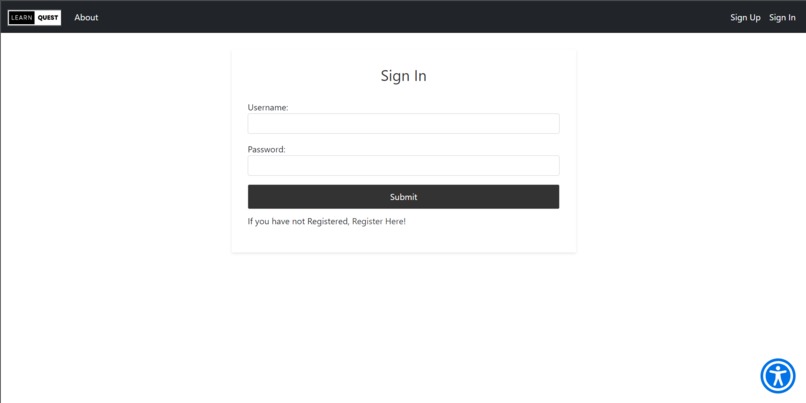
Sign In Page
-
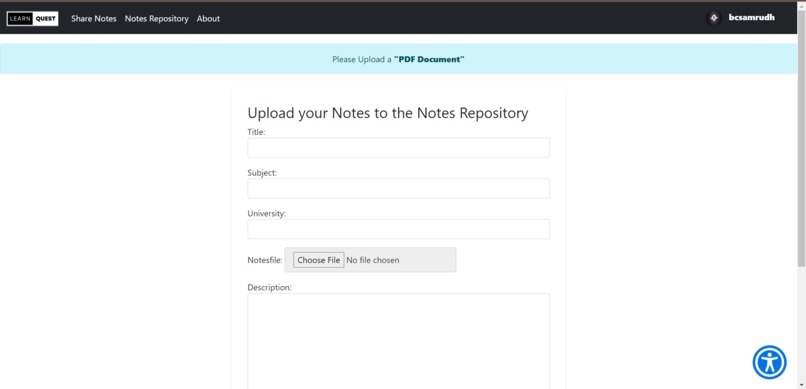
Upload Notes View
-
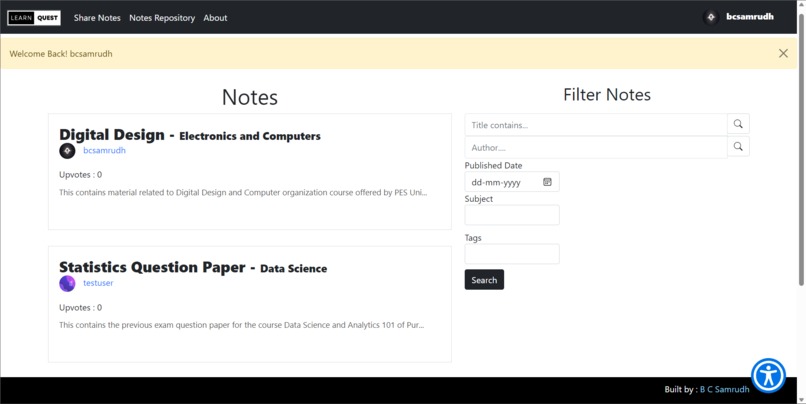
Notes List View
-
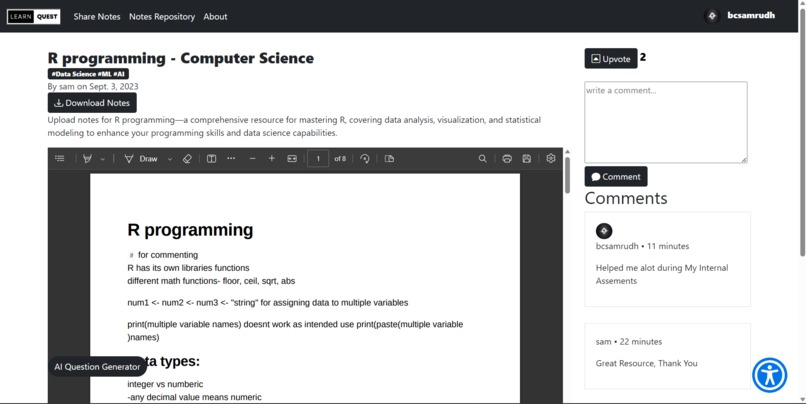
Detailed Notes View Page
-
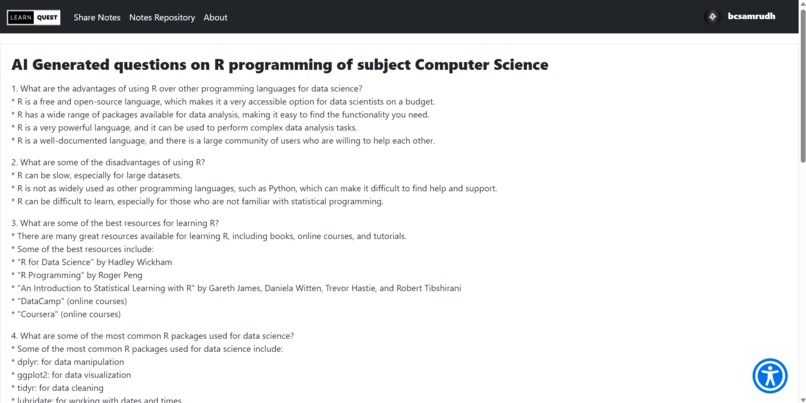
AI generated Questions Page


Inspiration
As a college student, I struggled to find high-quality study notes and practice questions online. I wasted most of my time searching for quality resources. Students could collaborate to produce valuable study materials by sharing their notes. This inspired me to build LearnQuest, a website where students can upload their notes and discuss them with their peers. Combining student contributions with AI-generated questions maximizes the value of this collaborative knowledge sharing. My own experiences struggling to find good study resources motivated me to create LearnQuest and tackle the problem by allowing students to use AI to generate useful questions from their notes, benefiting not just themselves but their peers as well through discussion and feedback.
What it does
LearnQuest is a website that helps students share study notes and generate questions based on the notes using AI. It allows students to upload their notes, which are then used by AI to generate questions. Students can also view and comment on each other's notes, which helps them to learn from each other and improve their understanding of the material.
The key features are:
Note Sharing: Students can upload handwritten or typed notes to share with their peers studying the same subject.
Question Generation: LearnQuest uses Cohere's API to automatically generate quiz questions from the uploaded notes.
Peer Collaboration: By viewing and commenting on each other's notes, students can discuss course material, clarify difficult concepts, and work together to improve their notes.
Filter notes: You can also filter notes based on the subject, title, date, and tags. This makes it easy to find the notes you need.
Accessible UI: The website is designed with a clean and simple layout that is easy to navigate. The text is large and easy to read, and there is a contrast between the text and the background. There is alternate text for all images. We will make the website even more accessible after the hackathon by adding keyboard navigation and screen reader support.
How we built it
LearnQuest is built with HTML, CSS, JavaScript, and Bootstrap, which is a popular front-end framework that provides quick and responsive styling. The back end is built with Django, which is a popular Python web framework. A "Batteries included framework". I was quickly able to build a user authentication system as evidenced by its tagline, "The web framework for perfectionists with deadlines." The Questions based on the notes are generated using the Google PALM API.
Challenges we ran into
We were unable to find a free large language model API that was suitable for my projects. Even the free APIs had a limited number of requests per day.
The PALM API was a bit slow to return responses, even for small prompts.
Accomplishments that we're proud of
- Worked with an LLM for the first time.
I had to learn how to integrate and leverage the advanced capabilities of Large Language Models through an API in my project. I used Google’s PALM API to generate unique questions based on the uploaded notes.
- Worked on the front end of a project:
Even though I had worked with HTML and CSS before, I found frontend development challenging as it's less familiar to me than backend development. This opportunity to build a Full Stack app helped me improve my understanding of front-end development. I am proud that I was able to build a clean UI, even though I had never completely constructed a UI before.
- Introduced Saharsh to Hackathons
It was Saharsh's, (a student at my university with a specialization in UI Design), first time participating in a Hackathon. In fact, he is the one who helped me write this (and the documentation for the project) as well as design the website.
What we learned
- Building clean and good-looking UI
As a backend developer, I have always prioritized the functionality of a website over its user interface. However, building the UI has helped me learn more about it and improve my front-end development skills. I now appreciate the importance of both the front-end and back-end, and I can create websites that are both functional and visually appealing, to a certain degree.
- From Admiring AI Websites to Building My Own
This was my first time working with a large language model (LLM). It was a great opportunity to learn and work on Google's AI products. It was a wonderful experience to go from admiring what AI websites could do to building my own using AI. During the hackathon, we also realized the true power of AI language Models, which helped us speed up our development.
What's next for LearnQuest
During the hackathon, we established a strong foundation but were unable to implement all of the planned features. Given more time, we intend to improve the project by adding answer generation for the generated questions using AI, note summarization, and note generation on a particular topic using AI, subject to API limits.


Log in or sign up for Devpost to join the conversation.