-
-
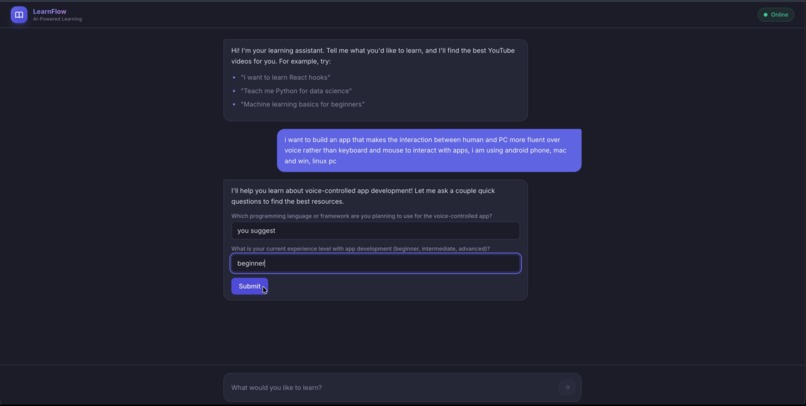
1. LearnFlow - Homepage
-
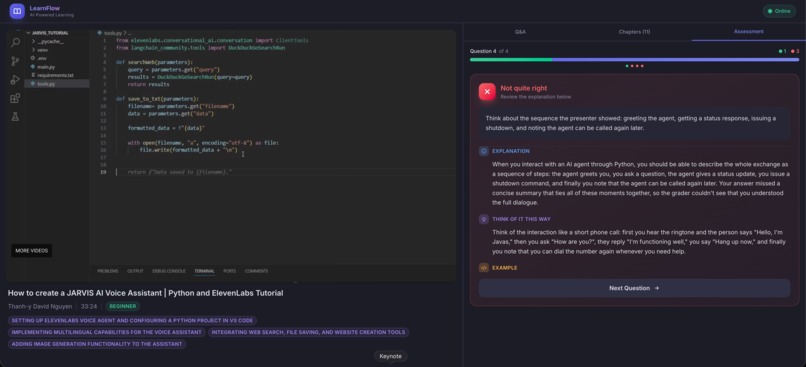
4. LearnFlow - evaluate
-
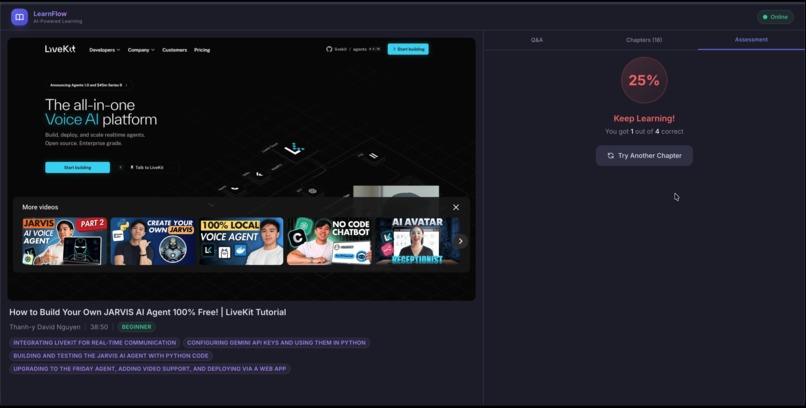
5. LearnFlow - measure and feedback
-
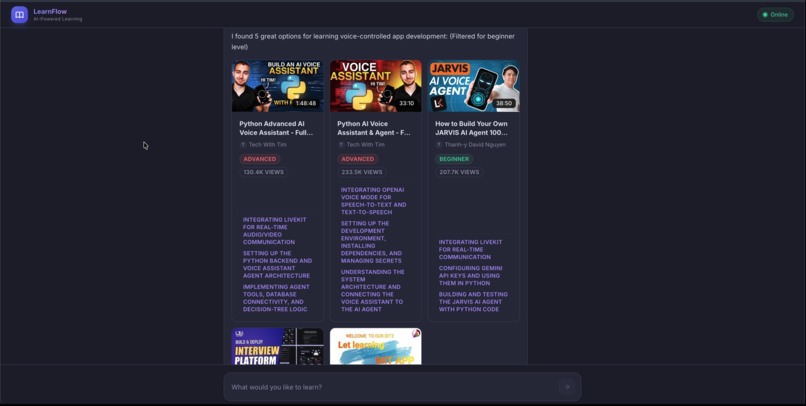
2. LearnFlow - explore
-
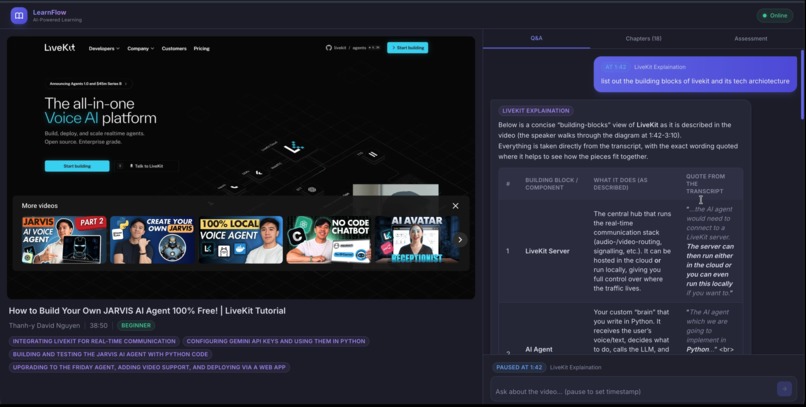
3. LearnFlow - reasoning


Inspiration
The educational model of the last century was built on Crystallized Intelligence - the ability to utilize learned knowledge and experience. Success meant memorizing facts, syntax, and historical data.
But we are witnessing a paradigm shift. With the advent of Large Language Models (LLMs), Intelligence has become a commodity. Knowledge is instant and ubiquitous. The new bottleneck for human relevance is Fluid Intelligence the capacity to reason, solve novel problems, and identify patterns in new situations, independent of acquired knowledge.
I was inspired to build LearnFlow because I realized that while AI can write code, it cannot yet fully replace the human architect's intuition. We don't need tools that help us remember more; we need tools that train us to think better.
What it does
LearnFlow is an AI-native learning platform designed to bridge the gap between passive consumption and active reasoning.
Instead of generic "Hello World" tutorials, LearnFlow functions as a Socratic Tutor. It ingests complex multimodal content—such as technical podcasts and dense architectural documentation—and creates an interactive "Active Workspace."
Key features include:
- The Attention Gate : Before allowing users to proceed, Gemini checks if they are mentally present by generating questions based on the narrative details of the content.
- Fluid Reasoning Engine: It refuses to simply "give the answer." When a user asks a question, the system guides them through the architectural logic (e.g., separating Signaling from Media Routing).
- Multimodal Ingestion: Users can learn via podcasts or article, with the AI maintaining context across both.
How we built it
The core of LearnFlow is built on a sophisticated orchestration of Gemini 3 Pro.
- The Brain (Gemini 3): We utilized Gemini's massive context window to hold the entire state of the learning material. This allows the model to connect concepts from "Minute 1" of a podcast to "Page 50" of a manual.
- The Real-Time Layer (LiveKit): For our demo use case— building a cross-platform voice agent —we integrated LiveKit . We didn't just use it as a tool; we used its architecture as the teaching material.
- We prompt-engineered Gemini to deconstruct the LiveKit architecture into its atomic blocks: Architecture = Server_{Signaling} + Agent_{Inference}
- This ensures the user understands the topology (Server vs. Python Agent) before implementation. ## Challenges we ran into
- The "Helpful Assistant" Trap: Modern LLMs are trained to be helpful and provide direct answers. We had to heavily fine-tune the system instructions to make Gemini withhold the code snippet and instead explain the concept first. Teaching the AI to be a "strict tutor" rather than a "copilot" was a delicate balance.
- Latency in Assessment: Generating meaningful "Attention Checks" in real-time while the user is consuming content required optimizing our inference calls to ensure the flow wasn't interrupted.
Accomplishments that we're proud of
- The Attention Gate: We successfully implemented a mechanism that differentiates between "hearing" and "listening."
- Architectural Visualization: In our demo, we successfully guide a user to architect a solution for with concrete system design. ## What we learned We learned that Context is King . By feeding the entire project scope into Gemini, the quality of the "Socratic" questions improved dramatically. We also validated that users retain information significantly better when they are forced to "unlock" the next stage of learning through active reasoning checks.
What's next for LearnFlow
- Dynamic Knowledge Graphs: We plan to implement a live knowledge graph visualization using libraries like D3.js, where nodes (e.g., "WebSockets," "Testing Strategy") appear and connect in real-time as the user masters them.
- IDE Integration: Bringing the "Fluid Intelligence" check directly into VS Code, warning developers when they are copying code they don't architecturally understand.
Built With
- client
- concept-extraction
- data
- fastapi
- gemini
- javascript/typescript-(frontend)-backend-framework:-fastapi-(api-layer-and-optional-web-backend)-frontend-framework:-react-with-vite-and-typescript-(optional-web-ui)-apis-&-integrations:-google-gemini-api-(llm-for-intent-analysis
- json
- library)
- pydantic
- quizzes
- technologies-used-in-learn-flow-programming-languages:-python-(primary-backend-and-cli)
- uvicorn
- v3
- youtube

Log in or sign up for Devpost to join the conversation.