-
-
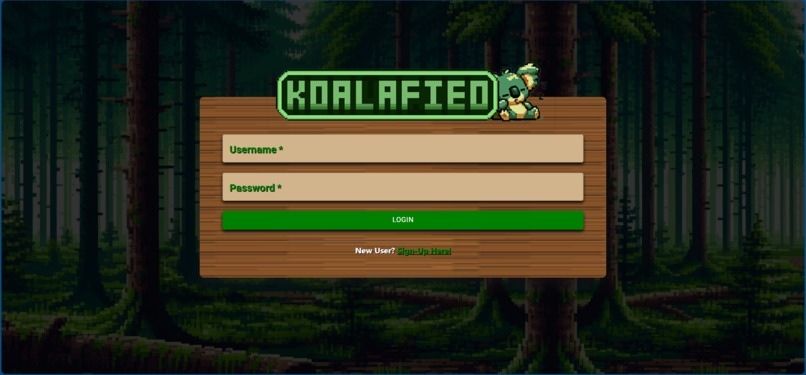
Login Page
-
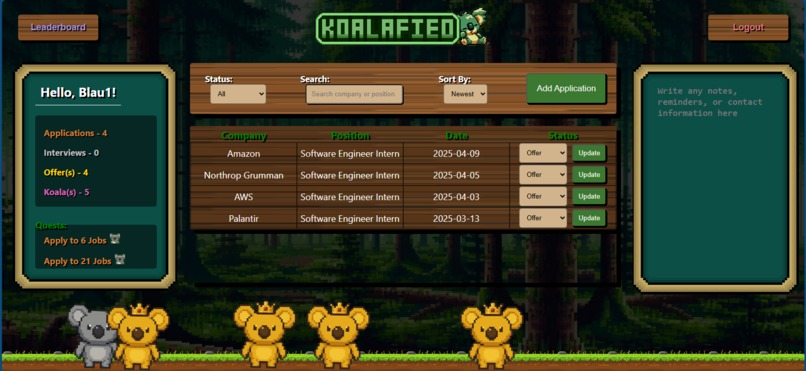
Application Dashboard
-
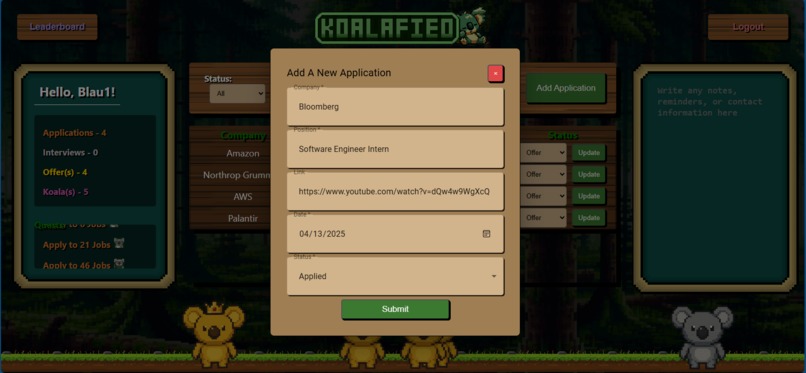
Adding a New Application
-

Getting a New Koala!
-
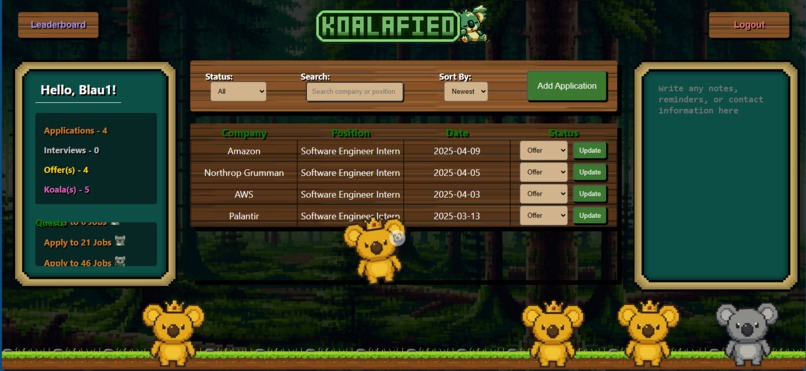
Playing With Your Koalas!
-
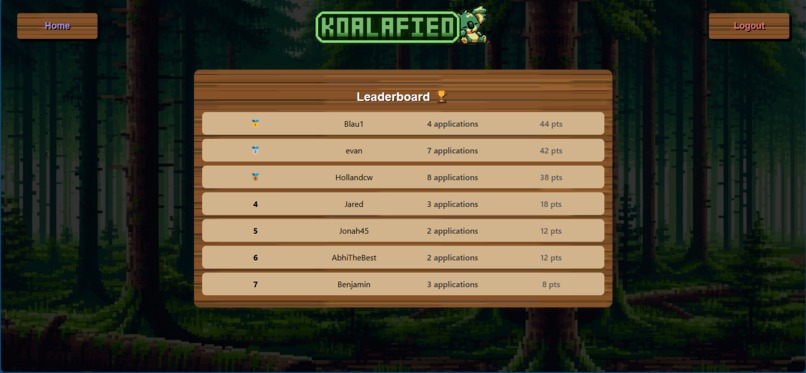
Climbing the Leaderboard


Inspiration
Applying for internships and jobs can be tedious and boring. In a competitive job market, students like us are rushing to apply to hundreds of internships without a proper way to keep track of them. Many have turned to the bland Excel spreadsheets to mindlessly track their applications. This leaves students like us to be disorganized and bored when it comes to applying to jobs. We were inspired by idle games like Neko Atsume, and decided to create a similar mechanism for gamifying job applications.
What it does
Enter Koalafied, a gamified way to keep track of your job applications and important information like interviews and offers. As you work towards building a future for yourself, you also work towards building a community of cutesy and unique Koala's deep within a quiet forest.
Users can sign up for an account to rise up the leaderboards to a wide range of koala-ity career choices and unmatched fame. They can collect koalas by applying to jobs, interviewing, and receiving offers. Track status updates on their applications and keep track of important interviews or deadlines via a notepad. Most importantly, they can play with their koalas!
How we built it
Koalafied is built on the MERN stack, meaning we used MongoDB, Express, React, and Node.js for our application.
We first planned out our application by storyboarding and creating mock-ups for interfaces and then collaborated on setting up our database on MongoDB, discussing the structure of our data.
We used Node and Express in combination with MongoDB to create users, an encrypted login system with JWT sessions, and store users' applications and of course those CUTE KOALAS. We found using MongoDB to be very efficient and easy to get started with. It made developing our backend a lot easier than we expected.
For our frontend, we used React and Material UI to build a login form, a leaderboard, and most importantly the dashboard, which displays all of a user's application statuses, notes, and user statistics (applications, interviews, etc.). And don't forget about those CUTE KOALAS playing around on the bottom of the screen!
Finally, we used Photoshop to edit and create graphics for our application, and Postman to test our backend API routes.
Challenges we ran into
Building animations With Pure React: we found it difficult to set up the initial function structure that would allow for smooth animations and movement physics. There was a steep learning curve, but after gaining a better understanding of React's page update structure, we were able to create complex movement for our koalas.
Creating Sessions with JSON Web Tokens (JWT): Allowing users to login, stay logged in, and also be restricted from accessing protect routes without an account proved to be a struggle. This was one of the more difficult and annoying challenges to deal with, not through just it's difficulty, but also through its recurring nature. We learned that in times where you find yourself getting annoyed with problems like these it's important to stay calm and work together.
As Always... Styling Everything: CSS is hard y'all. But we did it :)
What we learned
Evan Masiello, a second-time hackathon participant, first honed his existing skill for building react pages and creating backend connections when developing the dashboard and Express endpoints. Something that he did not expect to end up developing was the animation for the Koalas, but he found it to be a very fun experience. Evan enjoyed challenging himself by thinking of new ways the Koalas could move or be interacted with and figuring out how to implement them. He definitely strengthened his understanding and skills related to React.js through this process and also gained valuable experience using MongoDB for more intricate data than in the past.
Benjamin Johnson learned deeply about how react works and react syntax. A step up from what he was normally accustomed to, which was just HTML, CSS, and JavaScript for building a webpage. Ben expanded on his knowledge of MongoDB which he had minimal knowledge of before Bitcamp to implement the leaderboard functionality.
Caleb Holland, a second-time Bitcamp participant traveled from his usual comfort as a frontend developer to explore the backend. He learned how to create an encrypted user system using Node and MongoDB, create sessions with JSON Web Tokens (JWT), and most importantly learned how to have a good time with his pals. In addition, he continued to hone his sense of design by creating a majority of the graphics for the application, and by building some of the components used on the login and dashboard page.
What's next for Koalafied
Originally, we wanted to use the Gemini API to generate the sprites for the koalas and create endless quests for the user. Although this was beyond the scope of this hackathon, this is something we'd like to implement as we improve upon the project in the future.
We also had aspirations to have this tool auto track your applications after applying for jobs, either through an extension, or an email connection. This would make it much easier for users to organize their applications, as this removes the need to manually add in their applications.
In the end, it was a tree-at to create Koalafied. We learned a lot, and we look forward to expanding upon it in the future!


Log in or sign up for Devpost to join the conversation.