-
-
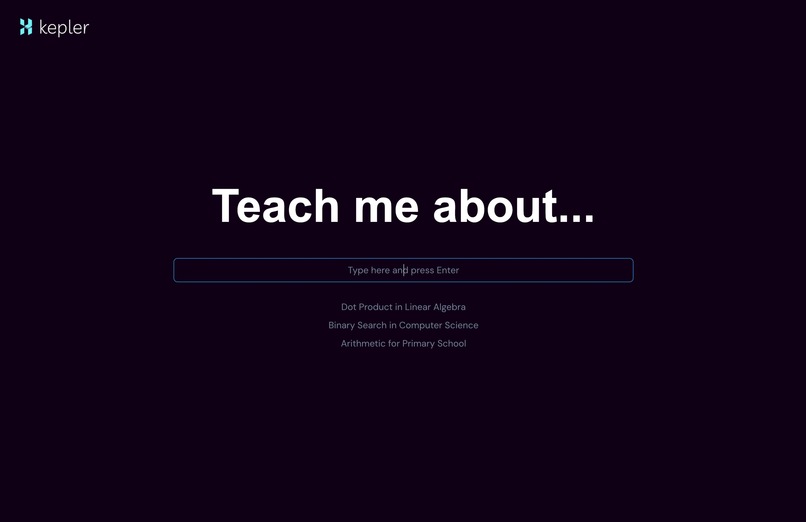
Landing page
-
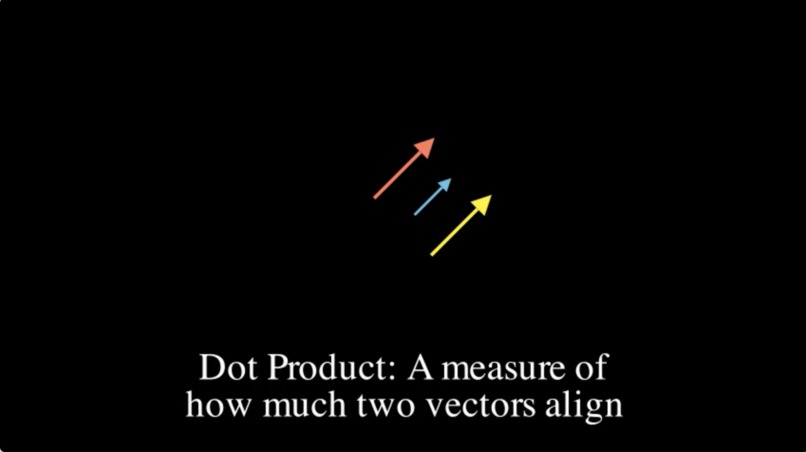
Frame from a generated video on vectors


Inspiration
The digital evolution brought about a flood of educational tools, making learning more scalable and accessible. Platforms like MOOCs, Khan Academy, and YouTube have pioneered in democratizing educational content.
But while large-scale, generalized education has been democratized, personalized learning remains expensive and inaccessible. The $35 billion private tutoring market in the U.S. signals the glaring gap between demand and accessibility of personalized learning.
In education, there’s always been a tradeoff between scalability and personalization. But that’s not the case anymore. Recent advances in AI offer personalization at scale, providing students access to an anytime, anywhere private tutor. A crucial gap in this arena is math education, an inherently visual discipline. We wanted to create a tool to help learners conceptualize mathematical concepts in a personalized manner.
What it does
Kepler serves as an on-demand, personalized math tutor. Learners simply submit a natural language prompt to Kepler; In response, Kepler generates a tailored, animated explanation video within seconds, illuminating the concept in an intuitive and engaging manner.
How we built Kepler
- Planning: GPT-4 crafts a detailed scene and animation script based on user prompts.
- Code Generation: We then employ GPT-4's 32k version to transmute these plans into Manim animation code.
- Self-healing Agents: Given the complexity of the task, there are instances where the generated code might contain errors. Our self-healing agents, powered by GPT-4 & GPT-3.5, dynamically correct these inconsistencies.
- Audio-Video Synthesis: The refined code is adapted for audio integration, followed by leveraging Azure's Text-to-Speech to produce the narration. Subsequently, the audio and animation are synchronized to produce the final video.
- Delivery: Our backend infrastructure is built on Flask & Next.js. not only facilitates real-time streaming of the video creation process but also ensures efficient delivery of the final output to the student.
Challenges we ran into
It turns out that GPT is not sufficiently intelligent to produce functional Manim code without significant steering and human intervention. As a result, we had to implement a series of self healing code agents in order to produce code that actually works.
Accomplishments that we’re proud of
We’re proud of our use of generative AI/ML in a way that’s unique from most projects. We’re also proud of our use of various technologies (GPT, Azure, Text-to-Speech, Manim) to generate working code and scripts that translate into practically useful content. We’re excited by Kepler’s potential as a project beyond the hackathon as well.
What we learned
We learned a lot about prompt engineering and producing steerable agents in a world where LLMs aren't necessarily generally intelligent.
We also learned a lot about audio engineering and figuring out how to match up byte streams to timestamps and video.
What’s next for Kepler
Cost Efficiency: For Kepler’s MVP, the current cost is $2/video. This should become dramatically cheaper with model improvements. Reducing cost is crucial to achieve our goal of democratizing personalized learning.
Generation quality & reproducibility: we hope to make Kepler’s animation generation more reproducible and higher quality. Some of the videos generated by our MVP are more helpful than others. Our goal is to produce consistently high quality tutorials.
Built With
- azure
- flask
- manim
- next.js
- openai
- python
- typescript
- vercel

Log in or sign up for Devpost to join the conversation.