-
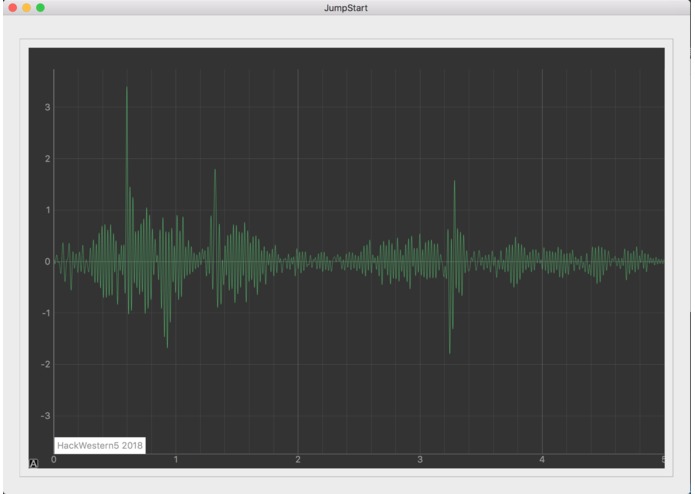
Heart wave

Inspiration
My inspiration comes from my educational background, through my time in the clinical area I gained a lot of experience working with EKGs in the ER and seeing defibrillators in action. After seeing that AEDs are hard to find outside of hospitals, and ones that are found may come with a list of problems from missed inspections, busted batteries, and missing pieces. So we decided to create our own take on the AED, and we're calling it JumpStart.
What it does
By building an EKG to sense for one of the two shockable heart rhythms, JumpStart uses an external battery phone case to deliver a shock in an attempt to re-establish sinus heart rhythm.
How I built it
The app was built using python and the pyaudio and scipy/numpy/matlib scientific libraries, and an arduino+breadboard to attach our makeshift electrodes and measure electrical pluse. Using the microphone input on the computer, the arduino sends the frequency of the heart's electric potential over the aux cord, which the computer reads as audio. Using some amplification, lowpass filtering and volume adjust, we eliminated most of the electrical noise to present the heart's rhythm. Rest of UI and graphing is made with Qt.
Challenges I ran into
The major constraint and the fact that there is way more interference to electrical signals than we thought, everything from the wires in the walls to radio stations we picked up using this device interfered with our hack. Another problem was using getting the app to recognize V-tach when it saw it (And where to find someone with V-tach lol)
Accomplishments that I'm proud of
the fact that I was able to make a functioning ECG out of spare parts and analog tool.
What I learned
Code hard, go hard. Swag is cool, electrical heart activity is cooler.
What's next for JumpStart
Get out there and start saving lives!

Log in or sign up for Devpost to join the conversation.